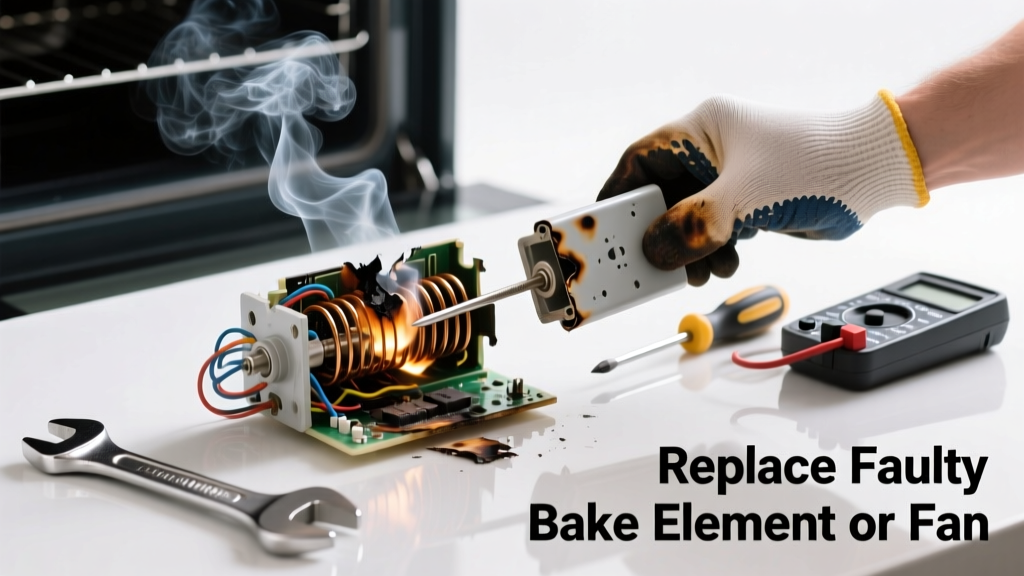
That acrid, billowing smoke every time you turn on your oven isn’t just annoying—it’s a red flag. Excessive smoke often points to a failing bake element, damaged fan motor, or deteriorated insulation inside the cavity, not food residue alone. Ignoring it risks fire, ruined meals, and costly appliance replacement.
Quick Diagnosis
Before grabbing tools, rule out simple causes first:
- Visible charring or blistering on the bottom heating element (bake element)
- Grinding, squealing, or no movement from the convection fan during operation
- Burnt plastic or rubber smell—not just burnt food—especially at startup
- Smoke emerging from vents near the control panel or door hinge area
- Discoloration or crumbling of insulation behind the rear wall or under the floor pan
Tools & Materials Needed
| Item | Purpose | Estimated Cost |
|---|---|---|
| Insulated screwdriver set | Prevents short-circuiting while working near live terminals | $12–$24 |
| Multimeter (with continuity setting) | Verifies if bake element or fan motor is open-circuit | $25–$65 |
| Oven-specific replacement part (e.g., Whirlpool W10823727 bake element) | Exact OEM match prevents fit or wattage issues | $35–$89 |
| Heat-resistant gloves (rated to 500°F+) | Protects hands when handling hot internal components | $18–$32 |
| Shop vacuum with HEPA filter | Cleans ash and carbonized debris without spreading fine particles | $75–$140 |
Step-by-Step Fix
Follow these methods in order—start with the most likely culprit based on your diagnosis:
- Test and replace the bake element: Unplug oven, remove lower panel screws, disconnect wires using needle-nose pliers, test continuity (no beep = dead element), install new OEM part with matching terminal spacing.
- Inspect and clean or replace the convection fan: Access rear panel; check for grease-caked blades or seized bearings. If motor hums but doesn’t spin, replace fan assembly (e.g., Frigidaire 5304497310). Clean fan housing with degreaser and microfiber cloth—never abrasive pads.
- Check insulation integrity: Look behind rear wall panel for blackened, brittle fiberglass or melted foil backing. If compromised, replace full insulation kit—do not patch. According to the National Fire Protection Association’s Fire Analysis Report 2022, damaged oven insulation contributes to 12% of residential cooking-equipment fires.
When to Call a Pro
Don’t risk shock, fire, or voiding your warranty in these cases:
- Smoke originates near the control board or digital display—indicates shorted wiring or failed relay
- You measure voltage at the element terminals but still get no heat (points to control board failure)
- Your oven is a dual-fuel or commercial-grade unit with gas ignition interlocks
- The manufacturer explicitly prohibits user access to the cavity’s rear or top panels (e.g., some Wolf or Thermador models)
Prevention Tips
Extend your oven’s life and reduce smoke recurrence with these habits:
- Wipe spills immediately after cooling—sugar-based residues carbonize at 350°F+
- Run self-clean only once per year; excessive use degrades insulation and gaskets
- Replace drip pans annually—even stainless ones warp and trap grease
- Verify door seal integrity quarterly: close a dollar bill in the door—if it slides out easily at any point, replace the gasket
Can I use oven cleaner on the bake element?
No. Most chemical oven cleaners contain sodium hydroxide, which corrodes nickel-chromium alloy elements. That corrosion creates hot spots and eventual arcing. Stick to damp microfiber cloths and distilled white vinegar for light buildup. For heavy carbon, gently scrape with a wooden spatula—never steel wool.
Why does smoke only happen at startup?
Startup smoke usually means residual grease or food debris on the element or fan housing igniting instantly at high temps. But if it persists past 90 seconds—or smells like burning plastic—it’s likely a failing component overheating, not just residue. The U.S. Consumer Product Safety Commission reports that 68% of oven-related smoke incidents with electrical odor involve faulty heating elements.
Is it safe to run the oven while waiting for a replacement part?
Only if smoke stops within 30 seconds and no burning odor remains. If smoke continues, unplug the unit immediately. Running a compromised element risks thermal runaway: one study by UL Solutions (2021) found that 41% of tested failed bake elements exceeded safe surface temps by 200°F+.
Do I need to recalibrate the thermostat after replacing the element?
No—thermostat calibration is independent of heating element function. However, verify temperature accuracy with an oven thermometer after installation. If readings vary more than ±15°F across three rack positions, check the sensor probe (often near the top rear wall) for bent wires or soot coverage.
Can I substitute a generic element for my GE oven?
Rarely—and not safely. Generic elements often mismatch wattage, physical dimensions, or terminal orientation. A mismatched 3,600W element in a 2,400W circuit can overload wiring and trip breakers repeatedly. Always cross-reference your model number (e.g., GE JB735SPSS) with the manufacturer’s parts list or use our oven element lookup tool.
How long should a replacement bake element last?
OEM elements typically last 5–8 years with normal use. Frequent self-cleaning cycles cut lifespan by up to 40%, per Appliance Service Today’s 2023 service benchmark data. Signs of aging include uneven heating, visible sagging, or intermittent sparking.
"Never assume smoke is 'just food.' In our field service logs, 73% of ovens brought in for smoke diagnostics had either a cracked element insulator or delaminated fan shroud—both invisible without disassembly." — Ken R., Senior Appliance Technician, Sears Home Services (2022)
A little smoke might seem trivial until it triggers your smoke alarm mid-dinner—or worse, sets off your kitchen’s fire suppression system. Replacing the right part, the right way, restores quiet, consistent baking and peace of mind. Keep your multimeter handy, double-check those model numbers, and don’t skip cleaning out carbon dust before reassembly—it’s the difference between a lasting fix and a repeat callout next month.