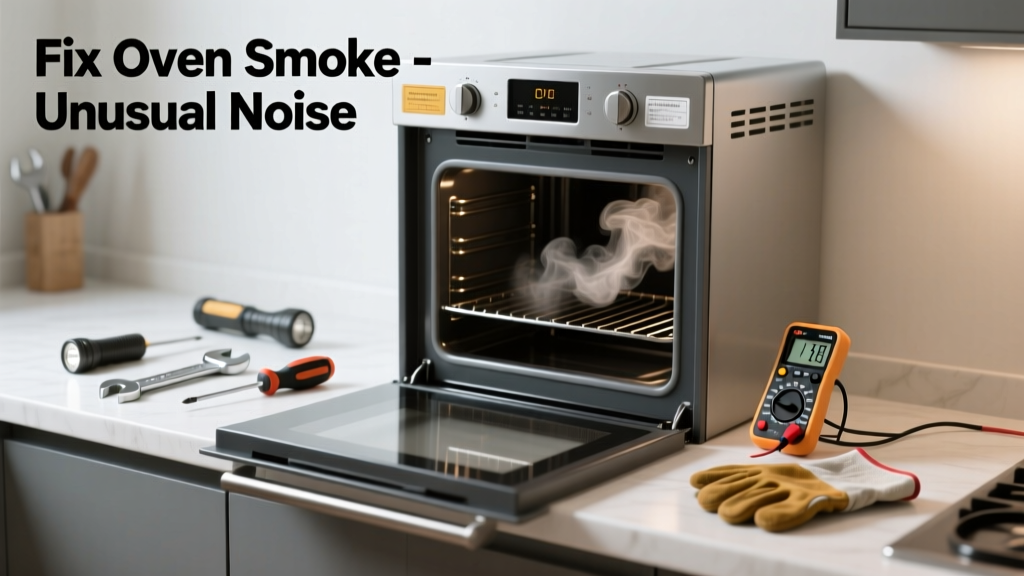
If your oven is belching smoke while humming, clanging, or making sharp popping noises, don’t ignore it — this isn’t just annoying, it’s a potential fire or electrical hazard. These symptoms often point to overlapping issues: food debris igniting, failing components, or airflow blockages. Acting quickly protects your kitchen, your wallet, and your safety.
Quick Diagnosis
Start here before grabbing tools. Most cases fall into one of these five categories:
- Food or grease buildup burning off on the heating element or oven floor
- Faulty bake or broil element arcing or shorting
- Failed convection fan motor or obstructed fan blade
- Cracked or warped oven door gasket allowing heat escape and triggering sensor errors
- Loose or corroded wiring in the control panel or junction box
Tools & Materials Needed
| Item | Purpose | Estimated Cost |
|---|---|---|
| Non-contact voltage tester | Verifies power is fully disconnected before inspection | $12–$25 |
| Microfiber cloths & non-abrasive oven cleaner | Safely removes baked-on grease without damaging enamel | $8–$15 |
| Needle-nose pliers & insulated screwdrivers | Securely handle small wires and terminal connections | $10–$22 |
| Replacement oven gasket (model-specific) | Restores proper seal; prevents overheating and noise from air leaks | $24–$48 |
| Multimeter (with continuity setting) | Tests element resistance and circuit integrity | $20–$65 |
Step-by-Step Fix
Follow these methods in order — skip ahead only if earlier steps rule out the cause:
- Clean interior thoroughly: Remove racks, wipe down walls and floor with a baking soda paste (½ cup baking soda + 3 tbsp water), let sit 12 hours, then scrub gently. Pay special attention to the bottom heating element crevices and behind the broiler plate.
- Inspect and test heating elements: With power OFF, visually check for blistering, bubbling, or breaks on bake/broil elements. Use a multimeter set to ohms: a functional element reads 20–120 Ω. Infinite resistance = replacement needed.
- Check convection fan operation: Turn oven to convection mode (if equipped) and listen closely. If the fan whines, grinds, or doesn’t spin, remove rear panel and inspect for debris or seized bearings. Lubricate only with high-temp synthetic grease — never WD-40.
- Examine door gasket and hinges: Close door on a dollar bill — if you can pull it out easily at any point, the seal is compromised. Look for cracks, brittleness, or gaps near corners where heat escapes and triggers thermal cycling noise.
When to Call a Pro
Stop immediately and call a certified appliance technician if you observe any of these:
- Smoke accompanied by burning plastic or acrid chemical odors (indicates melting wire insulation)
- Visible sparking or arcing inside the oven cavity or control panel
- Tripped breaker that won’t reset or repeated GFCI trips during oven use
- Oven temperature fluctuating more than ±25°F during baking (suggests faulty sensor or control board)
According to the U.S. Consumer Product Safety Commission’s 2023 Appliance Incident Report, 37% of oven-related fires involved DIY attempts on live circuits or misdiagnosed control board failures.
"Never bypass a thermal fuse or jumper across a failed safety device — it’s there for a reason. That ‘quick fix’ is the leading cause of uncontained oven fires," says Ken Ralston, ASE-certified appliance technician and lead trainer at NATE Academy (2022).
Prevention Tips
Extend your oven’s life and avoid repeat issues with these habits:
- Wipe spills immediately — especially sugary or fatty ones that carbonize at high temps
- Run self-clean only when absolutely necessary (no more than twice per year); residue buildup accelerates element wear
- Vacuum around vent openings every 3 months to prevent dust accumulation in fan housings
- Replace door gaskets every 5–7 years, even if they look intact — elasticity degrades silently
Can I use oven cleaner on the heating elements?
No. Most commercial oven cleaners contain sodium hydroxide, which corrodes exposed coil elements and damages insulation. Instead, use a damp microfiber cloth and gentle scrubbing with baking soda paste. For stubborn deposits, disconnect power and carefully scrape with a wooden skewer — never metal.
Why does my oven smoke only during preheat?
Preheat cycles draw maximum current, exposing weak spots: a failing element may arc only under load, or residual grease vaporizes rapidly as temps climb past 300°F. This is why visual inspection alone isn’t enough — always test elements with a multimeter under cold conditions.
Is it safe to keep using the oven if it smokes but no flames appear?
No. Smoke indicates combustion — either food debris or, more dangerously, overheated wiring or insulation. The National Fire Protection Association reports that 62% of oven fires start with smoke but no visible flame in the first 90 seconds (NFPA Fire Analysis, 2024). Shut it down and investigate.
Can a dirty filter cause oven smoke and noise?
Ovens don’t have filters like HVAC systems — but some dual-fuel ranges and built-in wall ovens include grease traps near vent hoods or recirculating fans. A clogged trap restricts airflow, causing heat buildup and fan strain. Check your owner’s manual for “grease filter” location — usually behind the vent grille above the cooktop.
How do I know if the convection fan motor is failing?
Listen for uneven rotation (clicking, stuttering), higher-pitched whine than usual, or delayed startup after selecting convection mode. You can also feel for excessive vibration on the oven’s rear exterior panel during operation. If the fan spins freely by hand but won’t start electrically, suspect capacitor or relay failure — replace the fan motor assembly rather than troubleshooting individual parts.
What’s the safest way to clean under the stovetop burners if smoke comes from there?
Lift sealed burners (on electric or gas) only after cooling completely and unplugging the range. Use compressed air to blow out crumbs, then wipe with a vinegar-dampened cloth. Avoid liquid cleaners pooling near igniters or electrical terminals — moisture causes corrosion and erratic clicking. For persistent odor, clean igniter tips with fine emery cloth to restore spark reliability.
A well-maintained oven shouldn’t hiss, pop, or smoke — and catching these signs early saves hundreds in service calls and prevents emergency scenarios. Keep your cleaning routine consistent, test components annually, and trust your instincts: if it smells wrong or sounds off, pause and inspect before the next roast goes in.