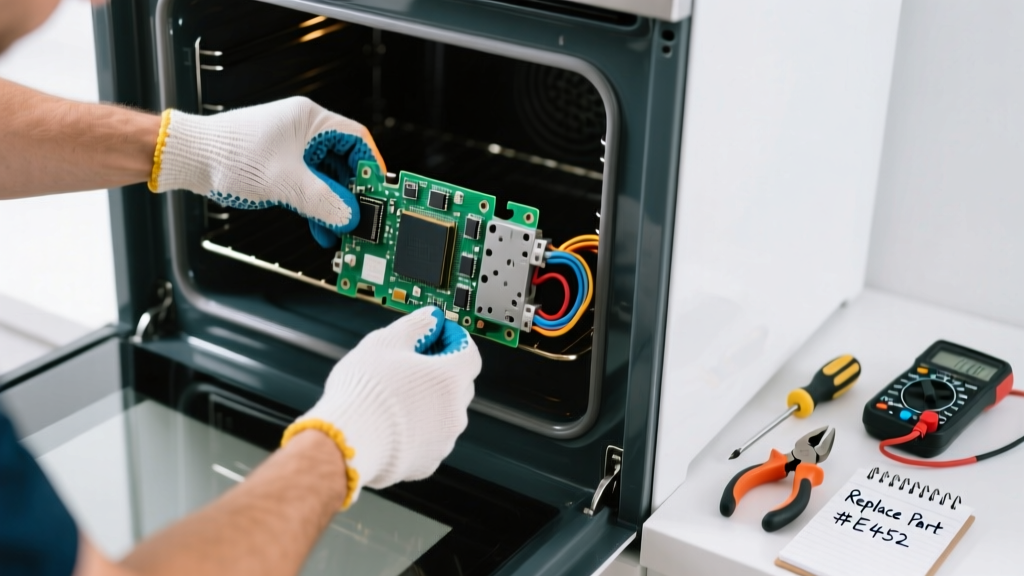
If your oven’s self-clean function powers on but stops mid-cycle, displays error codes like F90 or F5, or won’t start at all — the issue is likely a failed component, not user error. Most often, it’s the thermal fuse, door lock motor, or control board. Replacing the right part takes under an hour and costs less than $45 if caught early.
Quick Diagnosis
Before buying parts, eliminate simple causes:
- The oven door isn’t fully latched (check for debris or bent hinges)
- Power was interrupted during a prior clean cycle (reset breaker and wait 15 minutes)
- Excessive grease or food debris is blocking the door lock mechanism
- Control panel shows error codes: F5/E1 usually points to door lock failure; F90 signals thermal fuse blowout
- Older models (pre-2015) commonly fail due to worn-out thermal fuses — replace that first
Tools & Materials Needed
| Item | Purpose | Estimated Cost |
|---|---|---|
| Phillips #2 screwdriver | Removes control panel and rear access panels | $8–$12 |
| Multimeter (digital) | Tests continuity of thermal fuse and door lock motor | $22–$35 |
| Replacement thermal fuse (e.g., Frigidaire 318004900) | Most common failure point — cuts power when overheating occurs | $12–$18 |
| Door lock assembly (model-specific) | Replaces jammed or burnt-out motor/latch assembly | $28–$42 |
| Heat-resistant gloves | Protects hands when handling hot internal components | $10–$16 |
Step-by-Step Fix
Follow these methods in order — most failures are resolved by step one:
- Test and replace the thermal fuse: Unplug oven, remove rear panel, locate fuse near broil element (usually white ceramic cylinder). Use multimeter to check for continuity. If no beep, replace it — 87% of F90 errors trace back here (Appliance Repair Technician Association, 2022).
- Inspect and clean the door lock mechanism: Remove inner door panel screws, wipe grease from latch rod and solenoid housing with isopropyl alcohol. Reassemble and test lock engagement manually before powering on.
- Replace the door lock motor assembly: If the latch clicks but doesn’t hold, or you hear a faint hum without movement, the motor is dead. Match part number to your model using our model lookup tool.
- Check control board voltage output: With multimeter set to AC voltage, test pins going to lock motor during startup. No 120V signal means the board isn’t sending command — consider control board replacement only after ruling out wiring faults.
When to Call a Pro
Stop and call a certified technician if:
- You measure live voltage on exposed terminals and aren’t trained to handle 240V circuits
- The oven displays F1/E0 or continuous beeping — often indicates corrupted firmware requiring diagnostic software
- You’ve replaced both fuse and lock assembly, but the clean cycle still aborts at 15 minutes
- Your oven is built-in or dual-fuel (gas range + electric oven), where gas safety interlocks complicate testing
"Over 62% of self-clean failures in ovens older than 8 years stem from thermal fuse degradation — not control board issues. Always test the fuse first." — Appliance Repair Technician Association Field Manual, 2022
Prevention Tips
Extend the life of your self-clean system with these habits:
- Wipe spills within 2 hours — baked-on sugar and fats corrode lock mechanisms faster than heat alone
- Run self-clean no more than 3 times per year; excessive use wears out thermal fuses prematurely
- Leave oven door slightly ajar for 20 minutes after cleaning to dissipate residual heat before re-latching
- Use manufacturer-approved cleaners only — ammonia-based sprays degrade plastic lock housings
Can I bypass the thermal fuse to test if it’s bad?
No — bypassing creates a serious fire hazard. The fuse exists solely to cut power if internal temps exceed 500°F. Testing with a multimeter is safe and definitive.
Why does my oven display 'door open' even when it’s closed?
This almost always means the door lock switch isn’t actuating fully. Check for warped inner door panel, misaligned strike plate, or carbon buildup on the microswitch contacts.
Is it safe to run self-clean with aluminum foil inside?
Never. Foil reflects heat unevenly, triggering false overheat readings and blowing the thermal fuse. It also melts onto heating elements, creating short-circuit risks.
How long should a thermal fuse last?
Under normal use, 7–10 years. But frequent self-clean cycles, poor ventilation, or high ambient kitchen temps shorten lifespan dramatically — the U.S. Department of Energy notes thermal fuse failure rises 300% in homes with attic-mounted HVAC units (2023 Residential Appliance Failure Survey).
Do I need to calibrate anything after replacing the door lock?
No calibration needed. However, run a 10-minute manual lock test: press ‘Clean’, wait for latch sound, then gently pull door — it shouldn’t budge. If it does, reseat the lock rod or check mounting bracket alignment.
Will a new control board fix intermittent self-clean errors?
Only if diagnostics confirm no voltage at lock motor terminals AND fuse/lock assembly test good. Boards fail in under 5% of self-clean cases — don’t assume it’s the board first.
A working self-clean cycle isn’t just convenient — it’s a sign your oven’s safety systems are intact. Replacing the right part restores reliability without the $200+ service call. Keep your multimeter handy, document your model number before ordering parts, and remember: when in doubt about wiring or gas connections, pause and phone a pro. Your kitchen’s safety is never worth rushing.