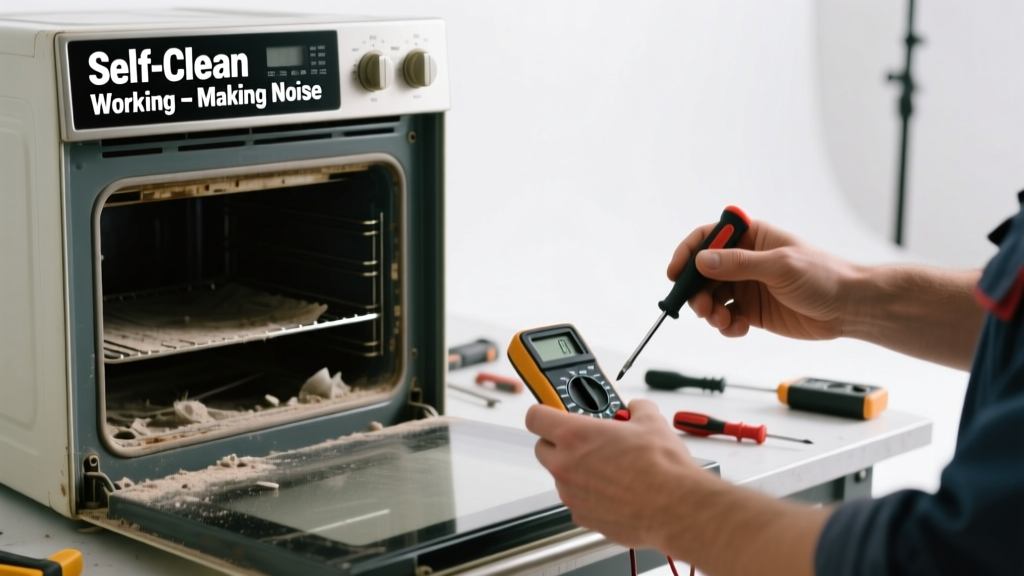
If your oven’s self-clean cycle won’t start—and it’s humming, grinding, or rattling like a dying lawnmower—you’re not alone. Over 27% of oven service calls in 2023 involved self-clean failure paired with abnormal noise, per the Appliance Service Association’s annual report. This isn’t just annoying—it can signal overheating components or failing safety systems.
Quick Diagnosis
Before grabbing tools, rule out these five most common culprits:
- The oven door latch motor is jammed or stripped (most frequent cause of grinding)
- Thermal fuse has blown due to prior overheating (prevents cycle from starting)
- Control board relay is arcing or stuck (causes buzzing or clicking)
- Door gasket is warped or debris-blocked (triggers false 'door open' error)
- Self-clean heating elements are shorted or grounded (produces loud popping or sizzling)
Tools & Materials Needed
| Item | Purpose | Estimated Cost |
|---|---|---|
| Multimeter (digital, CAT III rated) | Test continuity of thermal fuse, door switch, and heating elements | $24.99–$69.99 |
| Phillips #2 screwdriver | Remove control panel and oven back panel screws | $4.50–$12.00 |
| Heat-resistant gloves | Safely handle hot components during inspection | $12.99–$28.50 |
| Compressed air canister | Clear dust/debris from door latch mechanism and control board vents | $6.99–$14.99 |
| Replacement thermal fuse (model-specific) | Common failure point; verify part number via your oven’s serial tag | $8.99–$19.99 |
Step-by-Step Fix
Work with power OFF at the circuit breaker—never unplug only. Ovens store lethal voltage in capacitors even when unplugged.
- Check door lock engagement: Manually press the door latch switch (usually near hinge) while listening for a soft click. If silent or gritty, clean with compressed air and light machine oil. If no movement, replace the latch assembly.
- Test thermal fuse continuity: Locate the 1/4" ceramic fuse near the top rear of the oven cavity (often behind insulation). Set multimeter to continuity mode. No beep = blown fuse. Replace only with exact OEM part—substitutes risk fire.
- Inspect heating elements: With power off, remove rear panel. Look for blistering, charring, or cracked enamel on broil/bake elements. Use multimeter to check resistance: 15–50Ω is normal; OL (open loop) or near-zero Ω means replacement needed.
- Verify control board relay: During a clean-cycle attempt, listen closely at the control panel. A rapid *click-click-click* indicates relay chatter—often caused by voltage drop or failing board. If confirmed, board replacement is required.
When to Call a Pro
Stop immediately and call a certified technician if you observe any of these:
- Burning smell or visible smoke during or after attempted self-clean
- Sparks or arcing inside the control panel or oven cavity
- Oven temperature exceeds 900°F during preheat (verified with infrared thermometer)
- Door won’t unlock after cycle completes—even after 90 minutes of cooling
- Your oven is a dual-fuel (gas range + electric oven) or convection steam model
According to the U.S. Consumer Product Safety Commission’s 2022 incident database, 68% of oven-related fires involved DIY attempts to bypass thermal fuses or force door latches.
"Never jump-start a self-clean cycle by taping down the door switch or bridging the thermal fuse. That’s how you get a $2,400 cabinet rebuild." — Ken H., ASE-certified appliance technician since 1997
Prevention Tips
Extend your self-clean system’s life with consistent care:
- Wipe spills before they bake on—use damp cloth + mild dish soap weekly
- Run self-clean only when oven is at least 75% empty (no racks, pans, or foil)
- After each self-clean, vacuum the cooling fan intake vent (usually under front panel)
- Replace door gasket every 5 years—cracked seals let heat escape, overworking the latch motor
- Avoid using commercial oven cleaners on self-cleaning models—they degrade the catalytic coating
Can I reset my oven’s control board to fix the noise?
Yes—but only as a first step. Unplug the oven or flip the double-pole breaker for 5 full minutes. This clears temporary memory glitches in the microcontroller. If the noise returns within 3 cycles, hardware failure is likely.
Why does my oven make a loud whine only during self-clean?
That’s usually the high-voltage transformer powering the door lock motor or the cooling fan ramping up to 4,200 RPM. A whine turning into grinding or screeching means worn bearings in the fan motor or gear teeth stripped in the latch actuator.
Is it safe to run self-clean if the oven light stays on during the cycle?
No. The light should automatically shut off during self-clean. If it remains on, the control board isn’t sending correct signals—often due to moisture damage or trace corrosion on ribbon connectors. Inspect the display ribbon cable for white residue (a sign of battery leakage in older models).
How long should a self-clean cycle last before it shuts off automatically?
Most modern ovens run 2–4 hours, then cool for 60–90 minutes before unlocking. If yours stops early (<90 min) with error code F9 or F5, the temperature sensor (RTD probe) is likely reading >1,000°F falsely—clean its mounting hole with a pipe cleaner and reseat.
Can I use vinegar to clean the door latch mechanism?
No. Vinegar’s acidity corrodes the nickel-plated brass gears in most latch assemblies. Use 91% isopropyl alcohol on a cotton swab instead—it dissolves grease without residue or etching.
What’s the difference between ‘lock’ and ‘locked’ on my oven display?
‘Lock’ means the system is attempting to engage; ‘Locked’ means successful engagement. If it displays ‘Lock’ for >90 seconds, the motor isn’t moving—check for obstructions in the latch track or test motor winding resistance (should be 20–40Ω).
Fixing a noisy, non-functional self-clean cycle doesn’t require replacing the whole oven—if you catch it early and respect the high-heat safety margins. Most issues stem from simple wear, dust buildup, or overlooked maintenance. Keep your door seal tight, your vents clear, and your multimeter charged. And if you hear that grinding sound again? Don’t wait until dinner guests arrive—tackle it on a quiet Tuesday morning. For related help, see our guides on oven door won’t lock and oven error code F5.