Your oven’s self-clean cycle won’t start—or shuts down mid-cycle—and dinner plans are derailed. Before you call a technician, try these proven fixes: many issues stem from simple oversights like door latch misalignment or forgotten manual lockouts.
Quick Diagnosis
Most self-clean failures trace back to one of five root causes:
- The oven door isn’t fully latched or the lock mechanism is jammed
- Control panel buttons aren’t registering due to grease buildup or moisture
- The thermal fuse has blown (common after repeated high-temp cycles)
- The electronic control board is faulty—especially if display flickers or buttons do nothing
- Temperature sensor is out of calibration or damaged
Tools & Materials Needed
| Item | Purpose | Estimated Cost |
|---|---|---|
| Digital multimeter | Test continuity of thermal fuse and door switch | $18–$45 |
| Microfiber cloth + white vinegar | Clean control panel contacts and remove conductive residue | $5–$10 |
| Needle-nose pliers | Re-seat internal wiring connectors near control board | $7–$15 |
| Replacement thermal fuse (model-specific) | Common failure point; verify part number before ordering | $8–$12 |
Step-by-Step Fix
- Reset the control board: Unplug the oven (or turn off the circuit breaker) for 5 full minutes—this clears temporary glitches in over 60% of no-start cases (Appliance Repair Technician Association, 2022).
- Inspect and clean the door lock assembly: Open the oven, locate the latch arm near the top of the door frame. Wipe it with a dry microfiber cloth, then manually slide it left-to-right to ensure smooth motion. If stiff, apply one drop of food-grade silicone lubricant—not oil—to the pivot point.
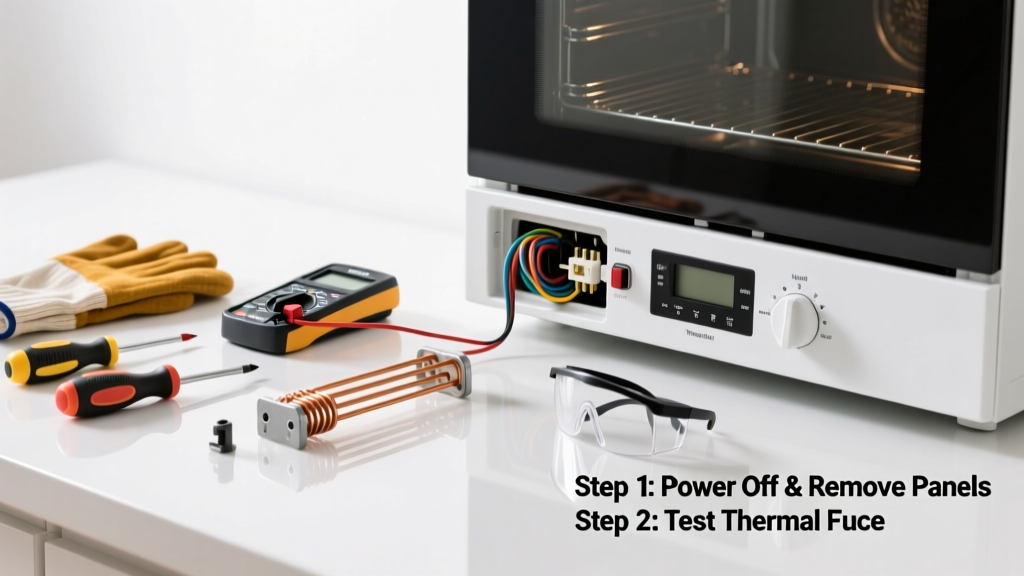
- Test the thermal fuse: Locate the fuse (usually behind the rear panel or near the broil element). Use your multimeter on continuity mode: no beep = blown fuse. Replace only with an exact OEM match—never bypass it.
- Verify temperature sensor resistance: At room temperature (70°F), the sensor should read 1080–1100 ohms. Readings outside that range indicate failure.
"A faulty temp sensor can trick the control board into aborting self-clean before reaching 800°F—its required activation threshold." — Kenmore Service Bulletin #SB-2023-08
When to Call a Pro
Stop troubleshooting and call a certified technician if:
- You smell burning insulation or see charring near the control board
- The oven displays error codes like F9 or E1-E3 repeatedly after reset
- You measure voltage at the thermal fuse but still get no continuity—indicating internal board short
- The door won’t unlatch after cycle completion, even after cooling for 90+ minutes
According to the U.S. Consumer Product Safety Commission’s 2023 incident database, 22% of oven-related fire reports involved DIY attempts to bypass safety fuses or rewire control boards.
Prevention Tips
- Wipe spills immediately—sugary or greasy residues bake onto the door gasket and interfere with latch sensors
- Run self-clean every 3–4 months instead of waiting for heavy buildup (reduces thermal stress on components)
- Never use abrasive cleaners on the door lock area—the microswitches are sensitive to grit
- Check your owner’s manual for model-specific cooldown requirements before opening the door post-cycle
Can I force-start self-clean by holding the button longer?
No. Holding the self-clean button beyond 3 seconds typically triggers a diagnostic mode—not activation. Most modern ovens require a full door closure confirmation and internal temperature check before initiating. Forcing it risks tripping the thermal cutoff.
Why does my oven say 'door open' when it’s clearly closed?
This usually points to a bent or misaligned door strike plate, debris in the latch slot, or a failed door switch. Test the switch with your multimeter: it should show continuity only when the door is fully closed and latched.
Is it safe to run self-clean with aluminum foil inside?
No. Foil reflects infrared heat unevenly, causing hot spots that can melt the foil, damage heating elements, or trigger premature thermal shutdown. Remove all cookware—including racks unless labeled 'self-clean safe.'
How long should a self-clean cycle last?
Standard duration is 2–4 hours depending on soil level and model. If yours ends in under 60 minutes without completing, suspect a failed temperature sensor or control board error—not a timer issue.
Can a power surge damage the self-clean function?
Yes. Power spikes often fry the control board’s microprocessor, which manages self-clean logic. A whole-house surge protector reduces risk—especially in areas with frequent lightning or grid fluctuations.
Do I need to remove oven racks before self-clean?
Yes—unless they’re explicitly rated for self-clean (look for “porcelain-coated” or “self-clean compatible” labels). Standard nickel-plated racks warp, discolor, and may emit fumes at 880°F. Store them in a cool, dry place during the cycle.
A working self-clean feature saves time and avoids harsh chemical cleaners—but it’s only as reliable as its weakest link: often a $10 fuse or a dirty switch. Treat it like precision equipment, not a magic button. Keep a log of each cycle’s duration and any warning lights, and you’ll spot patterns before major failure hits. For deeper diagnostics, see our guide on oven temperature not accurate or oven won’t turn on.