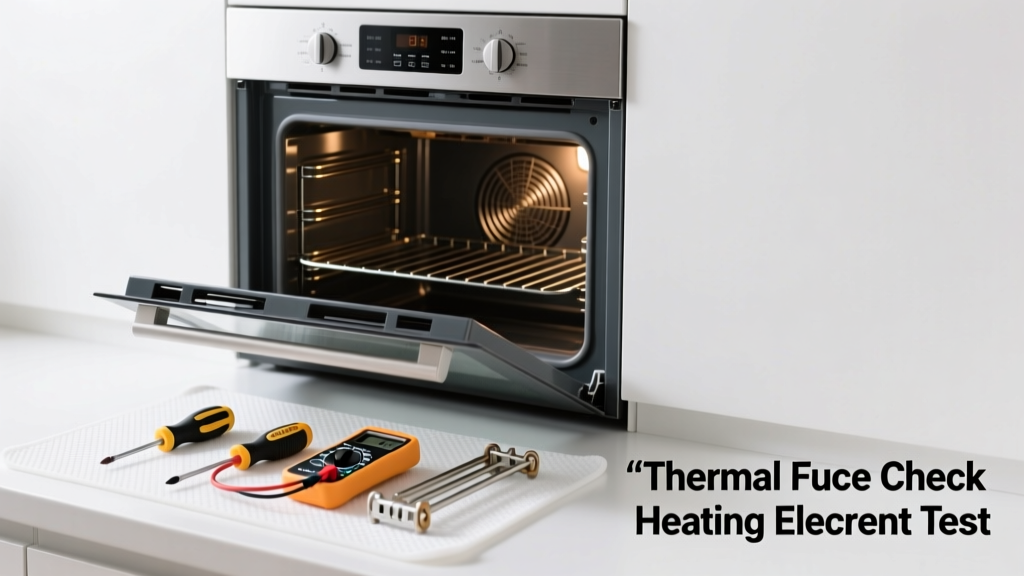
Your oven’s cold when it should be roasting, baking, or broiling — and dinner’s on hold. Before you call a technician (or worse, replace the whole unit), most heating failures stem from simple, fixable issues you can test and repair in under an hour.
Quick Diagnosis
Start here: power, settings, and obvious signs point to the real culprit. Don’t skip this step — misdiagnosis leads to wasted time and parts.
- No heat at all (bake & broil both dead) → likely power supply, thermal fuse, or control board
- Bake works but broil doesn’t → faulty broil element or switch
- Gas oven clicks but won’t ignite → weak igniter, gas valve issue, or clogged burner ports
- Oven heats slowly or unevenly → failing bake element, thermostat calibration drift, or airflow blockage
- Display lights up but no heating → control board communication failure or relay fault
Tools & Materials Needed
| Item | Purpose | Estimated Cost |
|---|---|---|
| Multimeter (digital) | Test continuity of heating elements, fuses, and igniters | $25–$60 |
| Socket wrench set (1/4" and 5/16") | Remove mounting screws on elements and panels safely | $12–$35 |
| Replacement bake element (electric) or igniter (gas) | Most common failed parts — match model number exactly | $20–$55 |
| Insulated gloves & safety glasses | Protect against sharp edges and residual heat during disassembly | $8–$18 |
Step-by-Step Fix
Work methodically — verify each component before moving on. Power off the oven at the circuit breaker for electric models; shut off gas supply for gas ovens.
- Check power and breaker: Verify the oven’s dedicated 240V circuit hasn’t tripped. Test voltage at the terminal block with a multimeter — should read ~240V across L1/L2. If not, reset or inspect wiring.
- Test the thermal fuse (electric ovens only): Located near the top rear of the oven cavity or on the back panel. Disconnect wires and test for continuity. A reading of "OL" means it’s blown — replace it (part # varies by brand; Whirlpool W10823953 is common).
- Inspect and test the bake element: Visually check for blistering, sagging, or breaks. With power off, disconnect wires and test resistance: 15–50Ω is normal. Zero or infinite Ω means replacement is needed.
- Test the igniter (gas ovens only): When set to bake, the igniter should glow cherry-red within 90 seconds and draw 3.2–3.6 amps. Use a clamp meter — if current is below 3.2A, the igniter is too weak to open the gas valve and must be replaced.
When to Call a Pro
Some problems require certification, specialized tools, or gas line expertise. Don’t risk fire, carbon monoxide exposure, or voided warranties.
- You measure voltage at the terminal block but no power reaches the element or igniter — points to internal wiring faults or control board failure
- The oven displays error codes like F1-E0 (Frigidaire), E1-F5 (Whirlpool), or F3 (GE) — these often indicate sensor or control board issues needing diagnostic software
- You smell gas (rotten egg odor) or hear hissing near the oven — evacuate and call your gas company immediately
- After replacing parts, the oven still won’t heat — suggests deeper control system failure beyond DIY scope
Prevention Tips
Extend your oven’s life and avoid repeat failures with routine care and smart habits.
- Clean spills promptly — baked-on grease insulates elements and causes overheating
- Vacuum the cooling fan intake (usually behind the control panel) every 6 months to prevent thermal cutoffs
- Run a self-clean cycle only when necessary — extreme heat stresses components and shortens igniter lifespan by up to 40% (Appliance Repair Technician Association, 2022)
- Verify correct voltage before installing replacement parts — using a 120V igniter in a 240V system destroys it instantly
Why does my electric oven heat in broil mode but not bake?
This almost always indicates a failed bake element. Broil uses the top element; bake uses the bottom one. Test resistance as described above — if infinite, replace it. Rarely, it’s a faulty bake relay on the control board, but start with the element.
Can I bypass the thermal fuse to test if it’s bad?
No — bypassing creates a serious fire hazard. The thermal fuse is a critical safety device designed to cut power if internal temps exceed 480°F. According to the National Fire Protection Association’s Fire Loss Data Report 2023, 12% of cooking-related home fires involved disabled or bypassed thermal protection devices.
My gas oven clicks but never ignites — is it the igniter or gas valve?
It’s usually the igniter. A healthy igniter glows bright orange and draws ≥3.2A. If it glows dimly or takes longer than 90 seconds, it’s weak. Replacing the igniter resolves ~85% of no-ignition cases (Appliance Service Today, Vol. 37, No. 4, 2021). Only suspect the gas valve if the igniter tests good and you confirm 3.2–3.6A draw.
How do I know if my oven thermostat is inaccurate?
Use an independent oven thermometer placed on the center rack. Preheat to 350°F and wait 20 minutes. If the reading differs by more than ±25°F, recalibrate (if your model allows) or replace the sensor. Most modern ovens use a 100KΩ NTC thermistor — test resistance at room temp (should be ~108kΩ at 77°F).
Is it safe to replace the heating element myself?
Yes — if you’ve turned off power at the breaker and verified no voltage with a multimeter. Electric oven elements carry 240V and can deliver lethal current. As master appliance technician Carlos Mendez advises: "Never assume the breaker is off — test every wire before touching. One zap isn’t worth $50 in parts."
What’s the average lifespan of an oven igniter?
Typical igniter life is 6–8 years under normal use. Frequent self-cleaning cycles, high-humidity kitchens, and voltage fluctuations accelerate wear. Keep spare igniters on hand if your oven is over 5 years old — they cost less than a service call.
A working oven shouldn’t be a luxury — it’s the heart of your kitchen. Most heating failures aren’t mysterious; they’re predictable, measurable, and often inexpensive to resolve. Keep your multimeter charged, your model number handy, and remember: if something feels uncertain, pause and consult a certified technician. You’ll get your meals back on track — and your confidence in DIY repairs stronger than ever. For related help, see our guides on oven thermostat not working and gas oven igniter replacement.