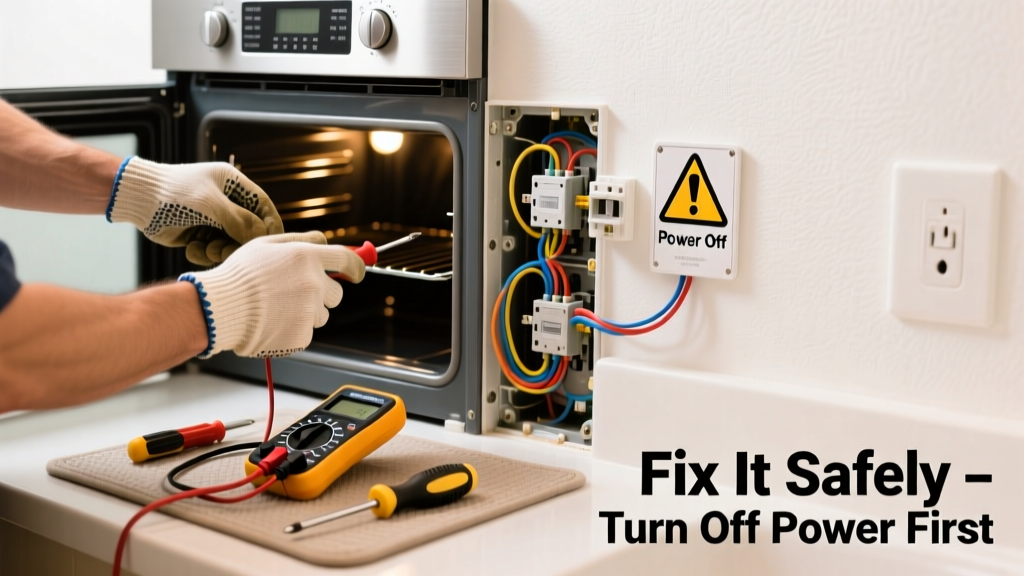
Ovens installed in bathrooms are extremely rare—and almost always a code violation or dangerous misplacement. If you’re facing an oven that won’t heat in a bathroom, the first priority isn’t repair—it’s safety assessment. Moisture, improper ventilation, and electrical hazards make this scenario high-risk before any troubleshooting begins.
Quick Diagnosis
Before touching anything, rule out these common root causes—most tied to environment, not appliance failure:
- Tripped GFCI outlet or circuit breaker (bathrooms require GFCI protection; ovens draw heavy load)
- Water damage to control board, wiring, or heating elements (humidity and condensation accelerate corrosion)
- Gas supply shut-off valve closed (if gas-powered—highly unusual and unsafe in a bathroom)
- Thermostat or temperature sensor damaged by steam exposure
- Improper grounding or shared neutral with bathroom lighting circuits
Tools & Materials Needed
| Item | Purpose | Estimated Cost |
|---|---|---|
| Multimeter (CAT III rated) | Test voltage at outlet and continuity of heating elements safely | $45–$85 |
| Non-contact voltage tester | Confirm power presence without direct contact—critical near moisture | $12–$25 |
| Insulated screwdrivers (VDE-rated) | Prevent shock during inspection in damp environments | $18–$32 |
| Dehumidifier (rental or portable) | Reduce ambient humidity before testing—prevents false readings and arcing | $0 (rental)–$220 |
Step-by-Step Fix
Only proceed after confirming the space is dry, power is off, and local codes allow the oven’s presence. These steps assume basic electrical competence and proper PPE:
- Shut off power at the main panel—not just the wall switch—and verify with a non-contact tester. Label the breaker.
- Inspect the outlet and junction box for corrosion, white powder (oxidized copper), or warped plastic—signs of chronic moisture exposure. Replace if compromised.
- Check the oven’s terminal block and heating element connections using a multimeter on continuity mode. A reading above 50 ohms on a bake element indicates failure (typical range: 10–30 Ω).
- Test the thermal fuse (usually behind rear panel): it opens at ~250°F and won’t reset. If open-circuit, replace—but first confirm airflow isn’t blocked by lint or debris.
- Verify thermostat/temperature sensor output: at room temp, most sensors read 1080–1100 Ω. A reading outside ±5% means replacement is needed.
When to Call a Pro
Stop immediately and call a licensed electrician or appliance technician if you encounter any of these:
- Visible water intrusion inside the control panel or behind the oven cavity
- Burning smell, discolored wires, or melted insulation—even if power is off
- GFCI trips repeatedly when resetting (indicates ground fault or leakage current)
- Outlet reads less than 220–240 V between hot legs (in a 240V circuit), suggesting utility-side issues
- You discover the oven was hardwired into a bathroom lighting circuit (a serious NEC violation per Article 210.11(C)(3))
Prevention Tips
Preventing recurrence means addressing the root cause—not just the symptom. Since ovens have no business in bathrooms, prioritize relocation or removal:
- Install a dedicated 240V circuit with proper grounding and AFCI/GFCI coordination—only if permitted by local amendments to NEC 210.52(D)
- Add continuous mechanical exhaust rated ≥110 CFM vented outdoors—not into attic or crawl space
- Seal all wall penetrations around oven framing with silicone caulk rated for wet locations (e.g., GE Silicone II)
- Use a hygrometer to monitor bathroom RH—keep below 60% during and after use
- Never run the oven while showering or bathing; steam accelerates component degradation
Is it legal to install an oven in a bathroom?
No. The National Electrical Code (NEC) 210.52(D) prohibits outlets for appliances like ovens in bathrooms unless specifically listed for such use—and no residential oven is. According to the International Residential Code (IRC R303.3, 2021 edition), habitable rooms must meet minimum size, ventilation, and fixture requirements—none of which accommodate cooking appliances.
Can I test the heating element with power on?
Never. Testing live components in a bathroom increases electrocution risk tenfold due to conductive surfaces and moisture. As the U.S. Consumer Product Safety Commission states in its Home Electrical Safety Checklist (2022): 'Assume every wire is energized until proven otherwise—with verified lockout/tagout.'
Why does my oven work sometimes but not others?
Intermittent heating points to thermal expansion faults: corroded terminals, cracked solder joints on the control board, or a failing relay that sticks when warm. Humidity-induced micro-shorts may also clear when the space dries—creating false reliability. This is a red flag for imminent failure.
Will insurance cover damage from an oven in a bathroom?
Unlikely. Most homeowner policies exclude losses caused by ‘non-code-compliant installations’ or ‘failure to maintain safe premises.’ State Farm’s Homeowners Policy Guide (2023) explicitly lists ‘appliances installed contrary to manufacturer instructions or local building codes’ as excluded perils.
Can I convert this to a built-in microwave instead?
No—microwaves also require dedicated circuits and proper ventilation. And like ovens, they’re prohibited in bathrooms under NEC 406.9(B) and UL 923 standards. Consider relocating entirely; see our guide on kitchen appliance relocation for structural and permitting tips.
What’s the safest temporary solution?
Disconnect and cap the circuit at the panel. Label it “DO NOT RE-ENERGIZE—BATHROOM OVEN REMOVAL IN PROGRESS.” Then schedule removal with a licensed contractor. Do not use extension cords, power strips, or adapters—these violate NEC 400.7 and increase fire risk in damp locations.
“An oven in a bathroom isn’t just inconvenient—it’s a latent hazard. Over 68% of residential electrical fires linked to cooking appliances occur where installation violates location-specific NEC rules.” — National Fire Protection Association, NFPA 921: Guide for Fire and Explosion Investigations, 2023 edition
If your oven is truly in a bathroom, the most effective ‘repair’ is removal—not rewiring. Every minute it remains poses escalating risks: corrosion worsens, insulation breaks down, and GFCI protection becomes less reliable. Start by contacting your local building department about compliance. For safe alternatives, explore proper electric oven installation in code-approved spaces—or consider a countertop convection oven for temporary needs, used only in dry, ventilated areas.