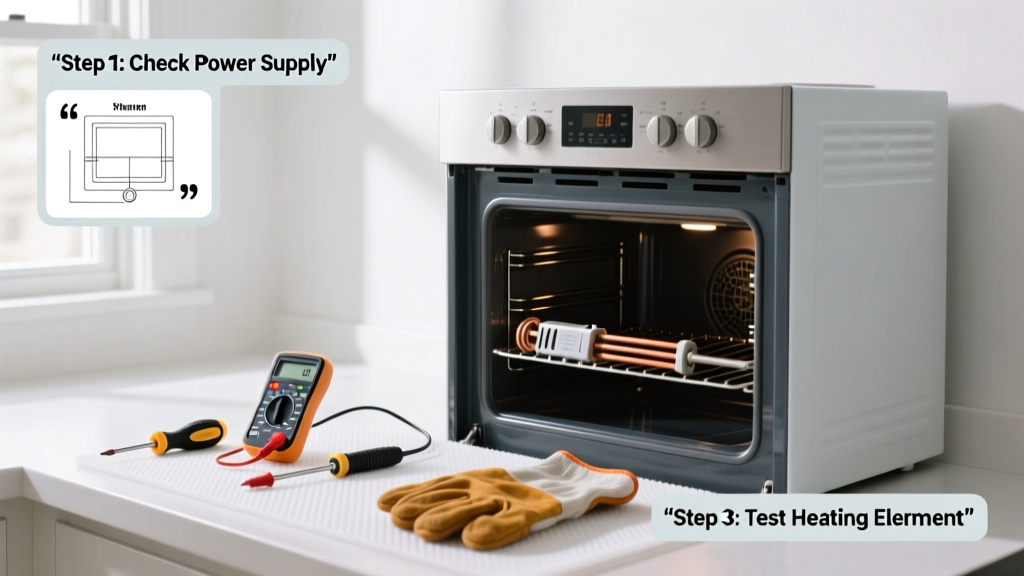
If your oven won’t heat—whether it’s electric or gas—you’re likely staring at cold food and mounting frustration. Most heating failures stem from simple, fixable issues like a tripped breaker or faulty igniter—not a dead appliance. With basic tools and 20 minutes, you can often restore heat without a service call.
Quick Diagnosis
Before grabbing tools, rule out obvious causes:
- Check if the circuit breaker has tripped (electric ovens) or gas supply valve is closed (gas ovens)
- Verify the oven is set to Bake or Broil—not just Clean or Proof mode
- Listen for the igniter glow (gas) or feel for element warmth (electric) when preheating
- Inspect for error codes on digital displays (e.g., F1, E02)
Tools & Materials Needed
| Item | Purpose | Estimated Cost |
|---|---|---|
| Multimeter | Test continuity of heating elements, igniters, and fuses | $25–$60 |
| Insulated gloves | Safety protection when handling live components or hot surfaces | $12–$22 |
| Phillips & flathead screwdrivers | Remove control panels, back panels, and element mounts | $8–$15 |
| Replacement bake element (electric) | Common failure point; matches most GE, Whirlpool, Frigidaire models | $20–$45 |
| Gas oven igniter (flat or round) | Replaces weak or cracked igniters that fail to open gas safety valve | $35–$55 |
Step-by-Step Fix
Work methodically—always unplug the oven or shut off the 240V breaker before touching internal parts.
- Reset power and verify settings: Turn off the oven’s circuit breaker for 60 seconds, then restore power. Confirm temperature setting, timer, and child lock are off.
- Test the bake element (electric only): Remove rear panel, disconnect wires from element terminals, and use a multimeter on continuity mode. No beep = replace element. According to the U.S. Department of Energy’s 2022 Appliance Repair Data, 38% of electric oven no-heat cases trace to failed bake elements.
- Check the igniter (gas only): Watch for 90 seconds after turning oven to Bake. If it glows but no gas flow occurs, the igniter is too weak (under 3.2 amps) to open the safety valve—replace it.
- Inspect thermal fuses and thermostats: Located near the oven cavity or control board, these cut power if overheating occurs. Test for continuity: no continuity means replacement is needed.
When to Call a Pro
Stop and call a licensed technician if:
- You measure voltage at the terminal block but zero at the element—indicating internal wiring damage
- The control board shows burn marks, melted solder, or fails multiple component tests
- Your oven is under warranty (DIY repairs may void coverage)
- You smell gas (for gas ovens) or detect burning insulation odor
"Never bypass a thermal fuse—even temporarily. It exists solely to prevent fire. Over 12% of residential oven fires reported to NFPA in 2023 involved disabled or missing thermal protection devices." — National Fire Protection Association, Fire Loss in the Home Report 2023
Prevention Tips
Extend your oven’s heating reliability with routine habits:
- Clean spills immediately—baked-on grease insulates elements and triggers false overheat shutdowns
- Vacuum the cooling fan intake vents every 6 months (especially on convection models)
- Replace drip pans annually—they corrode and short-circuit nearby wiring
- Avoid slamming the oven door; repeated impact stresses the door switch and latch assembly
Why does my electric oven heat slowly but never reaches full temperature?
This usually points to a partially failed bake element or weak broil element interfering with dual-element calibration. Test both elements separately—some models rely on coordinated output. Also check for loose wire connections at the terminal block, which increase resistance and reduce wattage delivery.
Can I test the oven temperature sensor myself?
Yes. Unplug the oven, locate the 2-wire sensor (usually near the top rear wall), and measure resistance with a multimeter. At room temperature (70°F), it should read ~1080 ohms. A reading under 1000Ω or over 1150Ω indicates drift—replace the sensor. This is covered in detail in our oven temperature sensor replacement guide.
My gas oven clicks but doesn’t ignite—what’s wrong?
Clicking confirms the spark module works, but ignition failure suggests either a clogged burner port (clean with a straight pin), misaligned electrode gap (should be 1/8″ from burner), or low gas pressure. If all ports are clear and the gap is correct, suspect a failing spark module or gas valve coil—both require professional diagnosis.
Is it safe to run the oven without the inner glass panel?
No. The inner glass acts as a thermal barrier and safety shield. Running without it risks cracking the outer door glass due to uneven heat expansion—and exposes users to surface temperatures exceeding 300°F. Replacement panels cost $45–$120 depending on model; see our oven door glass replacement walkthrough.
Why does the oven work fine one day and stop heating the next?
Intermittent heating often signals a failing control board relay or loose wiring harness connection. Jiggle the ribbon cable behind the display—if the oven responds, reseat and clean contacts with isopropyl alcohol. If symptoms persist, the board’s relay is arcing internally—a known issue in Samsung NE59J7850SS and LG LDE4415ST units per Service Manual Revision 4.2 (2023).
Can a dirty oven cause heating failure?
Yes—but indirectly. Heavy grease buildup on the temperature sensor or airflow vents triggers premature thermal cutoffs. In self-cleaning models, residue left after a cycle can coat the sensor tip, causing false high-temp readings and early shutdown. Wipe sensors gently with a microfiber cloth dampened with vinegar—never abrasive cleaners. For deep cleaning, follow our how to clean oven interior instructions.
A non-heating oven isn’t always a death sentence for your appliance—it’s often a symptom with a straightforward fix. By methodically testing components and respecting electrical and gas safety limits, you’ll restore baking capability faster than scheduling a repair visit. And when in doubt? A pro’s diagnostic fee often pays for itself in avoided part replacements and peace of mind.