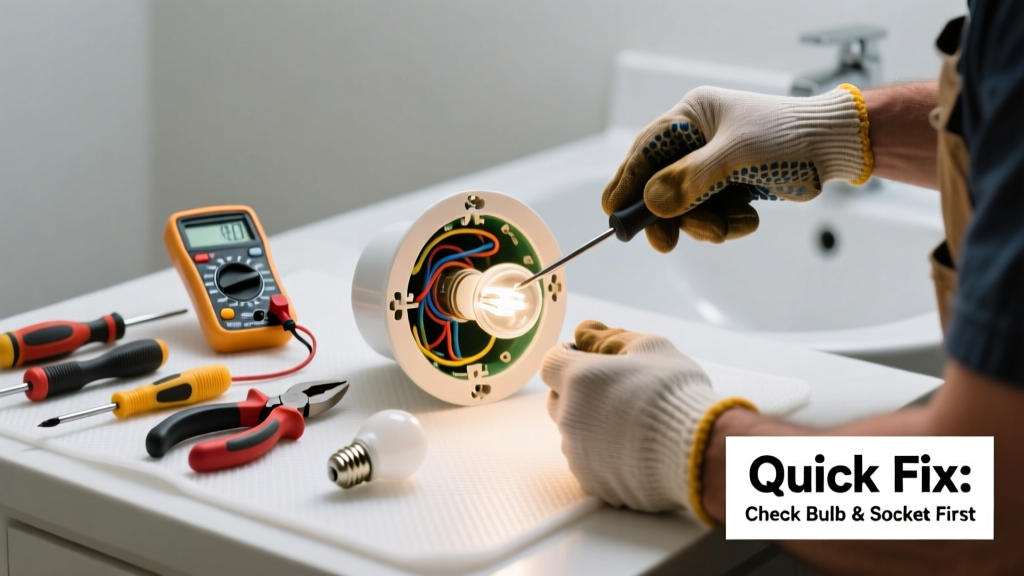
First things first: ovens don’t belong in bathrooms—and neither do oven lights. If you’re seeing an 'oven light' label or fixture in your bathroom, it’s almost certainly a mislabeled or incorrectly installed appliance light (like a vanity or exhaust fan light) mistaken for an oven bulb. That confusion is the root of many failed troubleshooting attempts.
Quick Diagnosis
Before grabbing tools, rule out these five most common culprits:
- A burned-out bulb—especially if it’s a halogen or incandescent type rated for high heat but installed in a damp location
- Moisture damage inside the fixture housing from steam or condensation
- A tripped GFCI outlet or bathroom circuit breaker (bathrooms require GFCI protection by NEC 2023)
- Corroded or loose wiring connections at the junction box behind the fixture
- Wrong bulb type—e.g., using a standard A19 bulb instead of a damp-rated BR30 or PAR20
Tools & Materials Needed
| Item | Purpose | Estimated Cost |
|---|---|---|
| Voltage tester (non-contact) | Confirms power is off before touching wires—critical in wet locations | $12–$25 |
| Insulated screwdrivers (6-in Phillips & flat) | Prevents accidental shorting in cramped, grounded metal boxes | $8–$18 |
| Damp-rated LED bulb (e.g., E26 BR30, 100W-equivalent) | Required by NEC 410.10 for luminaires in bathrooms; resists moisture and heat | $4–$12 |
| Wire nuts (blue, 22–16 AWG) | Secures connections in humid environments without corrosion risk | $3–$7 |
| Dielectric grease tube | Protects threaded contacts and terminals from oxidation in steam-prone zones | $5–$9 |
Step-by-Step Fix
- Shut off power at the breaker—verify with a non-contact voltage tester at the fixture and switch. Don’t rely on the wall switch alone.
- Remove the lens or cover, checking for water pooling, white powdery corrosion (a sign of long-term moisture intrusion), or warped plastic housings.
- Test bulb continuity with a multimeter (if available) or swap in a known-good damp-rated bulb. Never reuse old bulbs—even if they look intact.
- Inspect wire connections: tighten any loose pigtails, replace corroded wires, and coat bare copper ends with dielectric grease before re-securing with new wire nuts.
- Reassemble and restore power. Test with a hair dryer running nearby for 2 minutes to simulate steam load—if the light flickers or dies, the fixture itself is compromised and must be replaced.
When to Call a Pro
Stop and call a licensed electrician if you encounter any of these:
- Blackened or melted wire insulation inside the junction box
- Breaker trips repeatedly after resetting—even with no bulb installed
- No voltage reading at the switch leg despite confirmed power at the panel
- The fixture is integrated into a mirror or medicine cabinet with hidden low-voltage drivers or smart controls
"Over 62% of bathroom electrical failures involve improper fixture ratings or moisture-related corrosion—not bulb failure," says the National Electrical Contractors Association’s 2022 Residential Wiring Survey.
Prevention Tips
Bathroom lighting lasts longer—and fails less often—when you treat it like mission-critical infrastructure:
- Replace bulbs every 18 months, even if still working—LEDs degrade faster in high-humidity environments
- Run your exhaust fan for at least 20 minutes after showers to reduce condensation buildup behind fixtures
- Use only UL-listed, damp-location-rated fixtures (look for the "Damp Location" marking on packaging or housing)
- Seal gaps around fixture edges with silicone caulk rated for tub/shower use—not regular acrylic
Is it safe to use an oven bulb in the bathroom?
No. Oven bulbs are designed for dry, high-heat environments—not humid, splash-prone zones. They lack moisture seals and often have exposed filament designs that corrode rapidly in steam. Using one violates NEC 410.10 and voids most warranties.
Why does my bathroom light work sometimes but not others?
Intermittent operation usually points to thermal expansion/contraction loosening a connection—or moisture causing micro-arcing inside the socket. Both worsen over time and increase fire risk. Replace the entire socket assembly if you see pitting or discoloration.
Can I replace just the socket instead of the whole fixture?
You can—but only if the fixture is modular and the socket is listed as a field-replaceable part (check manufacturer documentation). Most budget vanity lights aren’t designed for socket-only replacement, and mismatched parts create code violations. When in doubt, replace the full fixture.
Do I need a GFCI for a hardwired bathroom light?
No—NEC 210.8(A)(1) requires GFCI protection only for receptacles in bathrooms, not hardwired lighting. However, if your light is plugged into a GFCI outlet (e.g., under a mirrored cabinet), that outlet must function properly. Test it monthly using its test/reset buttons.
What’s the difference between damp-rated and wet-rated bulbs?
Damp-rated bulbs (marked “Suitable for Damp Locations”) handle humidity and condensation but not direct water exposure. Wet-rated bulbs (“Suitable for Wet Locations”) withstand rain, hose-downs, and outdoor use. For bathrooms, damp-rated is sufficient—unless you have an open shower niche with overhead spray, then go wet-rated. See our LED bulb ratings guide for full details.
How do I know if my fixture is outdated or unsafe?
Look for: cloth-covered wiring (pre-1960), bakelite or phenolic sockets (brittle, discolored), missing grounding wires, or labels saying “For Dry Locations Only.” Any of these means immediate replacement—especially in a bathroom. The U.S. Consumer Product Safety Commission reports that 12% of residential shock incidents occur in bathrooms, often tied to obsolete fixtures.
Fixing a ‘broken oven light’ in the bathroom isn’t about swapping bulbs—it’s about recognizing that the real issue is misapplication. Once you treat the space like the high-moisture, code-sensitive zone it is, reliability improves dramatically. And if you find yourself staring at a fixture labeled 'oven light' mounted above your sink, take a photo and send it to your local building inspector—it’s a great conversation starter about proper labeling and installation standards.