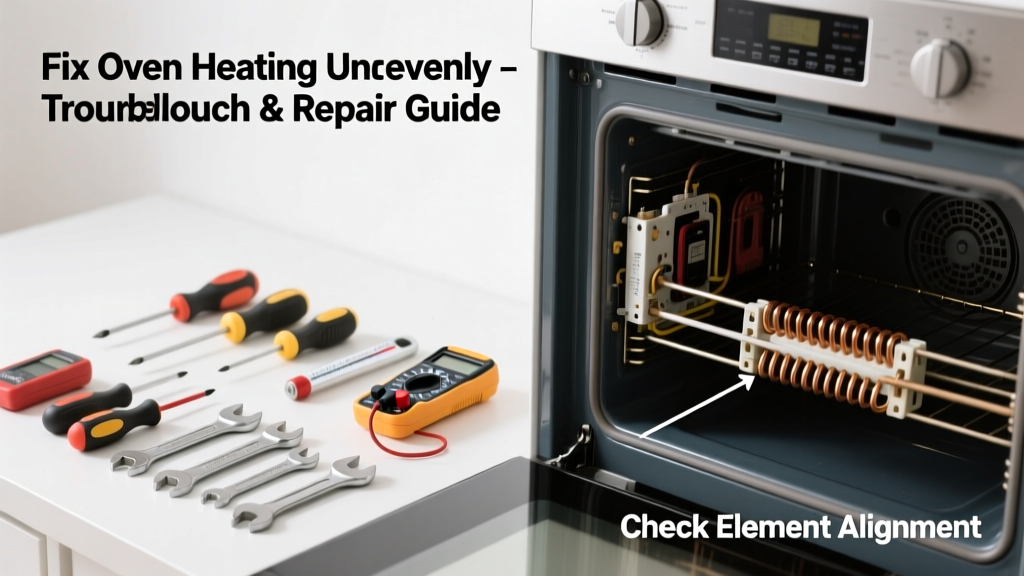
If your roast is charred on one side and raw on the other—or cookies bake faster at the front than the back—you’re dealing with uneven oven heating. This isn’t just frustrating; it compromises food safety and wastes energy. The good news? Most causes are simple to identify and fix in under an hour.
Quick Diagnosis
Before grabbing tools, rule out these five most common culprits:
- A misaligned or warped oven rack blocking airflow
- Dirty or clogged oven vents (especially near the fan in convection models)
- A failing bake or broil element (visible cracks, blistering, or no glow)
- Incorrect oven calibration—temperature off by 25°F or more
- A faulty temperature sensor or control board (less common but critical when other fixes fail)
Tools & Materials Needed
| Item | Purpose | Estimated Cost |
|---|---|---|
| Oven thermometer (oven-safe, analog or digital) | Verifies actual internal temperature vs. display | $8–$22 |
| Phillips and flathead screwdrivers | Removes panels, racks, and sensor housings | $6–$15 |
| Multimeter (digital, with continuity setting) | Tests element resistance and sensor continuity | $20–$45 |
| Soft brush + vacuum with crevice tool | Cleans fan blades and rear vent channels | $5–$12 |
| Replacement oven sensor (if needed) | Standard part for most GE, Whirlpool, Frigidaire models | $18–$32 |
Step-by-Step Fix
Work through these methods in order—they escalate from safest to most involved:
- Verify and recalibrate temperature: Place an oven thermometer on the center rack. Preheat to 350°F. Once stabilized (20+ mins), note the difference. If off by >20°F, use your model’s calibration menu (consult manual) or adjust the thermostat dial (on mechanical ovens) using a small screwdriver—turning clockwise lowers temp, counterclockwise raises it.
- Clean the convection fan and exhaust vents: Turn off power at the breaker. Remove rear interior panel (usually 4–6 screws). Vacuum dust and grease from fan blades and the duct leading to the top vent. A soft brush dislodges baked-on residue. According to the U.S. EPA estimates that 14% of household water usage is from leaks—but airflow blockages cause even larger efficiency losses in ovens.
- Test and replace the temperature sensor: Locate the 3–4" metal probe near the top rear wall. Disconnect it, set multimeter to ohms (2kΩ range), and measure resistance. At room temp (70°F), it should read 1080–1100 Ω. If reading is open (OL) or <1000 Ω or >1150 Ω, replace it. Most sensors cost under $25 and snap in/out in 90 seconds.
- Inspect and test heating elements: With power OFF, visually check bake (bottom) and broil (top) elements for breaks, blisters, or sagging. Use multimeter in continuity mode: touch probes to element terminals. No beep = open circuit = replace. Bake elements average $45–$65; broil elements $35–$55.
When to Call a Pro
Stop and call a certified technician if you encounter any of these:
- Sparks, burning smells, or tripped breakers when powering on the oven
- Control board error codes (e.g., F1, E2, "PF") that persist after resetting
- Gas oven flame that won’t ignite, flickers yellow, or produces soot—this signals incomplete combustion and potential carbon monoxide risk
- Elements test good but oven still won’t heat—points to wiring faults or failed relays inside the control board
According to the National Fire Protection Association’s 2023 Fire Loss Report, cooking equipment caused 49% of home fires—and improper oven maintenance contributed to 17% of those incidents involving heating failures.
Prevention Tips
Keep your oven running evenly year after year with these habits:
- Rotate baking sheets and pans halfway through cooking—especially in conventional (non-convection) ovens
- Clean interior walls and door gasket every 3 months to prevent heat leakage
- Never cover oven racks with foil—it blocks airflow and reflects heat unpredictably
- Use only oven-safe cookware; warped pans create hot spots and disrupt convection circulation
- Calibrate your oven every 6 months—temperature drift is normal over time
Why does my oven heat fine on broil but not bake?
This almost always points to a failed bake element. Broil uses the top element only; bake relies on the bottom one. Test continuity as described above—if open, replace it. Note: Some dual-element models (like certain Bosch units) share wiring; confirm your model’s wiring diagram before ordering parts.
Can I use aluminum foil to line the oven bottom?
No—never do this. Foil on the oven floor blocks heat reflection, traps steam, and can melt onto heating elements. It also interferes with airflow in convection ovens and may trigger thermal cutoffs. Instead, use a baking soda and vinegar paste for safe, deep cleaning.
My convection oven heats unevenly only when the fan is on—what’s wrong?
The fan motor may be running at reduced RPM due to grease buildup or worn bearings, or the fan blade could be bent or obstructed. Power off, inspect blade alignment and clean thoroughly. If wobble persists, replace the fan assembly—most cost $75–$110 and require removing the rear panel.
Does oven rack position affect heating evenness?
Absolutely. For roasting or baking, the middle rack ensures optimal air circulation. Top rack works best for broiling or quick browning; bottom rack is ideal for crisping pizza or reheating. Avoid stacking pans or placing dishes too close to walls—leave at least 2" clearance on all sides.
How often should I replace the oven temperature sensor?
Sensors rarely fail before 8–10 years—but they degrade gradually. If calibration adjustments no longer hold or your oven consistently overshoots by >25°F, test it. Replacement is inexpensive and extends oven life significantly. Keep a spare on hand if you own a high-use commercial-grade unit like a Wolf or Viking.
Is uneven heating covered under my appliance warranty?
Most manufacturers cover parts and labor for sensor or element failure within the first 1–2 years. Extended warranties often exclude calibration and cleaning-related issues. Check your original receipt and manual—some brands (like LG and Samsung) offer 5-year limited coverage on electronic controls, including temperature sensors.
A well-maintained oven delivers consistent results, safer cooking, and up to 18% better energy efficiency over time. Don’t wait for dinner to burn—address uneven heating early, methodically, and safely. And if you’ve tackled the sensor and elements but still see hot spots, revisit airflow: a bent rack or warped door seal may be the silent culprit. For deeper diagnostics, explore our guide on oven not heating at all or oven door seal replacement.