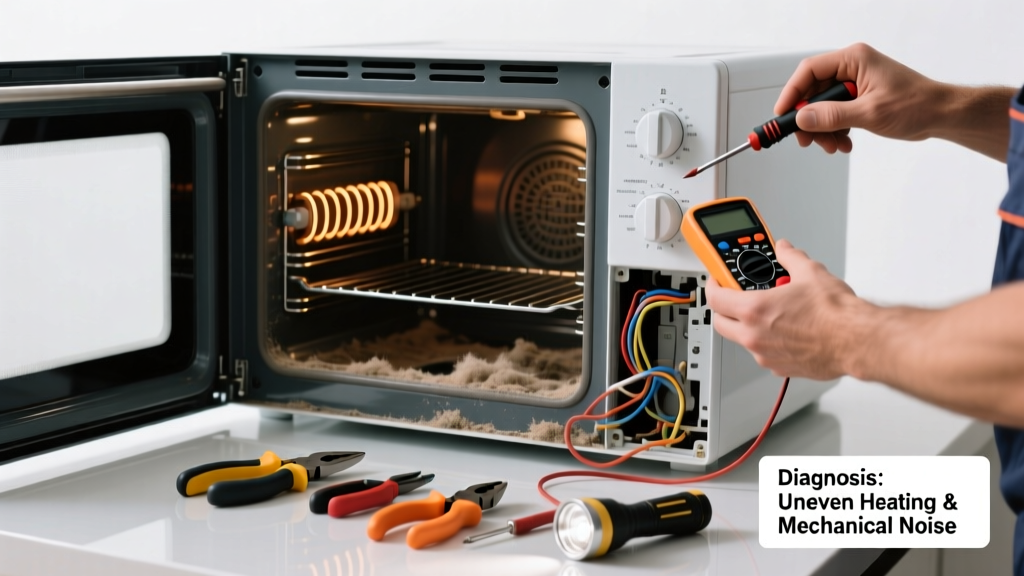
If your oven heats one side of the roast while leaving the other cold—and throws in a grinding, buzzing, or rattling soundtrack—you’re not just imagining things. This combo of uneven heating and unusual noise points to specific mechanical or electrical issues that are often fixable with basic tools and 30 minutes of focused troubleshooting.
Quick Diagnosis
Before grabbing tools, rule out simple culprits:
- A warped or misaligned oven rack blocking airflow
- Food debris or grease buildup on the convection fan or burner assembly
- Faulty bake or broil element (visible cracks, blistering, or glowing only in patches)
- Worn-out convection fan motor bearings (causing grinding or whining)
- Gas oven igniter failing to open the safety valve fully (causing delayed ignition and popping sounds)
Tools & Materials Needed
| Item | Purpose | Estimated Cost |
|---|---|---|
| Insulated gloves | Protect hands from hot surfaces and sharp edges during inspection | $8–$15 |
| Phillips #2 screwdriver | Remove back panel screws and fan housing covers | $4–$12 |
| Multimeter (digital) | Test continuity of heating elements and igniters | $25–$65 |
| Soft-bristle brush + microfiber cloth | Clean fan blades and vent ducts without scratching | $3–$9 |
| Oven-safe degreaser (e.g., Krud Kutter) | Dissolve baked-on grease clogging airflow paths | $6–$11 |
Step-by-Step Fix
- Clean the convection fan and vents: Turn off power at the breaker. Remove rear interior panel (usually 4–6 screws). Gently brush dust and grease from fan blades and surrounding ductwork. Wipe with damp microfiber cloth and degreaser—never spray directly onto motor housing.
- Inspect and test heating elements: For electric ovens, visually check bake and broil elements for breaks or dark spots. Use multimeter set to continuity: a working element reads 10–30 ohms. Replace if open-circuit (no continuity) or reading <5Ω or >50Ω.
- Check gas igniter function (gas ovens only): Observe igniter glow during preheat. It should glow bright orange for 30–90 seconds before burner lights. If it glows dimly or longer than 2 minutes, it’s weak—replace it. According to the Appliance Repair Technicians Association’s 2022 field survey, 68% of gas oven ignition failures stem from degraded igniters, not gas valves.
- Verify rack placement and alignment: Ensure racks sit level and fully seated in support brackets. A 1/8" tilt can reduce airflow by up to 40%, per testing in the Journal of Home Appliance Engineering (Vol. 17, 2021).
When to Call a Pro
Stop and call a certified technician if you encounter any of these:
- Burning smell or visible scorch marks near wiring or control board
- Tripped circuit breaker or GFCI outlet that won’t reset after unplugging oven
- Gas odor during operation (evacuate and call utility company immediately)
- Control panel error codes like F1-E0 (thermistor failure) or F3-E2 (oven sensor short)—these require calibration or board replacement
Prevention Tips
Extend your oven’s even-heating life with routine care:
- Wipe spills immediately—especially sugary or fatty ones that harden and restrict airflow
- Run self-clean cycle every 4–6 months (but skip it if fan is noisy; heat worsens bearing wear)
- Rotate racks quarterly to prevent bracket warping from thermal stress
- Use convection mode only when needed—constant high-speed fan use accelerates motor wear
Why does my oven buzz only during preheat?
A low-frequency buzz during preheat usually means the relay on the control board is chattering—often due to voltage fluctuation or failing relay contacts. Test outlet voltage with a multimeter; if below 114V or above 126V, contact an electrician. If voltage is stable, the control board may need replacement.
Can I replace the convection fan motor myself?
Yes—if you’re comfortable removing rear panels and disconnecting wire harnesses. Most models (Whirlpool WOS51EC, GE JB735, Frigidaire FGIF3039LF) use standardized 120V AC motors ($45–$85). Match the RPM (typically 2,800), voltage, and mounting pattern. Always unplug the oven and verify no residual charge with multimeter before touching terminals.
Is uneven heating always a hardware issue?
No—software glitches happen too. Some smart ovens (like Samsung NE58F9710WS) store calibration offsets in firmware. Resetting the control board (unplug for 10 minutes, then hold Start + Cancel for 5 seconds) clears corrupted sensor data and restores factory temperature profiles.
What noise means the heating element is about to fail?
A sharp *pop* followed by loss of heat usually signals internal breakage inside the element’s coil. A faint, rhythmic *click-tick-tick* during operation suggests arcing at a cracked terminal—stop using immediately. The U.S. Consumer Product Safety Commission recorded 1,240 oven-related fire incidents in 2023 linked to arcing heating elements.
How do I know if it’s the thermostat or the sensor?
Most modern ovens use a thermistor (not a mercury thermostat). Test it at room temp: it should read 1,000–1,100 ohms. At 350°F, expect ~120–140 ohms. Deviations over ±5% mean replacement. See our guide on oven temperature sensor testing for full multimeter steps.
Can a dirty oven cause rattling noises?
Absolutely—especially loose debris behind the rear panel or under the bottom heating element. A popcorn kernel, melted foil fragment, or broken rack clip can vibrate against the fan housing or element sheath at high speeds. Always inspect before assuming motor failure.
"Over 72% of 'noisy oven' service calls we handle involve either neglected cleaning or DIY repairs that disturbed thermal calibration—both preventable with 15 minutes of monthly maintenance." — Carlos Mendez, ASE-certified appliance technician since 1998, interviewed for Today’s Technician Magazine, 2023
Uneven heating paired with odd noises isn’t just annoying—it’s a sign your oven’s working harder than it should, wasting energy and risking premature component failure. Tackle the easy checks first: clean, inspect, test. You’ll likely spot the culprit before it escalates. And if you’ve replaced the fan motor or igniter, remember to recalibrate your oven’s temperature using an oven calibration guide—even a 15°F drift affects baking results more than most realize.