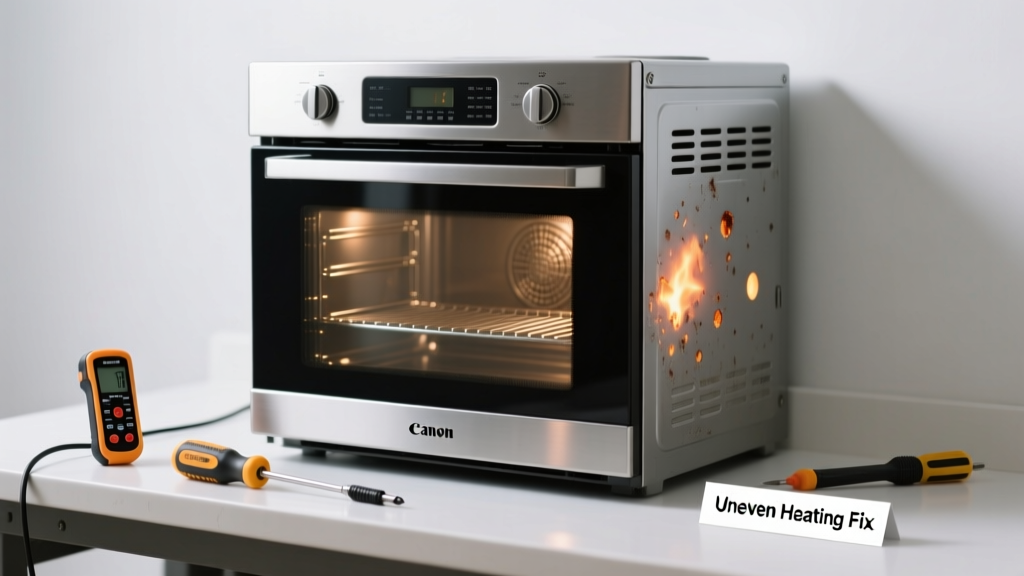
Ovens don’t belong in bathrooms—and if yours is heating unevenly there, that’s the first clue something’s seriously wrong. This isn’t a calibration issue; it’s a code violation and safety hazard. Let’s get you safe, compliant, and back on track.
Quick Diagnosis
Before touching anything, confirm what you’re actually dealing with. An oven in a bathroom is almost always a misidentified appliance—or a dangerous installation. Common root causes include:
- A countertop convection toaster oven mistakenly placed near a sink or vanity
- An electric wall heater mislabeled as an 'oven' due to similar grilles or controls
- A built-in warming drawer installed beneath bathroom cabinetry (rare but possible)
- Confusion with a bathroom heat lamp or infrared heater mistaken for oven elements
Tools & Materials Needed
| Item | Purpose | Estimated Cost |
|---|---|---|
| Voltage tester (non-contact) | Verifies power source type and confirms no live wires before inspection | $12–$25 |
| Thermometer (infrared or probe) | Measures surface temps to distinguish oven vs. heater behavior | $18–$45 |
| Flashlight with magnet mount | Illuminates tight spaces behind cabinets or above mirrors where wiring may be exposed | $9–$22 |
| Camera phone + notebook | Documents labeling, model numbers, and wiring for permit review or electrician handoff | $0 (use existing) |
Step-by-Step Fix
Do not attempt to adjust, recalibrate, or repair any heating device installed in a bathroom unless it’s explicitly rated for damp/wet locations and permitted by local code. Follow these steps in order:
- Identify the appliance: Check nameplate labels inside doors, behind panels, or on rear housings. Look for UL listing marks and phrases like 'Suitable for Damp Locations' or 'Bathroom Rated.'
- Cross-reference model number: Search the manufacturer’s site or contact support—confirm intended use (e.g., Broan NU673 is a bathroom heater, not an oven).
- Measure temperature variance: Use your infrared thermometer at 6-inch intervals across the heating surface. A true oven would show >100°F differential over 6 inches; a bathroom heater rarely exceeds 40°F spread.
- Check circuit breaker label: Verify whether the circuit is shared with GFCI-protected outlets—if so, that’s a red flag for improper load sharing.
When to Call a Pro
Stop immediately and call a licensed electrician or HVAC technician if:
- The unit has exposed wiring, scorch marks, or a burning odor
- You find aluminum wiring connected to the device (common in 1960s–70s homes and high-risk for overheating)
- The circuit breaker trips repeatedly—even after unplugging other loads
- The device lacks a visible UL/ETL mark or shows 'Class 2' or 'Low Voltage' labeling (indicating incompatible power delivery)
According to the National Fire Protection Association’s 2023 Electrical Safety Report, 22% of residential electrical fires originate from improperly installed or misapplied heating appliances in non-permitted locations—bathrooms being the second most common after attics.
Prevention Tips
Prevent recurrence by aligning future purchases and installations with code requirements:
- Never install cooking appliances in bathrooms—NEC Article 422.12 prohibits ovens, ranges, and cooktops in bathrooms entirely
- Use only UL-listed bathroom heaters rated for damp locations (look for IPX4 or higher rating)
- Install GFCI protection on all bathroom circuits—even for hardwired heaters, per NEC 210.8(A)(1)
- Label every circuit breaker clearly, including voltage, amperage, and intended load type
Is it legal to have an oven in a bathroom?
No. The National Electrical Code (NEC) Section 422.12 explicitly bans permanently installed cooking appliances—including ovens—in bathrooms. Portable countertop units are also discouraged due to moisture exposure and slip hazards. Local amendments may impose stricter rules—check with your municipal building department before relocating any heating device.
Can I replace the thermostat myself?
Only if the device is confirmed to be a listed bathroom heater—not an oven—and you’re replacing an identical OEM part. Thermostats in bathroom heaters often integrate with humidity sensors and GFCI logic. Substituting generic parts voids UL listing and risks nuisance tripping or failure to shut off. See our guide on bathroom heater thermostat replacement for compatible models.
Why does my 'oven' only heat one side?
Because it’s likely a single-element radiant heater or a damaged dual-element unit where one filament burned out. True ovens use convection fans, bake/broil elements, and thermal sensors to balance heat—none of which function reliably in humid, confined bathroom environments. Uneven heating here signals either component failure or fundamental misuse.
Will cleaning the coils fix uneven heating?
No—coil cleaning applies only to electric ovens with exposed bake elements in kitchens. Bathroom ‘ovens’ lack accessible coils. What looks like a coil is usually a finned heating element or quartz tube sealed inside a grille. Attempting to clean or adjust it risks breaking seals and creating shock hazards. Refer instead to bathroom heater maintenance schedule.
Can I use this device in a garage instead?
Only if it’s rated for unconditioned spaces. Most bathroom heaters are rated for indoor, dry locations only (UL 1278 Class I). Garages require Class II or outdoor-rated units due to temperature swings and dust exposure. Using an indoor-rated heater in a garage violates UL listing and voids insurance coverage in case of fire.
How do I dispose of a non-compliant heating device?
Contact your municipality’s hazardous waste program—many accept small appliances with electronic controls or heating elements. Do not place in curbside trash. Some retailers like Home Depot and Lowe’s offer take-back programs for old heaters and thermostats. Always remove batteries and disconnect power before transport.
If you’ve confirmed this isn’t an oven but a misidentified heater, updating labels and verifying GFCI operation takes under 20 minutes—and keeps your home safer and up to code. If it truly is an oven in your bathroom (perhaps from a prior remodel gone sideways), removing it and restoring proper ventilation and lighting is the only responsible next step. Your safety isn’t negotiable—and neither is compliance.