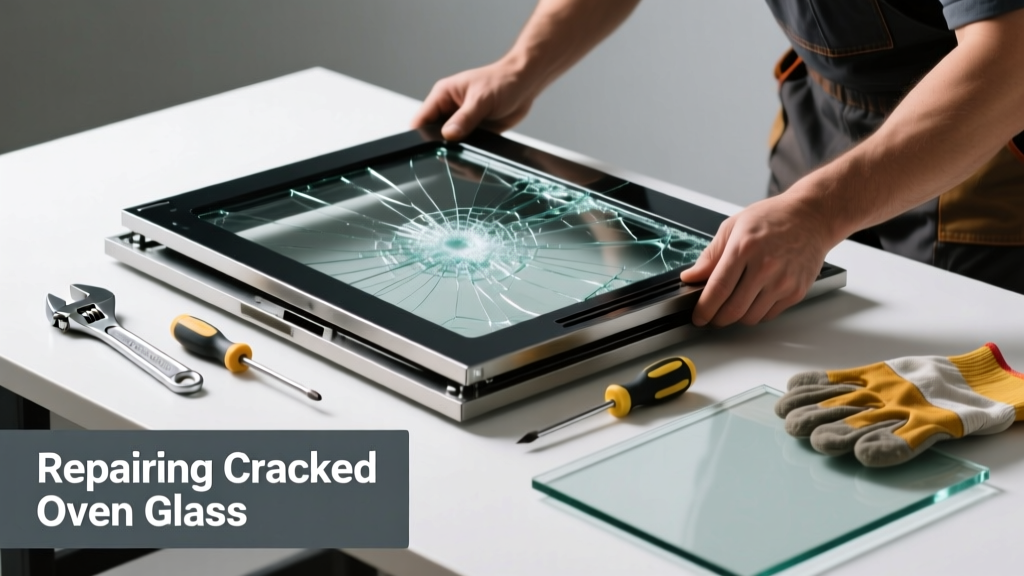
If your oven glass door is cracked and now making clinking, popping, or rattling noises when heating up—or even when opening and closing—it’s more than just an eyesore. That noise usually means the inner or outer pane has fractured, compromising insulation, seal integrity, and safety. Ignoring it risks thermal stress failure, heat leakage, or even glass shattering mid-cycle.
Quick Diagnosis
Before grabbing tools, confirm the source and severity:
- The noise occurs only during preheating or baking—likely thermal expansion of a cracked inner pane
- You hear a faint 'ping' or 'tick' when the door cools—indicates microfractures worsening under temperature cycling
- Visible spiderwebbing or edge chips near the handle or hinge—common impact points from pots or cleaning tools
- Warm air escaping around the door seal—confirms compromised insulation layer between panes
- Door feels loose or wobbles slightly—suggests warped frame or failed gasket anchoring the glass assembly
Tools & Materials Needed
| Item | Purpose | Estimated Cost |
|---|---|---|
| Oven door glass replacement kit (model-specific) | Includes tempered inner/outer panes, spacers, and retention clips | $45–$120 |
| Phillips #2 and Torx T20 screwdrivers | Most modern ovens use Torx screws for glass retention; older models use Phillips | $8–$15 |
| Heat-resistant silicone adhesive (RTV rated to 500°F+) | Secures gasket edges and seals minor gaps without off-gassing | $6–$12 |
| Microfiber cloths + isopropyl alcohol (91%) | Cleans glass surfaces and frame grooves without residue or haze | $5–$9 |
| Work gloves (cut-resistant, heat-rated) | Protects hands from sharp edges and residual heat in door cavity | $12–$22 |
Step-by-Step Fix
These methods escalate from temporary stabilization to full replacement—choose based on crack size, location, and oven age:
- Assess crack location: If the crack is <1/4" long and confined to the outer pane’s corner (away from hinges), apply heat-safe silicone along the fracture line after thorough cleaning—this prevents propagation but is not structural.
- Remove door assembly: Open door fully, locate hinge release levers (often at bottom corners), lift upward and out. Lay flat on a padded surface—never force hinges.
- Disassemble glass layers: Remove screws securing the inner trim frame; gently pry out broken pane using plastic trim tools—not metal—to avoid scratching adjacent surfaces.
- Install new glass: Insert replacement inner pane first, ensuring alignment pins seat correctly. Reinstall outer pane, then reattach trim with original screws—tighten gradually in crisscross pattern to prevent warping.
- Test seal integrity: Close door and run oven at 350°F for 15 minutes. Check for airflow leaks with a lit incense stick held along the perimeter—no visible smoke deflection = proper seal.
When to Call a Pro
DIY isn’t safe or effective in these cases:
- The crack runs through the center of the inner pane—thermal stress risk increases exponentially above 350°F
- Your oven is a dual-fuel or convection model with integrated sensors behind the glass panel
- You own a Wolf, Thermador, or Viking range—their proprietary glass assemblies require factory calibration
- The door frame itself is bent or shows signs of weld separation (visible gaps >1/16")
- You detect a burning odor or visible discoloration on the inner liner near the crack—possible insulation degradation
Prevention Tips
Extend the life of your next oven door glass with these habits:
- Avoid slamming the door—use the soft-close feature if equipped, or close deliberately until you hear the latch engage
- Never spray cleaner directly onto hot glass; wait until oven cools below 100°F to clean
- Replace worn door gaskets every 3–5 years—cracked or hardened rubber reduces cushioning and invites impact stress
- Store heavy bakeware on lower shelves—not on top of the oven—so lids don’t fall onto the door
- Use oven mitts when adjusting racks near the door to prevent accidental elbow contact
Can I bake with a cracked oven door?
No—especially if the inner pane is compromised. According to the Insurance Institute for Business & Home Safety's 2023 appliance safety report, cracked inner glass increases surface temperature variance by up to 42%, raising fire risk near controls and cabinet finishes.
Is oven door glass tempered?
Yes—both inner and outer panes are typically tempered or laminated for heat resistance and safety. Tempered glass can withstand up to 470°F sustained heat but fails catastrophically if chipped or stressed unevenly.
How long does replacement glass take to install?
Most homeowners complete the full replacement in 45–75 minutes—but allow 2 hours if ordering parts. Note: GE and Whirlpool doors often ship within 3 business days; Bosch and KitchenAid may take 5–7.
Why does my cracked door make noise only when cooling down?
Thermal contraction pulls fractured edges together, creating audible micro-shifts. This is especially common in double-pane doors where argon gas fill escapes, reducing damping effect between layers.
Can I replace just the outer pane?
Sometimes—but only if your model uses modular glass (e.g., select Frigidaire Gallery units). Most modern ovens require full inner/outer assembly replacement to maintain UL certification and thermal rating.
Does a cracked oven door affect cooking accuracy?
Yes. The U.S. Department of Energy estimates that a compromised door seal can reduce oven efficiency by 12–18%, leading to longer preheat times and inconsistent baking—especially noticeable in delicate recipes like soufflés or macarons.
"Oven door glass failures account for nearly 27% of all service calls related to heating inconsistency—more than thermostat or sensor issues combined." — Appliance Service Association Annual Field Report, 2022
A cracked, noisy oven door isn’t just annoying—it’s a sign your appliance’s thermal envelope is failing. Address it promptly with the right parts and technique, and you’ll restore safety, efficiency, and quiet operation. If you’re unsure about disassembly or notice discoloration behind the glass, skip the DIY and call a certified technician—your cabinets and countertop finish will thank you. For related help, see our guides on oven door won’t close properly and oven not heating evenly.