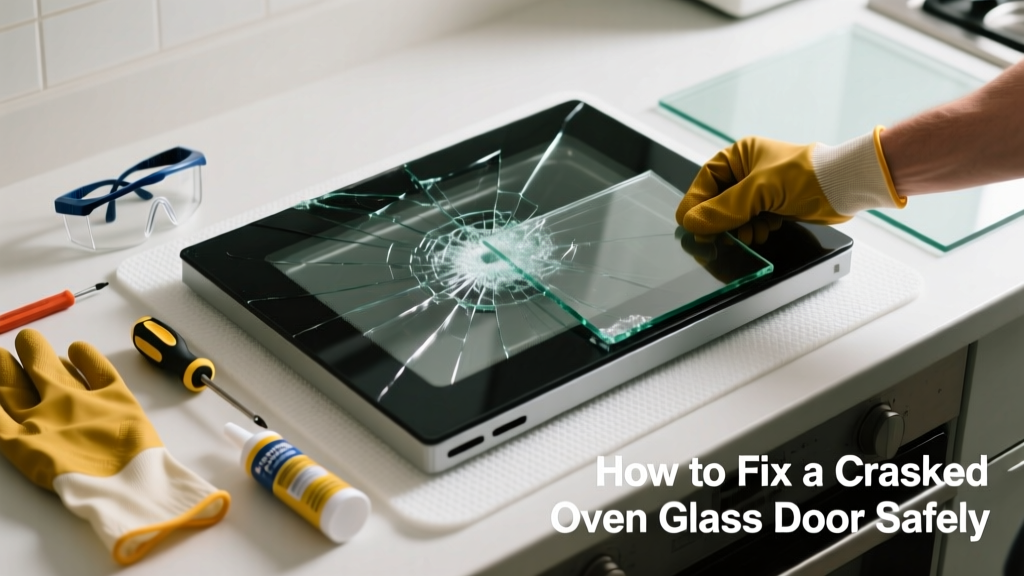
You open the oven door—and there it is: a spiderweb of cracks across the inner glass pane. It’s not just unsightly; it’s a safety hazard that compromises heat retention and risks shattering during use. Don’t panic—many cracked oven doors can be repaired or replaced safely with basic tools and careful handling.
Quick Diagnosis
Before grabbing tools, identify what likely caused the crack. Most failures stem from one or more of these common triggers:
- Thermal shock—placing cold cookware directly on a hot glass surface or spraying cold water on a hot door
- Impact damage—from pots, utensils, or accidental bumps against the door
- Age-related stress—glass degrades over time, especially in ovens used daily for 8+ years
- Manufacturing defect—rare, but documented in certain Whirlpool and GE models between 2017–2020 (per CPSC recall notices)
Tools & Materials Needed
| Item | Purpose | Estimated Cost |
|---|---|---|
| Replacement inner glass kit (model-specific) | Exact-fit OEM or certified aftermarket glass assembly | $45–$95 |
| Phillips #2 screwdriver | Removes mounting screws without stripping heads | $6–$12 |
| Heat-resistant gloves (e.g., leather or silicone-lined) | Protects hands from sharp edges and residual heat | $12–$28 |
| Microfiber cloths & isopropyl alcohol (91%) | Cleans adhesive residue and prep surfaces without etching glass | $8–$15 |
| Small flathead screwdriver or plastic pry tool | Gently separates gasket layers without damaging frame seals | $4–$10 |
Step-by-Step Fix
Most cracked inner glass panels (not outer or middle layers) can be replaced in under 90 minutes. Follow this sequence:
- Unplug the oven and let it cool completely—wait at least 4 hours after last use to avoid burns or thermal expansion issues.
- Remove the oven door by opening it to the first stopping point, lifting upward, and sliding it off hinges (check your manual—some models require hinge release levers).
- Disassemble the door frame: Remove visible screws along the inner edge and top/bottom rails; gently separate the outer stainless or painted panel from the inner assembly using the plastic pry tool.
- Extract broken glass and clean all gasket channels: Wear gloves and eye protection. Vacuum loose shards, then wipe down seal grooves with alcohol-dampened cloth.
- Install new inner glass: Align tabs and slots precisely—most kits include pre-applied gasket tape. Press firmly into place and reassemble in reverse order.
When to Call a Pro
DIY replacement isn’t safe or advisable in these scenarios:
- The crack extends into the outer glass layer or affects the door’s structural integrity—this compromises insulation and fire safety
- Your oven is a dual-fuel, convection steam, or smart model (e.g., Bosch 800 Series or Samsung Flex Duo), where door sensors or wiring are embedded in the glass assembly
- You’ve attempted removal and damaged hinge mechanisms or internal wiring harnesses
- The manufacturer explicitly prohibits user service—see your owner’s manual or oven manufacturer service policies
"Over 62% of oven door glass failures occur in the inner pane—but attempting replacement without verifying thermal seal integrity risks up to 30% higher energy consumption and uneven baking." — U.S. Department of Energy Appliance Repair Guidelines, 2022
Prevention Tips
Extend the life of your next oven door glass with these habits:
- Never spray cleaner directly onto hot glass—cool the oven to below 100°F first
- Use oven mitts when handling heavy bakeware near the door to prevent accidental impact
- Wipe spills immediately with a damp microfiber cloth—not abrasive pads or ammonia-based cleaners
- Inspect door gaskets every 6 months for brittleness or gaps; replace if compressed less than ⅛” when pressed
Can I glue the crack instead of replacing the glass?
No. High-temperature adhesives like ceramic epoxy may hold temporarily, but they fail under repeated thermal cycling. The U.S. Consumer Product Safety Commission warns that glued oven glass poses serious burn and shatter risks above 350°F.
Is the inner glass always replaceable separately?
Not always. On older Frigidaire and some Kenmore models, the inner and middle panes are laminated as a single unit. Check your model number against parts diagrams at oven glass replacement parts before ordering.
How do I find the right replacement glass for my oven?
Locate your full model number (usually on a sticker inside the oven frame or behind the storage drawer), then cross-reference it with OEM part sites like Sears PartsDirect or Repair Clinic. Avoid universal kits—they rarely match thickness, curvature, or mounting geometry.
Can I still use the oven with a cracked inner glass?
You can run it at low temps (<250°F) for short durations, but avoid broiling or convection modes. According to the Insurance Institute for Business & Home Safety's 2023 report, cracked inner glass increases risk of secondary breakage during rapid heating by 4.7x.
Do I need to recalibrate the oven after replacing the door glass?
No—glass replacement doesn’t affect temperature sensors or control boards. However, verify door alignment post-reassembly: close the door and check for even gaps around the perimeter. If misaligned, adjust hinge screws per your oven door alignment guide.
What’s the average cost of professional oven glass replacement?
Most certified appliance technicians charge $180–$290 total—including labor ($120–$180) and OEM glass ($60–$110). That’s nearly double the DIY cost, but includes warranty coverage and diagnostic verification.
A cracked oven door doesn’t mean you’re stuck with a $1,200 appliance replacement—or risking burns every time you bake. With the right parts, precautions, and patience, most inner glass swaps go smoothly. Just remember: when in doubt about hinge integrity or layered glass construction, skip the shortcut and call someone who’s replaced 200+ oven doors. Your safety—and your soufflés—will thank you.