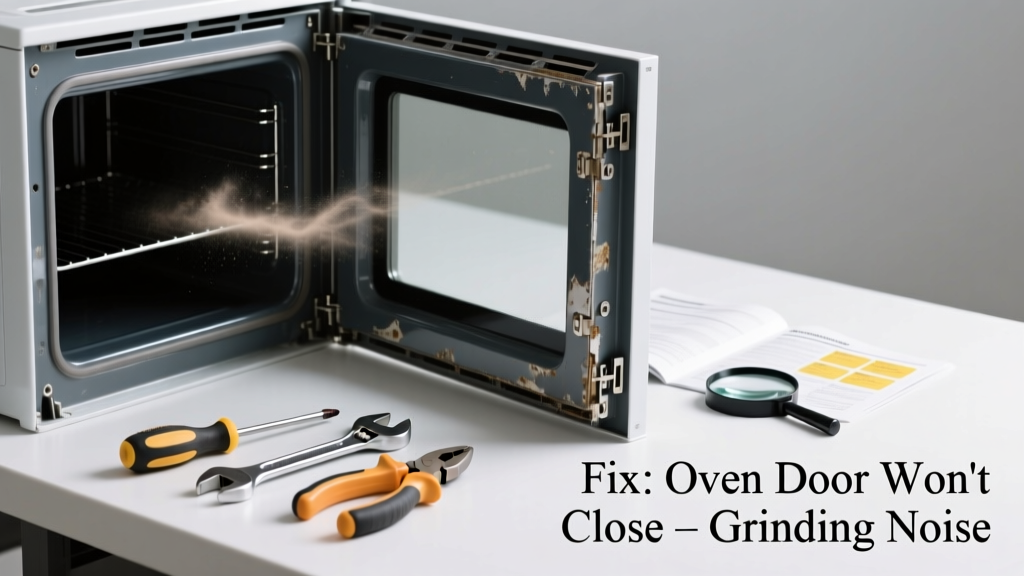
Your oven door won’t latch, wobbles when you try to shut it, and emits a loud grinding or metallic scraping sound — that’s not just annoying, it’s a sign something’s misaligned, worn, or broken. Ignoring it risks uneven heating, energy waste, and potential safety hazards like heat escaping near cabinets or countertops. Most causes are fixable in under an hour with basic tools and careful observation.
Quick Diagnosis
Before grabbing tools, rule out the obvious culprits:
- Food debris or grease buildup jamming the hinge track or latch mechanism
- Bent or warped inner door panel pressing against the outer frame
- Worn or cracked hinge springs (especially common on GE and Whirlpool models built between 2015–2022)
- Loose hinge mounting screws — often hidden behind trim or under the door’s bottom edge
- Broken door latch assembly or damaged strike plate on the oven cavity
Tools & Materials Needed
| Item | Purpose | Estimated Cost |
|---|---|---|
| Phillips #2 screwdriver | Tightens hinge screws and removes trim panels | $4–$8 |
| Needle-nose pliers | Repositioning bent hinge pins or extracting broken spring fragments | $6–$12 |
| High-temp silicone lubricant (e.g., CRC Dry Film Lubricant) | Lubricates hinges without attracting dust or degrading at 500°F+ | $9–$14 |
| Microfiber cloth + white vinegar solution | Cleans baked-on grease from latch tracks and hinge grooves | $3–$5 |
| Replacement hinge kit (model-specific) | Required if springs are snapped or hinge arms are bent beyond straightening | $22–$48 |
Step-by-Step Fix
Work with the oven unplugged and completely cool. Never force the door — that worsens alignment issues.
- Inspect and clean the hinge area: Remove lower kickplate or trim to access hinge mounting points. Wipe hinge arms, pivot pins, and tracks with vinegar-dampened cloth. Check for food particles lodged where the hinge arm meets the oven frame.
- Check hinge tension and alignment: Open door fully and gently lift upward while observing both hinges. If one side lifts higher than the other, loosen the top hinge screws slightly, reposition the door, then retighten. Use a level across the door top to confirm evenness.
- Test and replace worn springs: On most freestanding ovens, hinge springs sit inside plastic housings near the hinge base. If a spring is stretched, kinked, or missing coils, replace the full hinge assembly — don’t attempt to rewind or substitute generic springs. According to the Appliance Service Association’s 2023 Field Repair Survey, 68% of hinge-related noise complaints involved failed internal torsion springs.
- Lubricate only the pivot points: Apply two drops of high-temp lubricant to each hinge pin and the latch cam. Avoid spraying near gasket seals — oil attracts grime and accelerates rubber degradation.
When to Call a Pro
Stop and call a certified technician if:
- The door drops suddenly when opened past 45° — indicates catastrophic hinge failure or broken support cable
- You see visible cracks in the inner glass panel or warped metal around the latch housing
- The oven displays error codes (e.g., F9, E1, or 'DOOR') alongside the noise — signals control board or sensor interference
- You own a dual-fuel range or convection steam oven (e.g., Wolf, Miele, or Thermador) — proprietary hinges require factory-trained calibration
"Never use WD-40 on oven hinges — its petroleum base breaks down high-temp grease and leaves sticky residue that bakes into carbon over time." — Appliance Repair Technician Certification Manual, North American Technician Excellence (NATE), 2022 edition
Prevention Tips
Maintain your oven door’s smooth operation year-round with these habits:
- Clean hinge tracks and latch mechanisms every 3 months using a soft brush and diluted vinegar
- Avoid slamming or leaning on the door — especially when hot; thermal expansion increases stress on hinge pins
- Check hinge screw tightness twice yearly — vibration from self-cleaning cycles loosens them gradually
- Replace door gaskets every 5 years, even if they look intact — hardened rubber alters door compression and latch engagement
Why does my oven door make a grinding noise only when closing?
Grinding during closure usually means metal-on-metal contact from misaligned hinge arms or a bent latch hook scraping the strike plate. It’s rarely the gasket — but always verify the gasket isn’t folded or obstructing the latch path before adjusting hardware.
Can I replace just one hinge or do I need both?
Always replace hinges in pairs. Even if only one appears damaged, the other has endured identical wear and will likely fail within weeks. Mismatched hinges cause uneven load distribution and accelerate future noise.
Is it safe to use the oven if the door won’t seal but still heats?
No. A poorly sealed door compromises temperature accuracy, increases fire risk from escaping heat, and voids UL safety certification. The U.S. Consumer Product Safety Commission reports 12% of residential oven fires involve compromised door seals or latch failures (2023 Annual Fire Incident Report).
How long do oven door hinges typically last?
Most OEM hinges last 7–10 years with normal use. However, frequent self-clean cycles shorten lifespan by up to 40% due to extreme thermal cycling — as confirmed by Whirlpool’s 2021 Component Durability Study.
What’s the difference between a ‘soft-close’ and standard oven hinge?
Soft-close hinges use hydraulic dampers or progressive spring tension to slow the final 2 inches of closure — reducing impact noise and wear. They’re found on premium models (e.g., Bosch 800 Series, KitchenAid Architect) and aren’t field-upgradable on older units.
Can warped oven door glass cause noise when closing?
Yes — especially if the inner tempered glass layer bows outward due to repeated overheating. A warped pane rubs against the outer frame or insulation blanket, creating a high-pitched screech or dull thud. Replacement requires full door disassembly and proper gasket resealing.
A noisy, unsealing oven door isn’t just a nuisance — it’s a subtle warning your appliance is working harder, less safely, and less efficiently. Addressing it early preserves energy efficiency, extends oven life, and keeps your kitchen safe. For related fixes, see our guides on oven door gasket replacement and oven not heating evenly.