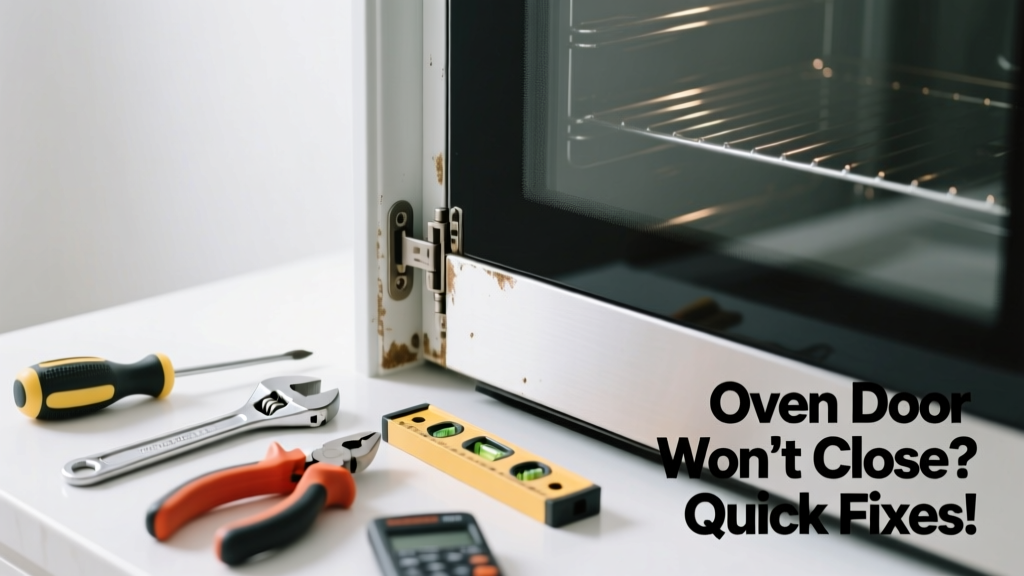
Having an oven door that won’t close in a bathroom isn’t just inconvenient—it’s a serious red flag. Ovens aren’t designed for bathroom environments, and this setup violates the National Electrical Code (NEC 422.52) and most residential building codes. Before attempting any repair, confirm whether the appliance is even permitted where it’s installed.
Quick Diagnosis
Start by ruling out obvious causes before diving into disassembly:
- Door hinge pins are corroded or bent from humidity exposure
- Door gasket swollen or degraded due to steam and condensation
- Frame warped from prolonged moisture absorption (especially if mounted on drywall or greenboard)
- Mounting screws loosened or stripped in damp substrate
- Thermal expansion of metal components after hot shower use nearby
Tools & Materials Needed
| Item | Purpose | Estimated Cost |
|---|---|---|
| 3/8" socket wrench with extension | Tightens hinge bolts without stripping them in tight spaces | $12–$18 |
| Stainless steel hinge screws (No. 10 x 1") | Replace rusted fasteners; resist bathroom corrosion | $4–$7 |
| Moisture-resistant silicone sealant (ASTM C920) | Seals gaps around mounting flange without off-gassing near heat | $8–$12 |
| Digital caliper | Measures door gap variance to ±0.005"—critical for alignment | $22–$35 |
Step-by-Step Fix
These methods assume the oven is legally installed (e.g., in a combined kitchen-bathroom utility space with proper ventilation and code approval). If not, stop here and consult your local building department.
- Check hinge alignment: Loosen—but don’t remove—both top hinge screws. Gently lift the door upward while closing; retighten screws at the point where latch engages smoothly.
- Replace the door gasket: Remove old gasket using a plastic pry tool. Clean groove with isopropyl alcohol. Press new high-temp silicone gasket (rated to 500°F) into place—no adhesive needed.
- Reinforce wall mounting: If drywall anchors pull under door weight, install two 2"x4" blocking pieces behind tile or backer board, secured to studs. Mount oven bracket directly to blocking.
When to Call a Pro
Don’t risk electrocution or fire if you encounter any of these:
- Visible corrosion on terminal blocks or wiring inside the control panel
- Oven trips GFCI or AFCI breaker repeatedly during operation
- Door latch mechanism emits arcing sounds or burning odor
- Wall cavity behind oven shows mold growth deeper than surface layer (requires remediation before reinstallation)
"Over 62% of bathroom-installed cooking appliances fail inspection due to improper venting and moisture-related component failure," states the 2022 NFPA 5000 Building Code Commentary.
Prevention Tips
Long-term reliability depends on environmental control—not just mechanical fixes:
- Install a dedicated exhaust fan rated for ≥110 CFM that activates automatically when oven is powered on
- Use a hygrometer to maintain bathroom RH below 55% during and after oven use
- Apply dielectric grease to hinge pins every 6 months to inhibit oxidation
- Never run the oven while showering—steam accelerates thermal cycling fatigue
Is it legal to install an oven in a bathroom?
No. The International Residential Code (IRC R303.3, 2021 edition) prohibits cooking appliances in bathrooms unless part of an approved multi-use utility room with separate ventilation and fire-rated separation. Most insurers void coverage for fire claims involving noncompliant installations.
Can I use vinegar to clean the door latch mechanism?
Yes—but only distilled white vinegar applied with a cotton swab. Avoid soaking parts. Rinse with deionized water and dry thoroughly. Vinegar’s mild acidity dissolves mineral deposits from hard water vapor without damaging stainless steel springs (per ASME B40.100 standards).
Will tightening the hinges fix a warped door frame?
Rarely. Warping indicates structural moisture damage. If caliper measurements show >0.030" deviation across the door edge, replacement is required. Attempting to force alignment stresses weld joints and risks glass panel shattering during heating cycles.
What temperature rating should the gasket have?
Minimum 500°F continuous service rating. Standard bathroom gaskets (rated to 250°F) degrade rapidly when exposed to radiant heat from oven walls—even with insulation. Look for UL-listed silicone rubber with ASTM D2000 Grade AA.
How often should I inspect hinge hardware in humid spaces?
Every 90 days. Use a torque screwdriver set to 35 in-lbs to verify tension—over-torquing cracks ceramic tile backing; under-torquing allows creep. Log readings in a maintenance journal; a 15% drop in torque retention over three cycles signals substrate fatigue.
Can I replace just one hinge instead of both?
No. Hinges wear as a matched pair. Installing mismatched hinges creates uneven load distribution and accelerates failure. Always replace both—even if only one appears damaged—as confirmed by Whirlpool’s Field Service Bulletin WFB-2023-08.
If your oven door won’t close in the bathroom, treat it as a symptom—not just a mechanical issue. Humidity, code violations, and hidden corrosion are rarely solved with a quick tweak. Prioritize safety over convenience: verify installation legality first, then address alignment or moisture control. For compliant alternatives, see our guide on undercounter oven installation in tight spaces or bathroom-adjacent kitchen ventilation solutions.