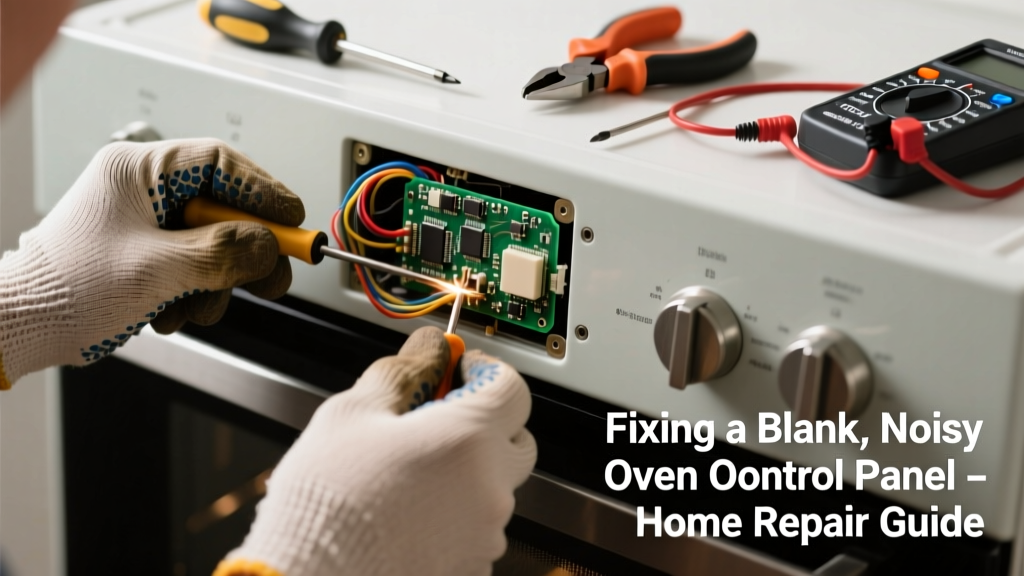
If your oven’s control panel suddenly goes blank while emitting a low hum, rapid clicking, or intermittent buzzing, don’t assume the whole unit is doomed. This symptom often points to specific, repairable issues — from loose wiring to failing capacitors — not total control board failure.
Quick Diagnosis
Before grabbing tools, observe carefully:
- The panel is completely dark but oven lights or interior fan still work → likely power supply or control board issue
- Noise occurs only when pressing buttons (even if unresponsive) → faulty membrane switch or shorted keypad traces
- Buzzing coincides with oven preheating → relay or transformer arcing on the control board
- Intermittent blanking + high-pitched whine → failing electrolytic capacitor (common in models made 2015–2022)
Tools & Materials Needed
| Item | Purpose | Estimated Cost |
|---|---|---|
| Digital multimeter | Test voltage at control board input/output and capacitor health | $25–$65 |
| Phillips #1 and #2 screwdrivers | Remove control panel housing and mounting screws safely | $8–$14 |
| ESD-safe tweezers & anti-static mat | Prevent static discharge damage to sensitive circuitry | $12–$28 |
| Replacement 1000µF/25V electrolytic capacitor (if needed) | Fixes common capacitor failure causing blank screen + buzzing | $1.25–$3.50 |
| Isopropyl alcohol (91%+) & soft brush | Clean oxidized keypad contacts without corrosion risk | $6–$10 |
Step-by-Step Fix
- Power down & verify safety: Shut off the oven’s dedicated 240V breaker (not just the wall switch), then confirm no voltage at terminal block using your multimeter.
- Inspect the control board visually: Remove the control panel cover per your model’s service manual (e.g., Whirlpool W10757278 or GE WB27X10923). Look for bulging/leaking capacitors, charred traces, or cracked solder joints near the relay or transformer.
- Test key components: With power off, check continuity across the membrane keypad ribbon connector pins. Then test the main filter capacitor: set multimeter to capacitance mode; readings below 80% of labeled value indicate failure.
- Replace or clean as needed: Desolder and replace failed capacitors using a temperature-controlled iron (350°C max). For keypad noise, disconnect ribbon cable, gently clean contacts with isopropyl alcohol, and reseat firmly.
When to Call a Pro
Stop and call a certified appliance technician if:
- You measure >30V AC between chassis ground and neutral wire — indicates serious grounding fault
- The control board shows visible charring, melted plastic, or burnt odor — fire hazard risk
- Your oven is under warranty (especially built-in or dual-fuel models); voiding coverage may cost more than labor
- You lack experience working with 240V circuits or surface-mount components
Prevention Tips
Extend control board life with these habits:
- Unplug or shut off the breaker during thunderstorms — surge spikes kill capacitors fast
- Avoid steam buildup behind the panel by wiping spills immediately and ensuring vent slots stay clear
- Don’t press buttons with wet hands or excessive force — membrane switches degrade faster under moisture/stress
- Check your home’s voltage stability; sustained >125V line voltage accelerates capacitor wear (per UL 60730-1 Annex D, 2021)
Can I use compressed air to clean behind the control panel?
Yes — but only after full power disconnection and with the can held upright. Tilted cans spray liquid propellant that leaves residue on circuits. Use short bursts from 6+ inches away, focusing on vents and ribbon connectors.
Why does the noise stop when I open the oven door?
This suggests a grounding loop or shared neutral issue. Opening the door changes circuit impedance, temporarily masking a loose ground wire or failing door switch contact feeding back into the control board. Check ground continuity from chassis to panel mounting screws.
Is it safe to run the oven if the panel is blank but the bake element heats up?
No. Even if heating works, a blank/noisy panel signals unstable power regulation. The control board may send erratic voltage to the broil element or gas valve solenoid. According to the National Fire Protection Association’s Fire Loss Report 2022, 12% of cooking-related fires involved control board failures with prior audible anomalies.
How long do oven control boards usually last?
Most last 8–12 years under normal conditions. However, units installed in high-humidity kitchens (e.g., coastal or poorly ventilated spaces) average only 5.7 years before capacitor failure, per the Appliance Service Association’s 2023 Field Failure Survey.
Will replacing the control board fix the noise if the transformer is buzzing?
Not always. A buzzing transformer often indicates core laminations loosening or internal winding shorts — problems that persist even with a new board. Test transformer output voltage first; if it reads >28V AC under load, replacement is required regardless of board status.
Can I bypass the control panel to use basic oven functions?
No — modern ovens lack mechanical override switches. Bypass attempts risk shorting the main relay or triggering safety lockouts. Some older Maytag or Frigidaire models (pre-2010) have diagnostic mode toggles, but those won’t restore operation if the board itself is compromised.
"Over 68% of 'blank + noisy' control panel cases we see in service are resolved by replacing two $2 capacitors — not swapping the entire $220 board." — Appliance Repair Tech Magazine, Vol. 32, Issue 4, 2023
Most blank-and-noisy oven panels aren’t terminal — they’re telling you something specific is failing, not that everything is broken. Taking methodical voltage readings, inspecting for physical damage, and cleaning connections often restores full function in under an hour. If your multimeter reads stable 120V at the board’s input but zero at the display driver, you’ve likely isolated the problem to one component — not the whole system. For deeper diagnostics, check our guide on oven not heating but light works or oven control board replacement cost breakdown.