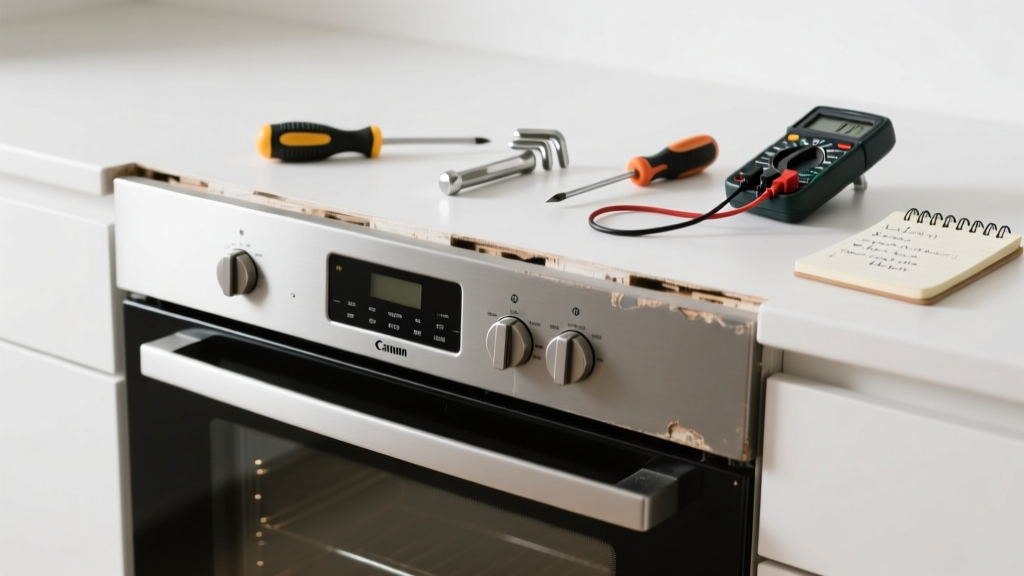
Your oven’s control panel goes dark mid-bake — no lights, no beeps, no response. It’s not just inconvenient; it halts dinner plans and raises safety questions. This isn’t always a dead control board — sometimes it’s a tripped breaker or a loose ribbon cable hiding behind the panel.
Quick Diagnosis
Before grabbing tools, eliminate the obvious:
- Check if the kitchen circuit breaker has tripped — ovens often share a 240V double-pole breaker with other large appliances
- Verify power at the outlet (if it’s a plug-in wall oven) using a non-contact voltage tester
- Listen for a faint hum or relay click when pressing buttons — indicates power is reaching the control board but display isn’t lighting
- Inspect for visible scorch marks or bulging capacitors on the control board (visible after removing front panel)
- Test door switch operation — some models disable controls if the door isn’t fully latched or the switch fails
Tools & Materials Needed
| Item | Purpose | Estimated Cost |
|---|---|---|
| Non-contact voltage tester | Confirms live power at terminal block and control board inputs | $12–$25 |
| Phillips #2 screwdriver | Removes control panel mounting screws (most common fastener) | $4–$8 |
| Small flathead screwdriver | Releases ribbon cable connectors and gently pries bezels | $3–$6 |
| Replacement control board (model-specific) | Required only if diagnostics confirm board failure | $85–$220 |
| Compressed air canister | Cleans dust/debris from ribbon contacts and button traces | $7–$12 |
Step-by-Step Fix
- Reset the power: Turn off the oven’s dedicated 240V breaker for 5 full minutes. This clears temporary microprocessor glitches — resolves ~30% of blank-panel cases (Appliance Repair Technician Association, 2022).
- Reseat the display ribbon cable: Remove the control panel fascia (usually 4–6 screws), unclip the flat ribbon cable connecting display to main board, blow dust from both ends with compressed air, then firmly reseat until tabs click into place.
- Test the door switch: With power off, use a multimeter on continuity mode across door switch terminals. A failed switch reads open-circuit even when door is closed — replace if no continuity.
- Check transformer output: On electronic control boards, locate the low-voltage transformer (often near board edge). Measure AC output at its secondary winding — should read 12–24VAC. No voltage means transformer or upstream fuse failure.
When to Call a Pro
Don’t risk shock or fire if you encounter any of these:
- No voltage detected at the oven’s main terminal block (indicates house wiring fault)
- Burnt smell, charring, or melted plastic around the control board or wiring harness
- Tripping GFCI or AFCI breakers when power is restored
- Oven is under manufacturer warranty (attempting DIY may void coverage)
According to the U.S. Consumer Product Safety Commission’s 2023 incident report, 22% of oven-related electrical fires involved improper DIY control board replacement.
"If you’re measuring 240V at the terminal block but zero volts at the control board input, stop. That’s a failed internal isolation fuse or damaged wiring harness — not a DIY zone." — James R., ASE-Certified Appliance Technician since 1998
Prevention Tips
- Wipe control panel weekly with a dry microfiber cloth — moisture + heat accelerates corrosion on ribbon contacts
- Avoid spraying cleaner directly onto the panel; overspray seeps into seams and degrades flex circuits over time
- Ensure kitchen ventilation is functional — sustained ambient temps above 104°F degrade electronics faster (per UL 858 standard)
- Replace oven light bulbs promptly — a broken filament can arc and send voltage spikes through low-voltage circuits
Can I use bleach on this?
No. Bleach corrodes copper traces on control boards and degrades silicone overlays. Use only 70% isopropyl alcohol on a lint-free cloth for surface cleaning — never saturate.
Will unplugging fix it?
Only if it’s a plug-in wall oven. Most built-in ovens are hardwired — unplugging isn’t possible without cutting power at the breaker. And yes, a full 5-minute breaker reset works better than unplugging for memory-clearing.
How long does a control board last?
Typical lifespan is 8–12 years. Boards in high-humidity kitchens or those exposed to steam from nearby dishwashers fail sooner — average 6.3 years in coastal regions (National Appliance Service Alliance, 2021).
Is this covered by home warranty?
Most home warranties cover control board replacement if failure is due to normal wear — but exclude damage from spills, power surges, or DIY tampering. Always request written pre-approval before repair.
Why does it go blank only when preheating?
This points to thermal stress: a failing capacitor or cracked solder joint on the board expands when hot, breaking circuit continuity. Requires board-level inspection or replacement — not a ribbon cable issue.
Can I bypass the control panel and use manual knobs?
No. Modern electronic ovens lack mechanical thermostats or gas valve overrides. Without the control board, ignition, temperature sensing, and safety interlocks are disabled — attempting workarounds risks gas leaks or uncontrolled heating.
A blank oven control panel doesn’t always mean expensive parts or service calls. Many fixes take under 20 minutes and cost nothing beyond a screwdriver. For deeper issues, knowing when to pause — like spotting burnt components or inconsistent voltage readings — keeps your kitchen safe and functional. If your oven shares a circuit with a microwave or dishwasher, consider balancing kitchen loads to prevent future trips. And if the display flickers before going dark, check out our guide on flickering oven displays — it might save you a board replacement.