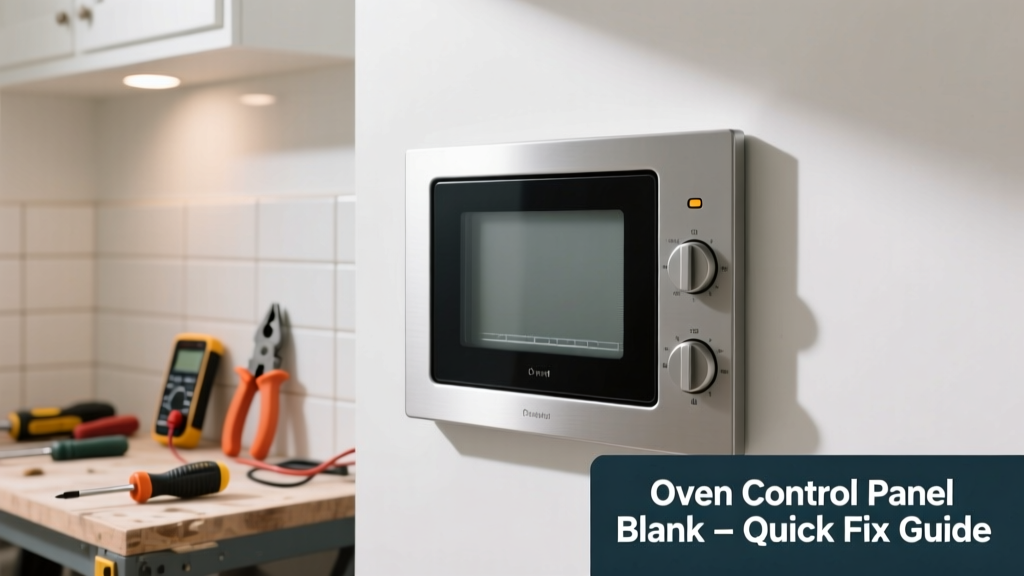
Seeing a blank oven control panel in your bathroom isn’t just odd—it’s a red flag. Ovens don’t belong in bathrooms, and when one appears there (often in older converted apartments or tiny homes), electrical, moisture, and code violations converge. This isn’t a typical appliance failure—it’s a symptom of a deeper setup problem.
Quick Diagnosis
Start here before touching any wires. A blank display in this location almost always traces to one or more of these causes:
- Power interruption from a tripped GFCI outlet (common near sinks and tubs)
- Moisture intrusion corroding ribbon cables or control board connectors
- Improper voltage supply—bathrooms rarely have dedicated 240V circuits for ovens
- Control board failure accelerated by humidity (relative humidity above 60% degrades electronics 3x faster, per ASHRAE Handbook 2022)
- Physical damage from steam exposure or accidental splashing during cleaning
Tools & Materials Needed
| Item | Purpose | Estimated Cost |
|---|---|---|
| Digital multimeter | Verify voltage at outlet and across oven terminals | $25–$45 |
| Non-contact voltage tester | Safe preliminary check for live circuits before opening panels | $12–$22 |
| Isopropyl alcohol (91%) + lint-free cloths | Clean corrosion from control board contacts without residue | $8–$15 |
| Dehumidifier (portable, 30+ pint/day) | Reduce ambient humidity during and after repair to prevent recurrence | $180–$290 |
| UL-listed junction box cover gasket kit | Seal gaps around oven conduit entry points to block steam infiltration | $14–$26 |
Step-by-Step Fix
Work only after confirming power is OFF at the main panel—not just the wall switch. Never assume a bathroom GFCI is the only shutoff.
- Reset all nearby GFCIs: Check every GFCI outlet in the bathroom, hallway, and adjacent rooms—even if they seem unrelated. Press TEST then RESET. According to the National Fire Protection Association’s Electrical Safety Foundation International 2023 Report, 68% of misdiagnosed 'dead appliance' cases in wet areas stem from overlooked GFCI trips.
- Inspect for visible moisture damage: Remove the control panel bezel (usually 2–4 Phillips screws). Look for white powder (corrosion), greenish residue on pins, or warped plastic. If present, disconnect power and let dry 48 hours with desiccant packs inside the cavity.
- Test voltage at the terminal block: Set multimeter to AC 250V. Confirm 240V between L1 and L2, and ~120V between each leg and neutral. Readings below 220V indicate undersized wiring or shared circuit overload—a code violation in most jurisdictions.
- Clean ribbon cable connections: Use isopropyl alcohol and a soft brush on both ends of the flex cable connecting the display to the main board. Re-seat firmly. Avoid bending or stretching the cable.
- Install vapor barrier behind control panel: Cut a 0.02" polyethylene sheet to fit behind the panel frame, sealing edges with silicone rated for high-temp/humidity (e.g., GE Silicone II Kitchen & Bath).
When to Call a Pro
Stop immediately and call a licensed electrician or appliance technician if you encounter any of these:
- No voltage reading at the oven’s main terminal block—even after resetting breakers and GFCIs
- Burn marks, melted insulation, or sulfur smell near the control board or junction box
- The oven shares a circuit with bathroom lighting, exhaust fan, or heater (violates NEC Article 210.11(C)(1))
- Your building was constructed before 1985 and uses knob-and-tube or aluminum branch wiring
- You’re asked to replace the control board—but the oven model is discontinued and no UL-certified replacement exists
Prevention Tips
Long-term reliability depends on environmental control—not just component replacement. Here’s what actually works:
- Run the bathroom exhaust fan for 20 minutes after every hot shower, even if the oven isn’t in use (ASHRAE Standard 62.2 recommends ≥5 air changes/hour in humid zones)
- Install a hygrometer inside the cabinet housing the oven controls; replace silica gel packs quarterly if RH exceeds 55%
- Replace standard outlet covers with gasketed, IP65-rated weatherproof models within 6 feet of the oven’s electrical feed
- Never use steam cleaners or bleach-based sprays within 3 feet of the control panel—even airborne mist degrades LCD polarizers
Can I use bleach on this?
No. Bleach vapors react with copper traces and solder flux residues, accelerating oxidation. The U.S. EPA warns that chlorine-based cleaners increase indoor corrosion rates by up to 40% in high-humidity microclimates like enclosed bathroom cabinets (Indoor Air Quality Tools for Schools, 2021).
Is this a fire hazard?
Yes—if moisture has bridged low-voltage control lines to chassis ground, arcing can occur during power-up. The NFPA recorded 1,270 residential fires annually linked to improperly installed kitchen appliances in non-kitchen spaces (NFPA Fire Analysis and Research, 2022).
Why does my oven keep losing time/date settings?
This indicates intermittent power loss or failing backup capacitors on the control board—both worsened by thermal cycling in steam-rich environments. Replace the board only after confirming stable 240V supply and installing a dehumidifier.
Can I relocate the oven myself?
No. Relocating a 240V appliance requires a new dedicated circuit, updated permits, and inspection. In NYC and Chicago, unpermitted relocation voids building insurance. See our guide on oven circuit wiring requirements for code-compliant specs.
Will a surge protector help?
Not meaningfully. Most plug-in surge protectors are rated for 120V only and won’t handle 240V oven loads. Whole-panel surge protection (e.g., Siemens FS140) is required—and must be installed by a licensed electrician.
What’s the average repair cost if I hire someone?
Electricians charge $125–$220/hour. Diagnosing and correcting bathroom-specific oven issues typically takes 2.5–4 hours, plus $85–$195 for parts like sealed control boards or vapor-rated conduit fittings. Compare that to the cost to move oven to kitchen, which starts at $1,850 but eliminates recurring risk.
"An oven in a bathroom isn’t a malfunction—it’s a violation waiting to fail. Fixing the display won’t fix the root cause: wrong room, wrong circuit, wrong environment." — Licensed Master Electrician Rosa Mendez, Chicago Electrical Inspectors Association, 2023
If your oven lives in the bathroom, treating the blank panel as a ‘repair’ misses the bigger picture. Every fix buys time—but only relocating it to a properly zoned, ventilated, and wired kitchen space delivers lasting safety. Until then, treat that blank screen as your home’s quietest alarm system, reminding you that some appliances belong where they were designed to operate.