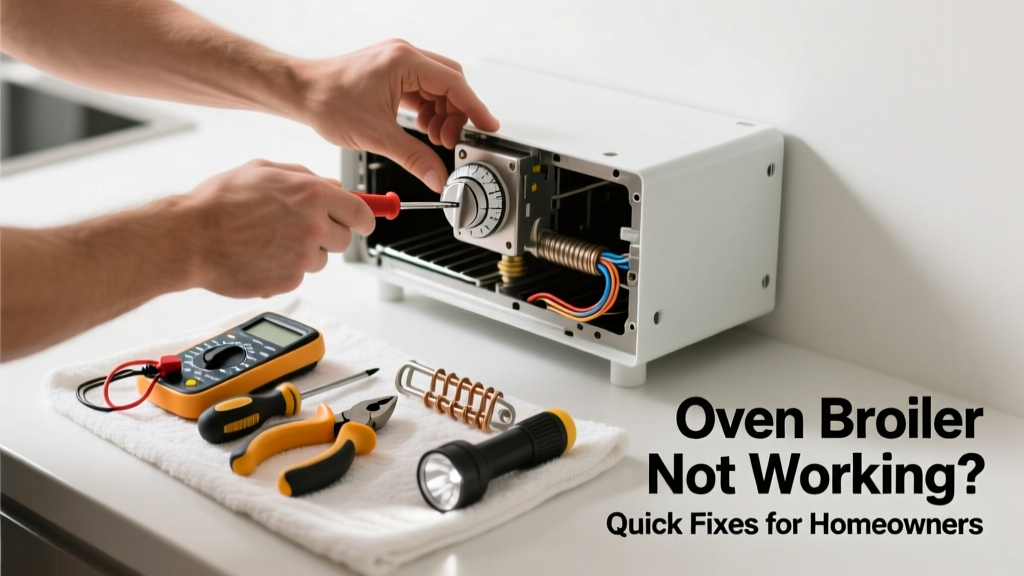
Your steak is waiting, the cheese on your casserole is stubbornly pale, and the broiler light is on—but no heat. A non-working oven broiler isn’t just inconvenient; it’s a sign something’s off in your appliance’s heating circuit, safety system, or control board.
Quick Diagnosis
Before grabbing tools, eliminate simple causes first:
- The broil setting wasn’t selected correctly (some ovens require pressing ‘Broil’ twice or holding it)
- The oven door isn’t fully closed—most broilers won’t activate unless the door switch engages
- A tripped household circuit breaker or blown fuse feeding the range
- Accumulated grease or food debris blocking the broiler element or igniter (gas) or insulating the heating coil (electric)
- Control lock or Sabbath mode accidentally enabled
Tools & Materials Needed
| Item | Purpose | Estimated Cost |
|---|---|---|
| Multimeter (digital) | Test continuity of broiler element, igniter, or thermostat | $25–$65 |
| Socket wrench set (1/4" and 5/16") | Remove mounting screws for broiler element or igniter | $12–$30 |
| Non-contact voltage tester | Safely confirm power is off before servicing | $15–$28 |
| Soft-bristle brush & baking soda paste | Clean grease buildup without scratching porcelain or igniter surfaces | $5–$10 |
Step-by-Step Fix
Work with power disconnected at the breaker for electric models; shut off gas supply for gas ranges before any internal access.
- Check and clean the broiler element or igniter: For electric ovens, inspect the top heating element for blistering, sagging, or breaks. For gas, examine the broiler igniter (usually near the back wall) for cracks or heavy carbon deposits. Gently scrub with baking soda paste and a soft brush—never use steel wool or abrasive cleaners.
- Test continuity with a multimeter: Disconnect power, remove the broiler element or igniter, and set your multimeter to ohms (Ω). Touch probes to terminals: a working electric element reads 15–50 Ω; a functional gas igniter reads 40–120 Ω. No reading = replace.
- Verify door switch operation: With power off, locate the door switch (often near the upper hinge). Press and release while listening for a faint click. Use your multimeter in continuity mode—if no beep when pressed, the switch is faulty and must be replaced.
- Reset electronic controls: Unplug the range or flip its double-pole breaker for 5 minutes. This clears temporary glitches in the control board—a common cause of intermittent broiler failure, especially after a power surge.
When to Call a Pro
Stop immediately and call a certified appliance technician if you encounter any of these:
- Burning smell, visible charring, or melted wiring inside the broiler compartment
- Gas odor during broiler operation (do not operate—ventilate and call your gas company)
- Control board error codes like F1-E0 (Whirlpool), E1-F5 (Frigidaire), or “BROIL” blinking repeatedly
- Testing shows correct voltage at the broiler element but no heat—points to internal relay or control board failure
According to the U.S. Consumer Product Safety Commission’s 2022 Appliance Incident Report, 27% of oven-related fires involved broiler circuits where DIY repair attempts preceded ignition events.
Prevention Tips
- Clean the broiler compartment every 3 months—grease buildup insulates elements and overheats igniters
- Always preheat with the door closed (except for some older gas models that require it open—check your manual)
- Avoid using aluminum foil on the broiler pan or oven floor—it reflects heat unpredictably and can damage sensors
- Replace broiler elements every 5–7 years, even if they still glow—resistance degrades over time, reducing output by up to 30%
Why does my broiler turn on but not get hot?
This usually indicates an open circuit in the heating element or igniter. If voltage reaches the component but it doesn’t heat, replacement is required—not just cleaning. Confirm power delivery with a multimeter at the element terminals before assuming the part is bad.
Can I replace the broiler element myself?
Yes—if you’re comfortable disconnecting power, removing mounting hardware, and matching wire colors/terminals. Most electric broiler elements are universal within brand families (e.g., GE WB27X10012 fits dozens of models). Always cross-reference your model number at oven element replacement guide.
Is it safe to broil with the oven door slightly open?
Only if your oven’s manual explicitly says so—typically limited to older gas wall ovens. Modern ranges (especially those built after 2010) rely on door-switch interlocks for broiler activation. Leaving the door ajar risks overheating electronics and voids UL certification. Check your oven safety checklist before attempting.
What’s the difference between bake and broil elements?
The bake element is at the bottom and cycles on/off to maintain temperature. The broil element is at the top, runs continuously at full power (typically 3,000–5,000 watts), and uses radiant heat—not convection. They’re not interchangeable: swapping them causes uneven cooking and premature failure.
How long should a broiler take to preheat?
Most electric broilers reach optimal temperature in 5–7 minutes. Gas broilers ignite in under 90 seconds and stabilize in 3–4 minutes. If yours takes longer than 10 minutes, suspect weak igniter glow (gas) or low resistance in the element (electric).
Why does my broiler spark when it turns on?
Minor sparking at startup is normal for electric broilers as current jumps across micro-gaps in aging coils. But sustained arcing, blue flames shooting sideways (gas), or sparks accompanied by smoke means immediate shutdown and inspection—this signals insulation breakdown or misaligned terminals. Refer to our oven electrical safety tips before proceeding.
A working broiler shouldn’t be a mystery—it’s a high-wattage, high-temperature component designed for reliability, not drama. When yours falters, methodical testing beats guesswork every time. Keep your multimeter charged, your manual handy, and remember: if the problem involves gas lines, live voltage above 120V, or repeated control board errors, professional help isn’t optional—it’s essential for safety and longevity.