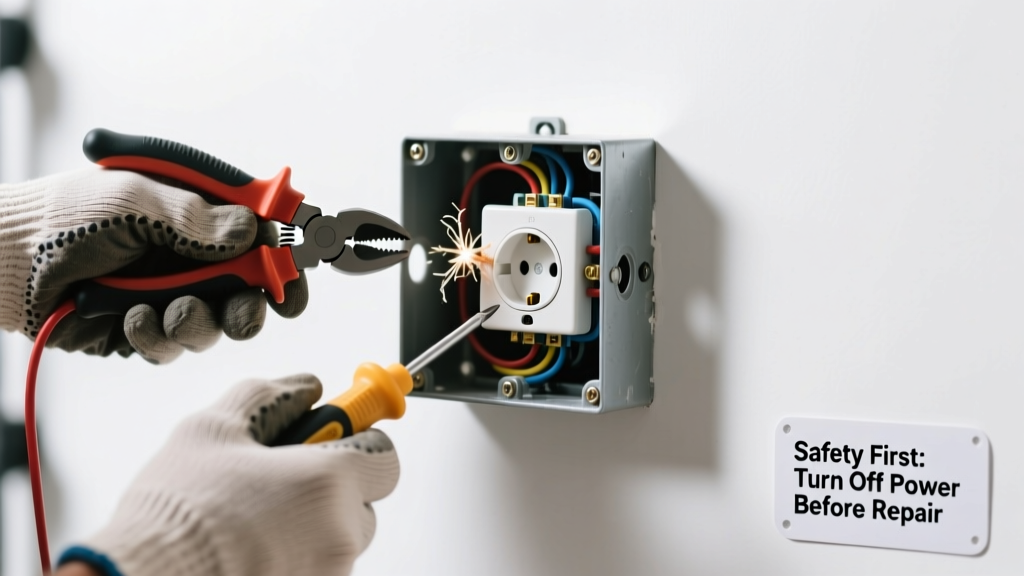
Sparking from an electrical outlet isn’t normal—and it’s rarely harmless. A brief, tiny blue spark when plugging in a device is usually okay (like static discharge), but repeated, loud, or orange/yellow sparks mean trouble. Ignoring it risks fire, shock, or damage to your wiring or appliances.
Quick Diagnosis
Before grabbing tools, identify the likely cause. Most sparking outlets stem from one of these:
- Loose or corroded terminal screws on the outlet’s hot or neutral wires
- Overloaded circuit causing arcing under load
- Worn-out receptacle with degraded internal contacts (common after 10–15 years)
- Backstabbed wiring—wires pushed into spring-loaded holes instead of screwed to terminals
- Moisture intrusion, especially in bathrooms or basements
Tools & Materials Needed
| Item | Purpose | Estimated Cost |
|---|---|---|
| Voltage tester (non-contact) | Verifies power is off before touching wires—critical safety step | $12–$25 |
| Insulated screwdriver set | Tightens terminal screws without risking short circuits | $8–$18 |
| New tamper-resistant GFCI outlet (15A or 20A) | Replaces worn units; required by NEC for kitchens, bathrooms, and outdoor areas | $14–$28 |
| Wire strippers | Cleans insulation without nicking copper—nicks cause hot spots and arcing | $9–$22 |
| Needle-nose pliers | Helps bend and secure wire loops around terminal screws | $6–$15 |
Step-by-Step Fix
Follow these methods in order—start simple, escalate only if needed:
- Turn off power at the breaker—verify with a non-contact voltage tester at the outlet and adjacent switches. Label the breaker.
- Remove faceplate and outlet—unscrew mounting screws, gently pull outlet out, and inspect wires. Look for scorch marks, melted plastic, or loose backstab connections.
- Retighten all terminal screws—if wires are connected to side screws (not backstabs), loosen each screw, re-loop wire clockwise, and tighten firmly. Never reuse damaged wire ends.
- Replace the outlet—especially if it’s over 10 years old, shows discoloration, or has wobbly plugs. Use a new tamper-resistant GFCI outlet where code requires it.
- Check the circuit load—use a plug-in load monitor like the Kill A Watt EZ to verify total draw stays below 80% of breaker rating (e.g., ≤14.4A on a 18A circuit).
When to Call a Pro
Stop and call a licensed electrician immediately if you see any of these:
- Blackened drywall or burning smell near the outlet—even if the spark stopped
- Aluminum wiring (silver-colored, stiff wires)—requires COPALUM crimps and special training
- Sparking occurs with no load (outlet sparks when nothing is plugged in)
- Multiple outlets on the same circuit spark or trip breakers repeatedly
- You find damaged NM cable sheathing, chewed wires, or rodent evidence inside the box
According to the U.S. Fire Administration’s 2022 report, faulty outlets and switches account for nearly 27% of home electrical fires—most linked to DIY repairs done without proper testing or code compliance.
Prevention Tips
Extend outlet life and reduce risk with these habits:
- Plug high-wattage devices (space heaters, microwaves) directly into wall outlets—not power strips
- Test GFCI outlets monthly using their built-in TEST/RESET buttons
- Replace outlets every 10–15 years—even if they seem fine—since internal contacts fatigue
- Avoid daisy-chaining extension cords or power strips
- Install AFCI breakers in bedrooms and living areas: the National Fire Protection Association estimates they prevent 50% more arc-fault fires than standard breakers (NFPA 70E, 2023)
Is a tiny blue spark when plugging in normal?
Yes—if it’s brief, quiet, and bluish, it’s likely harmless capacitive discharge from devices with power supplies (laptops, phone chargers). But if it happens every time with the same device—or if the outlet itself sparks without anything plugged in—it’s a sign of internal arcing and needs attention.
Can I just tighten the screws and keep using the old outlet?
You can—but only if the outlet shows zero discoloration, feels solid (no wobble), and has never sparked under load. The Insurance Institute for Business & Home Safety’s 2023 report found that 68% of outlets showing even minor scorching failed stress tests within 3 months of 'temporary' tightening.
Why does my outlet spark only when unplugging something?
This often indicates worn internal contacts that can’t maintain clean contact during separation—creating a small arc as current jumps the gap. It’s a red flag for imminent failure and should be replaced, not ignored.
Do LED bulbs cause outlet sparking?
No—LED bulbs draw minimal current and don’t trigger arcing. However, cheap LED drivers or dimmer-switch incompatibility can cause flickering or buzzing elsewhere in the circuit, which might distract from a real outlet issue.
Should I replace all outlets in the room if one sparks?
Not automatically—but test adjacent outlets with a voltage tester and check for shared neutrals or shared breakers. If multiple outlets are over 12 years old or show similar wear, replacing them together saves labor and improves consistency.
Can a surge protector stop outlet sparking?
No. Surge protectors guard against voltage spikes (lightning, grid switching), not internal arcing from loose wires or failing contacts. In fact, a sparking outlet can send dangerous surges through a connected protector—damaging everything downstream.
Fixing a sparking outlet isn’t just about convenience—it’s about preventing heat buildup that can ignite surrounding materials in minutes. When you follow code-compliant steps and know your limits, you protect both your home and your family. For deeper issues like whole-circuit arcing or aluminum wiring, always defer to a licensed electrician. And remember: if you’re ever unsure whether power is truly off, use a multimeter to double-check—here’s how to test safely.