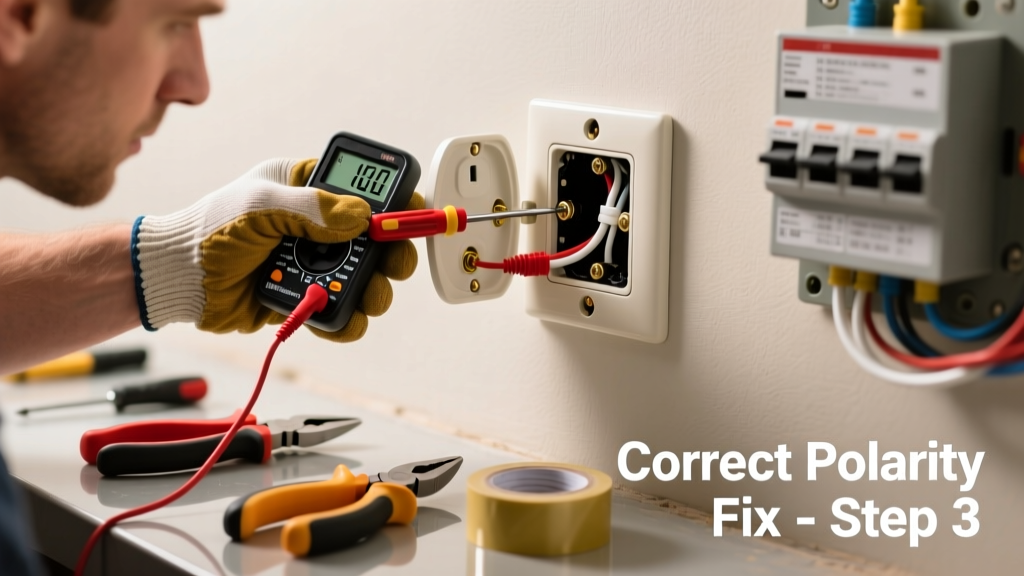
Reversed polarity means the hot and neutral wires are swapped at an outlet — a silent hazard that can energize appliance casings and trip GFCIs without warning. It’s surprisingly common in older homes or after DIY electrical work, and while it’s often simple to correct, misdiagnosis can lead to dangerous shocks or fire risk. Don’t ignore that "reversed" reading on your outlet tester.
Quick Diagnosis
Before grabbing tools, confirm the issue isn’t something else. Reversed polarity shows up as a specific pattern on a 3-light outlet tester (two amber lights, red off), but similar symptoms can stem from other faults. Check these first:
- Loose or corroded neutral wire at the outlet or upstream junction box
- Shared neutral (multi-wire branch circuit) with an open neutral elsewhere
- Backstabbed connections where wires popped out of spring-clamp terminals
- Ground wire mistakenly connected to neutral terminal
- Outlet wired correctly but fed from a switch loop with misidentified travelers
Tools & Materials Needed
| Item | Purpose | Estimated Cost |
|---|---|---|
| Digital multimeter (CAT III rated) | Verify voltage presence, polarity, and ground continuity safely | $45–$95 |
| 3-prong outlet tester (UL-listed) | Quick visual confirmation before and after repair | $8–$15 |
| Non-contact voltage tester | Confirm power is OFF at the outlet before touching wires | $12–$25 |
| Insulated screwdrivers (Phillips & flat) | Tighten terminals without shorting hot-to-ground | $10–$20 |
| Wire strippers (with gauge markings) | Cleanly strip 3/4" of insulation without nicking copper | $14–$32 |
Step-by-Step Fix
Once you’ve confirmed power is OFF at the breaker and verified no voltage is present, follow this sequence:
- Remove the outlet cover and mounting screws, then gently pull the device from the box. Note wire colors: black (hot), white (neutral), bare/green (ground).
- Check terminal connections: Black should be on the brass (smaller) screw, white on silver (larger) screw, ground on green screw. If reversed, loosen screws and reassign wires correctly.
- Inspect for backstabbed wires: If black or white wires are pushed into rear holes instead of wrapped around screws, cut them flush and reattach under screw terminals — backstabs fail 3x more often than screw terminals (NFPA 70E 2023 Annex D).
- Tighten all terminals to 0.6 lb-ft torque (use a torque screwdriver if possible — over-tightening cracks yokes; under-tightening causes arcing).
- Reassemble, restore power, and test with both the outlet tester and multimeter: 120V between hot & neutral, ~0V between neutral & ground, and no voltage between hot & ground.
When to Call a Pro
Stop and call a licensed electrician if any of these apply:
- You find aluminum wiring (common in homes built 1965–1973) — improper handling increases fire risk
- The reversed reading appears on multiple outlets on different circuits — suggests panel-level miswiring or neutral bar issues
- Neutral and ground wires are bonded anywhere downstream of the main service panel
- You measure >2V between neutral and ground at the outlet — indicates a compromised neutral path, possibly at the utility transformer
- Your home has knob-and-tube or early BX cable without a ground conductor
Prevention Tips
Reversed polarity rarely happens by accident — it’s almost always due to human error during installation or replacement. Build in safeguards:
- Label wires with tape before disconnecting: “H” for hot, “N” for neutral, “G” for ground
- Use only outlets rated for your circuit (e.g., 15A outlets on 15A circuits — never mix with 20A)
- Replace old outlets every 15 years — internal contacts fatigue and increase resistance
- After any electrical work, test every outlet with a calibrated outlet tester — not just the one you touched
Can reversed polarity damage my appliances?
Yes — especially devices with polarized plugs (like lamps or power supplies). Reversal sends current through the wrong internal path, potentially overheating switches or capacitors. The U.S. Consumer Product Safety Commission reports ~2,300 fires annually linked to incorrect polarity or grounding (CPSC Fire Incident Data 2022).
Why does my GFCI trip when polarity is reversed?
GFCIs monitor current balance between hot and neutral. When reversed, the internal sensing coil reads imbalance even under no-load conditions — triggering immediate trip. This is a safety feature, not a defect.
Will a surge protector still work with reversed polarity?
No. Most surge protectors rely on correct hot/neutral orientation to route clamping energy safely to ground. With reversed polarity, MOVs may fail silently or allow surges to pass through unclamped.
Can I fix this with the power on?
Never. Working on live outlets violates OSHA 1910.333 and risks arc flash, electrocution, or fatal shock. Always verify de-energization with two independent methods: non-contact tester and multimeter across terminals.
Does reversed polarity affect LED bulbs or smart switches?
LEDs may flicker or fail prematurely. Smart switches — especially those requiring neutral for standby power — often won’t pair, reset constantly, or report communication errors. Some models (like Lutron Caseta) will refuse to operate entirely until corrected.
Is reversed polarity the same as an open ground?
No. Open ground means the ground wire is disconnected or missing — a separate fault with its own tester pattern (amber light on right only). Both are hazardous, but they require different fixes. Confusing them delays proper repair.
"In residential inspections, reversed polarity ranks among the top 5 most frequently missed defects — yet it’s also one of the easiest to catch and correct with basic tools." — International Association of Certified Home Inspectors (InterNACHI), Electrical Inspection Standards Manual, 2023
A properly wired outlet shouldn’t be a guessing game — it’s a foundational safety requirement. Fixing reversed polarity takes under 15 minutes once you’re set up, but skipping verification steps or rushing the reconnection puts you and your home at real risk. If you’ve replaced an outlet before, this is familiar territory — just slower, more deliberate, and always double-checked. For deeper issues like shared neutrals or panel miswiring, trust the pro. And remember: your outlet tester isn’t just for show — keep it in your toolbox and test every outlet you touch. For related help, see our guide on how to test a GFCI outlet or outlet not working troubleshooting.