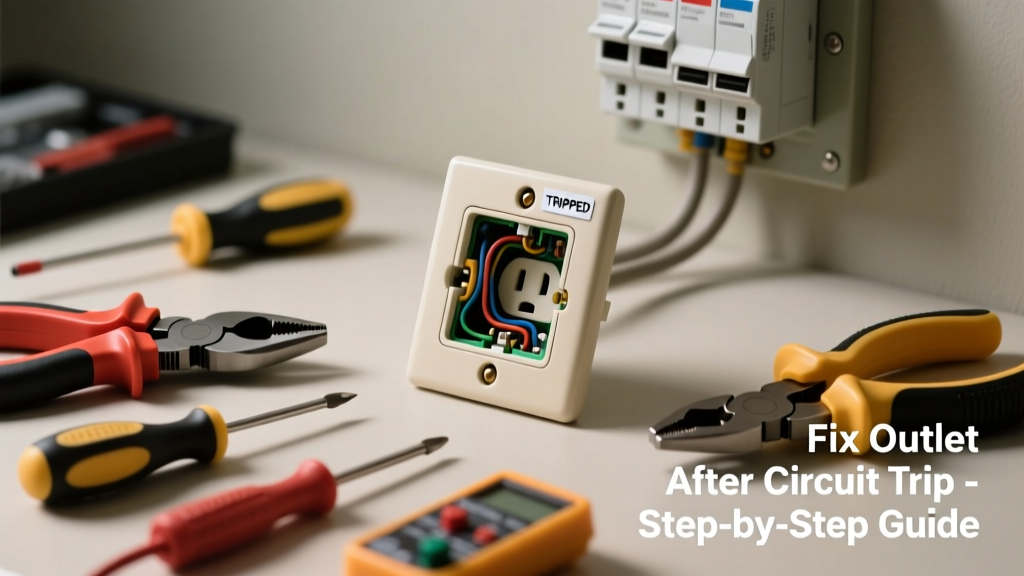
That dead outlet after a tripped breaker is more common than you think — especially in kitchens, garages, or laundry rooms where high-wattage appliances live. Before you assume it’s broken or call an electrician, most cases are resolved in under 15 minutes with basic tools and methodical checking. But rushing in without verifying safety can turn a simple fix into a shock hazard.
Quick Diagnosis
Start here before grabbing tools. A non-working outlet after a trip usually stems from one of these causes:
- The circuit breaker hasn’t been fully reset (it may appear 'on' but is actually in the middle 'tripped' position)
- A GFCI outlet upstream has tripped — even if it’s in another room or behind furniture
- Loose or corroded wiring at the outlet or junction box
- A failed outlet receptacle (especially units over 10 years old)
- Damaged cable between the panel and outlet, often from nails, rodents, or aging insulation
Tools & Materials Needed
| Item | Purpose | Estimated Cost |
|---|---|---|
| Non-contact voltage tester | Confirms power is off before touching wires — critical for safety | $12–$25 |
| Outlet tester (3-light) | Diagnoses open neutral, hot/neutral reverse, or ground faults | $8–$15 |
| Insulated screwdrivers (flat & Phillips) | Tightens terminal screws without risking shorts or shocks | $10–$20 |
| New tamper-resistant receptacle | Required by NEC 2017+ for all new/replaced outlets; safer and more reliable | $2–$4 |
| Wire strippers & needle-nose pliers | Prepares and secures connections cleanly — no nicks or frays | $15–$30 |
Step-by-Step Fix
Work methodically — skipping steps risks misdiagnosis or unsafe conditions. Always verify power is off at the panel before touching any wires.
- Reset the breaker fully: Flip it all the way to OFF, then firmly to ON. Listen for a click. If it trips again immediately, stop — there’s likely a short or overload.
- Test all GFCIs on the same circuit: Press TEST, then RESET on every GFCI outlet in the home — including bathrooms, basements, garages, and outdoor outlets. One tripped GFCI can kill power downstream to multiple standard outlets.
- Check voltage at the outlet: Use your non-contact tester near the outlet slots and faceplate screws. If no voltage detected, move upstream to the last working outlet on the circuit and inspect its connections.
- Inspect and reseat wiring: With power OFF, remove the outlet cover and check for loose backstabbed wires (pull gently — if they come out, replace with screw-terminal connections) or discolored terminals indicating arcing.
- Replace the receptacle: If wiring looks sound but the outlet still fails the 3-light tester, install a new tamper-resistant receptacle. Match hot/neutral/ground positions exactly — reversing hot and neutral trips GFCIs and creates shock risk.
When to Call a Pro
Some situations require licensed expertise — not just for code compliance, but for your safety. Call an electrician if:
- The breaker trips instantly when reset, even with all devices unplugged
- You smell burning, see charring on the outlet or wires, or notice warm faceplates
- Multiple circuits trip simultaneously — points to panel issues or whole-house grounding problems
- You’re dealing with aluminum wiring (common in homes built 1965–1973), which requires special connectors and anti-oxidant paste
- Your home lacks proper grounding — confirmed by a 3-light tester showing "open ground" on every outlet
"Over 50% of residential electrical fires start at outlets or switches, often due to loose connections or outdated devices." — National Fire Protection Association (NFPA) Electrical Safety Report, 2022
Prevention Tips
Reduce future trips and extend outlet life with these practical habits:
- Label your breaker panel clearly — use a label maker or printed stickers so you know which breaker controls each area
- Avoid daisy-chaining power strips — plug space heaters, microwaves, and vacuum cleaners directly into wall outlets
- Replace outlets every 10–15 years, even if they seem fine — internal contacts fatigue and lose grip
- Install AFCI breakers if your panel supports them — they detect dangerous arc faults that standard breakers miss
- Use outlet testers quarterly — they catch early signs of reversed polarity or failing grounds before failure occurs
Why does my outlet work sometimes but not others?
Intermittent operation usually means a loose connection — either at the outlet’s terminals, a wire nut in a junction box, or a failing backstab connection. Wiggling the plug or tapping the wall may temporarily restore contact. Turn off power and inspect all connections on that circuit, starting at the first non-working outlet.
Can I replace a 15-amp outlet with a 20-amp one?
No — unless the entire circuit is wired with 12-gauge copper (not 14-gauge) and protected by a 20-amp breaker. Upgrading the outlet alone violates NEC 210.21(B)(3) and creates a fire hazard. If you need 20-amp capacity, consult an electrician to evaluate the full circuit.
Do I need a permit to replace an outlet?
In most jurisdictions, replacing an existing outlet with the same type and rating doesn’t require a permit. However, adding new outlets, changing circuit types (e.g., installing GFCI where none existed), or upgrading panels does. Check with your local building department — some cities, like Portland and Chicago, require permits for all electrical work, even replacements.
What’s the difference between GFCI and AFCI protection?
GFCI (Ground Fault Circuit Interrupter) protects against shock by cutting power if current leaks to ground — essential in wet areas. AFCI (Arc Fault Circuit Interrupter) prevents fires by detecting dangerous arcing in damaged or deteriorated wires. Modern panels often combine both in dual-function breakers. Learn more in our GFCI outlet replacement guide.
Why did only one outlet go out when the breaker didn’t trip?
This suggests a problem isolated to that outlet or its connections — not an overload. Common causes include a failed internal contact, a broken wire inside the wall (often near a nail or staple), or a disconnected pigtail in a multi-outlet box. Use your outlet tester and voltage detector to trace continuity from the last working outlet.
How do I know if my house has knob-and-tube wiring?
Knob-and-tube was used until the 1940s and features separate black (hot) and white (neutral) wires run through ceramic knobs and tubes. It lacks a ground wire and can’t support modern loads safely. If you see cloth-covered wires entering outlets or junction boxes without a third conductor, stop work and contact a licensed electrician — learn more about knob-and-tube safety risks.
A tripped outlet isn’t always a sign of serious trouble — often it’s just a loose wire or forgotten GFCI. But treating electricity with respect, verifying every step, and knowing your limits keeps you safe and saves money. If you’ve walked through the diagnostics and still get no power, don’t force it: that’s when experience and licensing matter most. And remember — your outlet tester isn’t optional gear. It’s the first line of defense between you and a preventable accident.