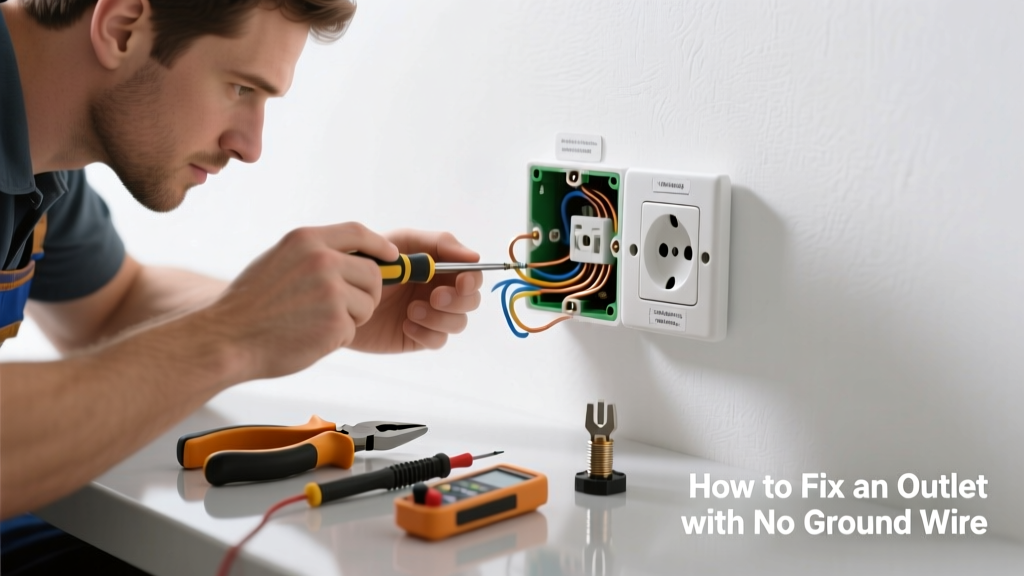
If you've tested an outlet with a plug-in tester and seen the 'open ground' light—especially in older homes built before 1960—you're dealing with a common but potentially hazardous issue. Ungrounded outlets lack a safety path for stray current, increasing shock and fire risk. Don’t ignore it, but don’t panic: many cases are fixable—or at least safely managed—with the right knowledge.
Quick Diagnosis
Before grabbing tools, confirm the problem isn’t misdiagnosis or simple wiring errors:
- Outlet tester shows 'open ground' but ground pin is physically missing or disconnected
- Outlet is installed in a metal box with no grounding conductor attached to the box or device
- Home has knob-and-tube or early NM cable (no bare copper ground wire)
- Ground wire was cut, capped off, or never extended to the outlet during prior renovation
- Shared neutral/ground configuration (illegal post-1999, but found in outdated multi-wire branch circuits)
Tools & Materials Needed
| Item | Purpose | Estimated Cost |
|---|---|---|
| Voltage tester (non-contact & contact) | Verifies power is off and confirms absence of ground continuity | $12–$25 |
| Outlet tester (3-light) | Diagnoses open ground, reversed polarity, and other faults | $8–$15 |
| Grounding pigtail (green 14 AWG) | Connects grounded outlet to metal box if box is grounded | $2–$5 |
| GFCI receptacle (tamper-resistant) | Code-approved replacement where grounding isn’t possible | $14–$22 |
| Wire strippers & screwdrivers (insulated) | Safe handling of live circuits; UL-rated for 600V | $18–$35 |
Step-by-Step Fix
Choose the method that matches your wiring condition and local code (NEC 2023 permits GFCI protection as a ground-fault alternative in ungrounded systems):
- Verify box grounding: Turn off circuit at panel, remove outlet, and test continuity between metal box and known ground (e.g., cold water pipe or ground rod). If grounded, attach a green pigtail from outlet’s ground screw to box using a 10-32 grounding screw.
- Install GFCI outlet: Replace existing outlet with a GFCI unit. Connect line wires only (ignore ground terminal), label outlet “No Equipment Ground” using included sticker. This satisfies NEC 406.4(D)(2)(a) and protects downstream devices.
- Run new grounded cable: Only feasible if walls are open (e.g., during remodel). Pull 14/2 NM-B with ground from panel or nearest grounded junction box. Requires permit and inspection in most jurisdictions.
- Add grounding electrode conductor: If service panel has no grounding electrode system, install 6 AWG copper to driven rod (8 ft deep) per NEC 250.52(A)(5). Not a standalone fix—but required if upgrading grounding infrastructure.
When to Call a Pro
Some situations demand licensed expertise—not just for safety, but code compliance:
- You measure voltage between neutral and ground terminals (indicates bootleg ground or dangerous neutral-to-ground bond)
- Multiple outlets on the same circuit show open ground—suggesting a broken ground path upstream or panel-level fault
- Your home uses aluminum branch-circuit wiring (pre-1974); splicing requires special connectors and torque specs
- The circuit breaker trips intermittently or smells burnt—signaling arcing, overloaded neutrals, or failing panel bus bars
"Retrofitting ground wires in finished walls without opening drywall carries a 37% higher risk of damaging existing conductors, according to the National Fire Protection Association's 2022 Electrical Safety Report."
Prevention Tips
Ungrounded outlets rarely appear overnight—they’re symptoms of aging infrastructure or past shortcuts. Stay ahead:
- Test all outlets annually with a 3-light tester—keep a log by circuit
- When replacing switches or outlets, verify ground continuity before installing new devices
- Label GFCI-protected ungrounded outlets clearly—future homeowners or electricians need to know
- During renovations, budget for grounding upgrades: NM-B cable, grounding clamps, and panel bonding checks
Can I add a ground wire to an old 2-wire circuit?
Yes—if you can physically run a separate 14 AWG bare copper ground wire back to the panel’s grounding bus bar or to a grounded metal conduit system. But NEC 250.130(C) requires it to be continuous, unspliced, and protected from damage. It’s rarely practical in finished walls and often fails inspection unless installed by a licensed electrician.
Is it safe to use a 3-prong adapter (cheater plug)?
No. These bypass grounding entirely and create false security. They’re prohibited under NEC 406.4(D)(2)(c) unless the outlet is GFCI-protected and labeled accordingly—and even then, they shouldn’t be used for surge-sensitive electronics like computers or medical devices.
Why does my GFCI trip when I plug something in?
On an ungrounded circuit, GFCIs still function—but frequent tripping may indicate moisture intrusion, damaged appliance cords, or a failing GFCI unit. Test the GFCI itself with its test/reset buttons first. If it trips with nothing plugged in, replace it. If it trips only with certain loads, inspect those devices for internal ground faults.
Do ungrounded outlets affect surge protectors?
Absolutely. Most plug-in surge protectors require a functional ground to shunt excess voltage. Without it, they offer little to no protection—and some may falsely indicate they’re working. Use only GFCI-protected outlets with UL 1449-rated suppressors designed for ungrounded applications (e.g., Tripp Lite Isobar models with isolated filtering).
Can I ground to a cold water pipe?
Only if the pipe is metal, continuous, and bonded to the service grounding electrode system within 5 feet of where it enters the building (NEC 250.104(A)). PVC or CPVC sections, dielectric unions, or water heaters break continuity. Never rely on plumbing alone—it’s not a substitute for proper grounding.
Does AFCI protection fix the no-ground issue?
No. AFCIs detect arc faults (dangerous sparking), not ground faults. They’re complementary—not interchangeable—with GFCI protection. An ungrounded circuit still needs GFCI coverage for shock protection, even if AFCI breakers are installed.
Fixing an ungrounded outlet isn’t always about adding copper—it’s about understanding what safety layer you *can* restore, and accepting the limits of legacy wiring. Whether you install a GFCI, verify box grounding, or schedule a full rewire, each decision affects long-term safety and resale value. For more on related upgrades, see our guides on GFCI outlet replacement and old house electrical safety.