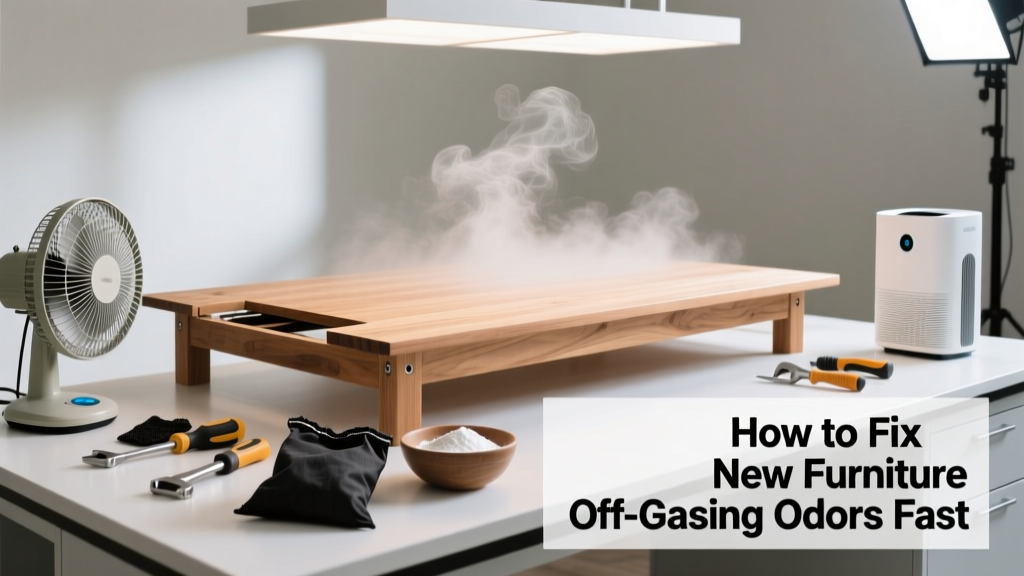
That sharp, chemical smell from your new sofa or particleboard bookshelf isn’t just annoying—it’s volatile organic compounds (VOCs) escaping into your air. Most off-gassing peaks in the first 72 hours but can linger for weeks, especially in poorly ventilated rooms.
Quick Diagnosis
Off-gassing isn’t mold or mildew—it’s the release of formaldehyde, benzene, and other VOCs from adhesives, laminates, foams, and finishes. Common culprits include:
- Pressed wood products (MDF, particleboard, plywood) using urea-formaldehyde resin
- Low-density polyurethane foam in cushions and mattresses
- UV-cured or solvent-based lacquers on cabinets and dressers
- Non-certified 'eco-friendly' veneers that still use high-VOC edge banding
Tools & Materials Needed
| Item | Purpose | Estimated Cost |
|---|---|---|
| Box fan (20-inch) | For cross-ventilation to accelerate VOC dispersion | $35–$65 |
| Activated charcoal bags (5-lb set) | Absorbs formaldehyde and acetaldehyde more effectively than baking soda | $18–$28 |
| HEPA + carbon air purifier | Removes airborne VOCs; look for ≥100g activated carbon filter | $199–$349 |
| Hygrometer/thermometer | Monitors temp (≥77°F) and humidity (30–50%)—higher temps increase off-gassing rate | $12–$24 |
Step-by-Step Fix
- Air it out outdoors (if possible): Place furniture on a covered porch or garage for 48–72 hours. Avoid direct sun on laminates—it can warp edges and degrade adhesives.
- Run continuous cross-ventilation indoors: Open two opposite windows and position box fans to create airflow *across* (not into) the room. Run 24/7 for 3–5 days.
- Deploy targeted adsorption: Place activated charcoal bags directly inside drawers, under cushions, and behind cabinet backs—areas where VOCs concentrate. Replace every 30 days.
- Wipe surfaces with white vinegar solution: Mix 1:1 distilled white vinegar and water. Dampen (don’t soak) a microfiber cloth and gently wipe exposed MDF edges and laminate seams. Vinegar neutralizes residual formaldehyde.
When to Call a Pro
DIY stops working—and health risks escalate—when:
- You or household members develop persistent headaches, eye irritation, or respiratory symptoms lasting >72 hours after ventilation
- Formaldehyde test strips show >0.1 ppm (the EPA’s chronic exposure limit) after 5 days of mitigation
- The furniture is part of a built-in system (e.g., kitchen cabinetry) with hidden adhesive layers or insulation backing that can’t be accessed safely
Prevention Tips
Before buying, inspect labels and ask questions. Look for certifications—not marketing terms:
- Specify NAF (No Added Formaldehyde) or Ultra-Low Emitting Formaldehyde (ULEF) on cabinet and shelving orders
- Avoid products with CARB Phase 2 compliance only—opt for CARB ATCM Phase 2 + ANSI A208.1-2016 certified particleboard
- Choose solid hardwood frames over engineered wood for bed frames and dining sets
- Ask retailers for VOC test reports (ASTM D6007 or ISO 16000-9) before delivery
How long does off-gassing usually last?
Most off-gassing drops by 80% within 30 days, but trace emissions from adhesives can continue at low levels for up to 6 months—especially in warm, humid rooms. According to the U.S. EPA, formaldehyde emissions from pressed wood drop exponentially: 50% in the first week, another 30% by day 21, then plateau.
Can I use an ozone generator to eliminate the smell?
No—ozone generators are unsafe and ineffective for VOC removal. The FDA and EPA warn they produce lung-damaging ozone and don’t break down formaldehyde. Instead, they mask odors while creating harmful byproducts like formic acid. Stick with ventilation and carbon filtration.
Does sunlight help reduce off-gassing?
Indirect sunlight helps slightly by raising surface temperature (which accelerates VOC release), but direct UV exposure degrades laminates and causes edge delamination. Never place particleboard furniture in south-facing windows without UV-filtering film.
Will sealing the furniture stop off-gassing?
Sealing *can* help—but only with specific products. Water-based polyurethane or shellac (e.g., Zinsser Bulls Eye) creates a partial barrier on exposed edges. However, it won’t seal internal layers, and applying it incorrectly traps VOCs underneath, worsening long-term emission. Use only on finished, dry surfaces after 72 hours of airing.
Are IKEA or Wayfair products safer for off-gassing?
Not automatically. While IKEA meets EU E1 standards (≤0.1 ppm formaldehyde), many of their MDF items still emit detectable VOCs for 2–4 weeks. Wayfair sellers vary widely—some list CARB-compliant specs; others don’t disclose testing. Always verify certification codes on product spec sheets, not just marketing copy.
Can houseplants reduce off-gassing?
Not meaningfully. NASA’s 1989 study on plants and air quality was conducted in sealed chambers with extreme plant-to-air ratios—1 plant per 10 sq ft. In real homes, you’d need 10–20 plants per room to match one activated carbon bag’s absorption capacity. Focus on proven methods instead.
"Carbon filtration remains the single most effective residential intervention for VOC reduction—far outperforming plants, candles, or essential oil diffusers." — Dr. Elena Torres, Indoor Air Quality Lab, UC Berkeley, 2022
Off-gassing isn’t a sign your furniture is defective—it’s chemistry doing its thing. With smart ventilation, targeted adsorption, and careful material selection next time, you’ll cut odor time in half and protect your indoor air quality year after year. For ongoing concerns, pair your efforts with an home air quality test kit and consider upgrading to low-VOC finishes during your next refresh.