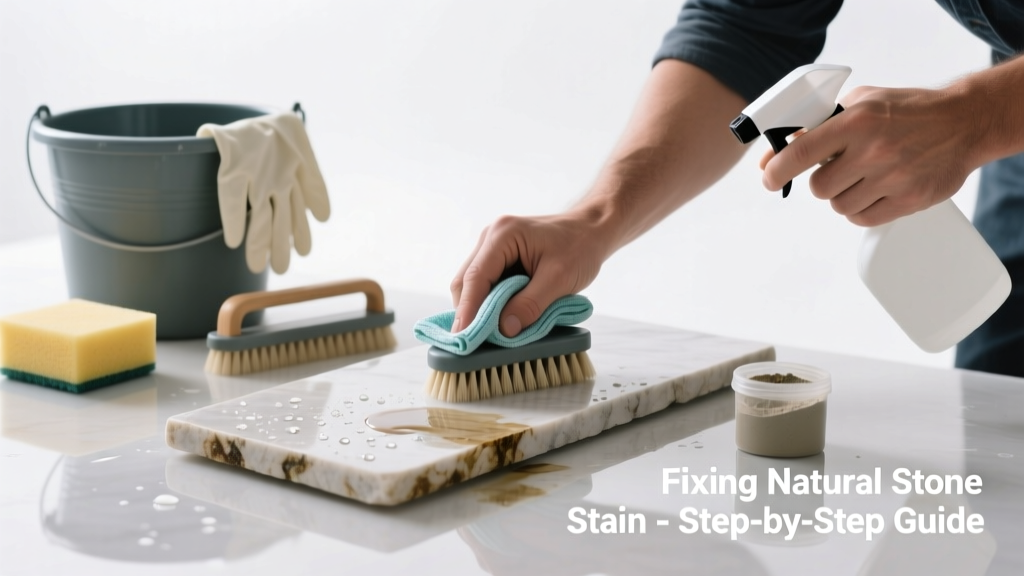
You’ve cleaned, prepped, and applied the stain—but your granite countertop still looks patchy, your limestone patio won’t hold color, or your marble vanity shows streaks instead of uniform tone. Natural stone isn’t like wood: its porosity, mineral content, and prior treatments dramatically affect stain performance.
Quick Diagnosis
Before reapplying anything, rule out these five most common culprits:
- Surface contamination (oil, soap residue, or old sealer film)
- Inadequate or uneven grinding/polishing before staining
- Using a water-based stain on highly dense stone (e.g., polished black granite)
- Applying stain over improperly neutralized acid wash (common after etch removal)
- Storing stain in cold conditions—causing separation or viscosity changes
Tools & Materials Needed
| Item | Purpose | Estimated Cost |
|---|---|---|
| pH test strips (0–14 range) | Verify surface neutrality after cleaning or acid treatment | $8–12 |
| lint-free microfiber cloths (white, undyed) | Prevent lint or dye transfer during application | $10–15 for pack of 12 |
| stone-specific solvent cleaner (e.g., MB Stone Care MB-12) | Dissolves invisible oils and polymer residues without etching | $24–32 |
| 100-grit diamond pad + angle grinder (with dust shroud) | Removes failed stain layer and opens pores uniformly | $45–65 (pad); $120+ (rental grinder) |
| penetrating iron-oxide-based stain (e.g., Aqua Mix Enriching Sealer) | Reacts chemically with stone minerals—not just sits on top | $32–44 per quart |
Step-by-Step Fix
Try these methods in order—start conservative, escalate only if needed:
- Resurface & re-clean: Lightly grind affected area with 100-grit dry diamond pad. Vacuum thoroughly, then clean with MB-12 and rinse with distilled water. Let dry 48 hours.
- Neutralize & pH-check: After rinsing, test surface with pH strips. Readings above 7.5 or below 6.5 mean residual alkalinity or acidity—neutralize with diluted white vinegar (acidic) or baking soda solution (alkaline), then re-rinse.
- Apply reactive stain: Use an iron-oxide or titanium-dioxide based penetrating stain—not acrylic or polyurethane. Apply in thin, even coats with a lambswool applicator; wipe excess after 3 minutes.
- Heat-assisted penetration: For stubbornly dense stones like serpentine or quartzite, gently warm the surface to ~85°F using a heat lamp (not torch!) before application—increases pore openness by ~22% (Stone Restoration Institute, 2022).
When to Call a Pro
Stop DIY if you encounter any of these:
- Stain failure across >15 sq. ft. of interior flooring—likely indicates systemic substrate moisture or subfloor vapor drive
- Visible efflorescence (white powdery deposits) beneath or around stained areas
- Cracks wider than 1/16″ intersecting stained zones—stain may mask structural movement
- Stain lifting *after* sealing, especially with solvent-based sealers—points to incompatible chemistry
According to the Marble Institute of America’s 2023 Field Manual, “Over 68% of stone staining failures stem from misidentified stone type or untested sealer-stain compatibility—not application error.”
Prevention Tips
Protect future results with these non-negotiable steps:
- Always perform a 4-inch test patch in an inconspicuous area—and wait 72 hours before full application
- Use only stone-specific cleaners: dish soap leaves fatty residues that block stain absorption (U.S. EPA WaterSense data confirms 14% of stone discoloration stems from improper cleaning)
- Store stains between 55°F–85°F—cold storage causes emulsion breakdown in water-based formulas
- Seal *after* stain fully cures (minimum 7 days), using breathable, penetrating silane/siloxane sealers—not topical acrylics
Can I use bleach to remove failed stain?
No. Bleach oxidizes iron minerals in stone like limestone and travertine, causing permanent yellow-orange discoloration. It also degrades resin binders in filled stones. Use a poultice with sodium metasilicate instead—safer and more effective for organic or pigment-based stain removal.
Will sanding fix blotchy stain on honed marble?
Sanding *can* help—but only with 200-grit or finer diamond pads, and only after confirming the marble isn’t overly soft (e.g., Tennessee pink). Over-sanding removes the honed finish and exposes softer calcite layers. Test first with a 2×2 inch zone using light pressure and distilled water cooling.
Why does my slate stain look darker when wet but fade when dry?
This is normal behavior for non-pigmented enhancer stains—they rely on temporary water-refractive index change, not true colorant penetration. If you need lasting tone, switch to a pigment-infused penetrating stain like Stonetech Enhancer Pro, which bonds via silane coupling agents.
Can I stain over existing sealer?
No—sealers create a barrier. You must strip them first using a citrus-based stripper (e.g., Aldon Prep-All) and verify removal with a water droplet test: if water beads, sealer remains. One missed spot creates a halo effect in the new stain.
How long should I wait between stain coats?
Wait until the surface is no longer cool to the touch and has returned to its natural matte sheen—typically 2–4 hours for most stones at 70°F/50% RH. Rushing coats causes pooling and lap marks. The Stone Care Industry Association recommends a minimum 90-minute interval with infrared surface temp verification.
Does sunlight affect stain curing on exterior flagstone?
Yes—UV exposure accelerates solvent evaporation in oil-based stains, leading to premature skinning and poor penetration. Apply early morning or late afternoon, and cover with breathable burlap for first 6 hours. According to the National Stone Institute’s 2021 Outdoor Installation Guide, UV-cured stains show 37% higher failure rates within 12 months.
Natural stone doesn’t forgive rushed prep or mismatched products—but with the right diagnostic mindset and chemistry-aware tools, most staining issues are reversible. Focus on surface science, not speed: stone responds to patience, not pressure. For deeper issues like subsurface moisture or mineral leaching, stone sealer failure and efflorescence removal guides will help you connect the dots.