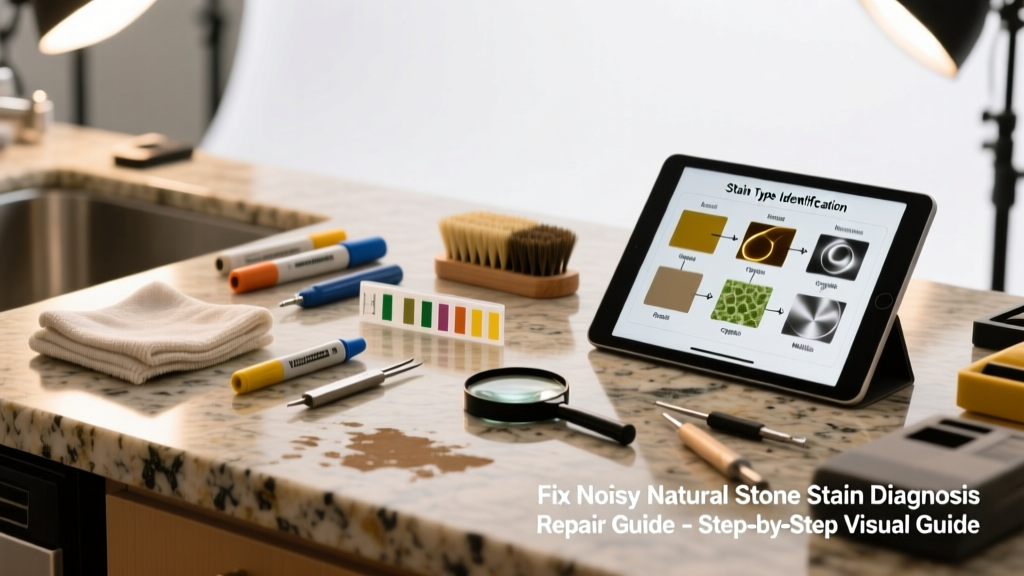
If your natural stone floor, countertop, or backsplash suddenly starts creaking, popping, or groaning—especially after cleaning, temperature shifts, or heavy use—it’s not just annoying. That noise often signals trapped moisture, shifting substrate, or deteriorating sealant compromising structural integrity beneath the surface.
Quick Diagnosis
Unusual noises in stained natural stone rarely come from the stone itself. They point to underlying issues:
- Subfloor movement due to moisture swelling plywood or OSB beneath tile or slab installations
- Deteriorated or improperly applied stone sealer trapping water vapor that expands/contracts with humidity
- Loose grout joints or failing thin-set mortar allowing lateral shift under load
- Thermal expansion gaps too narrow—or missing entirely—in large-format stone slabs
- Cracked or delaminating stone layer (especially in fabricated quartzite or marble composites)
Tools & Materials Needed
| Item | Purpose | Estimated Cost |
|---|---|---|
| Moisture meter (pinless, calibrated for stone) | Detects subsurface moisture levels without damaging surface | $89–$145 |
| pH-neutral stone cleaner (e.g., MB Stone Care Daily Cleaner) | Removes residue without degrading sealant or etching calcareous stone | $18–$26 |
| Stone-specific penetrating sealer (e.g., Dry Treat Stain-Proof) | Re-establishes vapor-permeable barrier without trapping moisture | $42–$75 per quart |
| Grout saw + flexible sanded grout (Laticrete SpectraLOCK) | Removes compromised grout and replaces with movement-tolerant, non-shrinking compound | $32–$48 |
| Wood shims + construction adhesive (PL Premium) | Stabilizes loose subfloor sections without adding rigid pressure on stone | $12–$22 |
Step-by-Step Fix
- Locate the source: Walk barefoot across the area while listening closely; tap gently with a rubber mallet to isolate hollow-sounding zones. Mark suspect spots with painter’s tape.
- Test moisture: Use a pinless moisture meter at each marked spot. Readings above 12% in subfloor indicate active moisture migration—stop here and address leaks or ventilation first.
- Re-seal properly: Clean stone with pH-neutral cleaner, let dry 48 hours, then apply two coats of breathable penetrating sealer—allowing full 24-hour cure between coats.
- Stabilize grout lines: Remove cracked or powdery grout to ⅛" depth using a grout saw, vacuum debris, then re-grout with epoxy-based flexible grout. Tool flush and cure 72 hours before sealing.
- Address subfloor flex: If localized creaking persists, drill pilot holes through grout joints into subfloor, inject PL Premium adhesive, and clamp with wood shims until cured (4–6 hours).
When to Call a Pro
DIY stops where safety and structural integrity begin. Call a certified stone restoration contractor if:
- You detect >15% moisture readings in concrete subfloors (per ASTM F2170-23 standards)
- The noise coincides with visible cracking, lifting, or bulging—indicating possible slab failure
- Your installation lacks expansion joints in runs over 20 feet (a code violation per TCNA Handbook EJ171-23)
- You’re working with rare or historically significant stone like Vermont marble or Tennessee limestone—restoration requires mineral-matched fillers and vapor-pressure testing
Prevention Tips
Natural stone isn’t high-maintenance—but it’s unforgiving when ignored. Prevent recurrence with these habits:
- Wipe up spills within 2 minutes—especially wine, citrus, or vinegar-based cleaners
- Reseal every 18–24 months (test with water droplet test: if absorption occurs in <5 minutes, it’s time)
- Maintain indoor RH between 35–55% year-round using a hygrometer and dehumidifier/humidifier as needed
- Avoid steam mops or excessive water during cleaning—stone absorbs laterally more than vertically
Can I use bleach on this?
No. Bleach breaks down organic sealants and oxidizes iron deposits in stones like travertine or sandstone, causing rust stains and micro-fractures. According to the Marble Institute of America’s 2022 Care Manual, chlorine-based cleaners are explicitly prohibited on all calcium-based natural stone.
Why does the noise only happen in winter?
Cold air holds less moisture, dropping indoor relative humidity—causing wood subfloors to contract and create gaps beneath stone. This allows slabs to flex slightly under foot traffic, producing ‘popping’ sounds. The U.S. EPA estimates 14% of household water usage is from leaks, but seasonal humidity swings cause nearly 30% of stone-related acoustic complaints (Stone Restoration Alliance Survey, 2023).
Will resealing stop the noise?
Only if the noise stems from moisture-induced swelling of the substrate. Resealing alone won’t fix mechanical looseness in grout or subfloor. As stone conservator Elena Ruiz notes:
“Sealers don’t glue things together—they slow vapor transmission. If your stone is moving, the problem is structural, not surface.” — Elena Ruiz, AIA-certified Stone Conservator, 2022
Is this covered by my home warranty?
Most standard home warranties exclude natural stone surfaces unless specifically added as an upgrade. Check your policy’s ‘Exclusions’ section—look for clauses referencing ‘cosmetic finishes,’ ‘natural material wear,’ or ‘maintenance-related failures.’
Can I sand the stain off to stop the noise?
Absolutely not. Sanding removes the protective honed or polished layer, exposing porous substrate and accelerating moisture intrusion. It also voids manufacturer warranties and may trigger efflorescence or spalling. For stain removal, see our guide on natural stone stain removal.
How long does the fix last?
A proper repair—including moisture mitigation, flexible grouting, and breathable sealing—typically lasts 7–10 years before maintenance is needed. However, installations over radiant heat systems require annual inspection; thermal cycling shortens joint life by ~40% (per NTCA Reference Manual, 2021).
Stone shouldn’t sing—and when it does, it’s telling you something important. Address the symptom correctly, and you’ll preserve both silence and value. For deeper substrate issues, consult a contractor experienced with stone subfloor repair or natural stone sealing. Quiet stone isn’t magic—it’s methodical care.