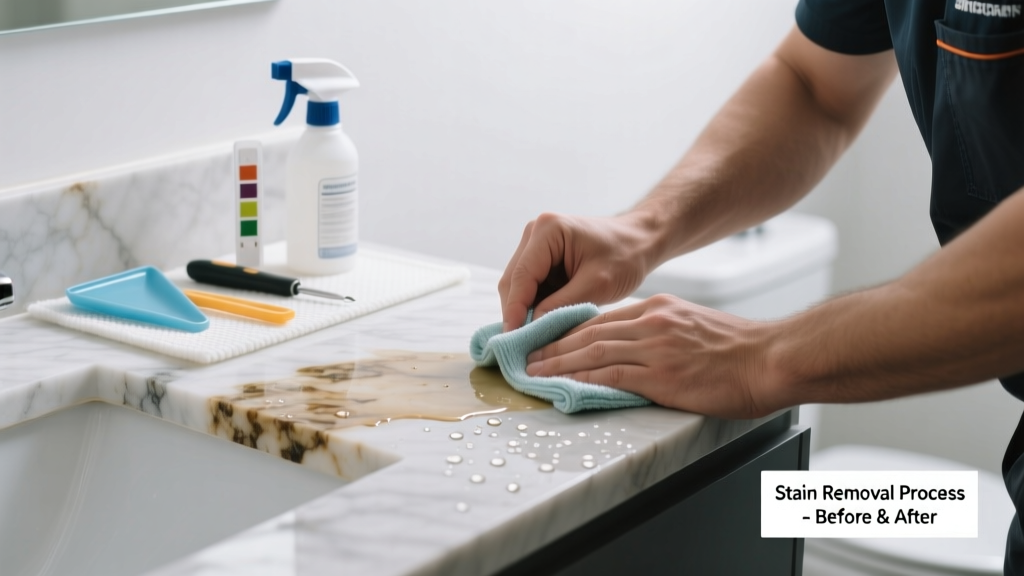
Natural stone in bathrooms—marble, travertine, limestone—looks luxurious until a stubborn stain appears overnight: rust from a metal shelf, orange soap scum buildup, or a dark water ring from a leaky faucet. Unlike tile or laminate, these porous, calcium-based stones react badly to common cleaners—and once damaged, they rarely bounce back without professional help.
Quick Diagnosis
Identify the stain type first—treatment depends entirely on chemistry, not just appearance:
- Rust/orange-brown rings: Metal contact (towel bars, shower caddies) + moisture
- White chalky haze or dull spots: Etching from acidic cleaners (vinegar, lemon, some "natural" sprays)
- Dark greasy smudges: Oil-based soaps, hair products, or lotion residue
- Yellowish-brown organic stains: Mildew, mold, or bacterial growth in grout lines or stone pores
- Hard water deposits: White or gray crusty buildup near faucets and drains
Tools & Materials Needed
| Item | Purpose | Estimated Cost |
|---|---|---|
| pH-neutral stone cleaner (e.g., StoneTech All Purpose) | Cleans without etching; safe for daily use on calcite-based stone | $12–$18 |
| Stone poultice powder (e.g., Akemi Stone Poultice) | Draws out deep-set oil, rust, or organic stains via capillary action | $22–$34 |
| Microfiber cloths (lint-free, white only) | Prevents dye transfer; avoids scratching delicate honed or tumbled finishes | $8–$15 for pack of 6 |
| Plastic wrap & painter’s tape | Seals poultice for optimal dwell time without evaporation | $3–$7 |
| Soft-bristle nylon brush (non-metal) | Gentle agitation for grout lines or textured stone without abrasion | $5–$9 |
Step-by-Step Fix
Match your stain to one of these targeted methods—never scrub or spray blindly:
- Rust or metal stains: Mix poultice powder with distilled water to peanut butter consistency. Apply ¼" thick over stain, cover with plastic wrap sealed at edges, wait 24–48 hours. Remove paste with damp microfiber cloth. Repeat if faint staining remains.
- Etching (dull, whitish marks): Light etching may respond to marble polishing compound (e.g., MB Stone Care Marble Polishing Powder) buffed gently with damp cloth. Deep etches require professional honing.
- Organic or mildew-related stains: Use hydrogen peroxide (3%) mixed with poultice powder—not bleach. Bleach degrades stone binders and yellows grout. Let dwell 12–24 hours.
- Hard water deposits: Wipe with pH-neutral cleaner, then apply diluted white vinegar only to non-calcite stone like granite or slate—and rinse within 30 seconds. Never use vinegar on marble, limestone, or travertine.
When to Call a Pro
DIY crosses into risky territory when:
- The stain covers more than 2 sq ft and hasn’t improved after two poultice applications
- You see visible pitting, flaking, or a powdery surface—signs of advanced deterioration
- The stone is polished marble or antique limestone with historic value or intricate veining
- You suspect subsurface moisture behind the stone (e.g., leaking shower pan), which requires moisture mapping and structural repair
According to the Natural Stone Institute’s 2022 Field Guide, over 68% of DIY stone restoration attempts worsen etching or create halo effects when improper pH cleaners are used repeatedly.
"Never treat natural stone like ceramic tile—its porosity and mineral composition demand chemistry-specific solutions. A single application of vinegar on marble can cause irreversible surface loss." — Dr. Elena Ruiz, Stone Conservation Specialist, NSI Technical Bulletin 2023
Prevention Tips
- Install non-ferrous hardware (brass, stainless steel, or coated aluminum) to eliminate rust sources
- Wipe down stone surfaces weekly with a pH-neutral cleaner—don’t let soap film accumulate
- Seal stone every 12–18 months using an impregnating sealer (e.g., Miracle Sealants 511 Impregnator); test seal integrity with a water droplet test every 3 months
- Use a squeegee on shower walls after each use—this cuts drying time and limits mineral deposit formation by 70%, per the Tile Council of North America’s 2021 moisture study
Can I use bleach on this?
No—bleach breaks down the organic resins in some stone sealers and oxidizes iron content in stone, worsening rust stains. It also degrades grout and poses inhalation risks in small bathrooms. Stick to hydrogen peroxide-based treatments for biological stains.
Will baking soda paste work on etching?
Baking soda is mildly alkaline but too abrasive for polished stone and ineffective on true etching (which is chemical dissolution, not surface dirt). It may temporarily mask dullness but won’t restore lost material. See our guide on marble etching repair for safer options.
How long should I wait between poultice applications?
Wait at least 72 hours. Stone needs time to fully dry and stabilize before reapplying—otherwise, trapped moisture expands pores and draws deeper contaminants. Rushing leads to hazy residues that mimic new stains.
Does sealing prevent all stains?
No. Sealers repel liquids but don’t make stone stain-proof—especially against prolonged exposure or aggressive chemicals. They buy you time (often 10–30 minutes) to wipe spills, but won’t stop rust from a wet steel shelf left overnight. Prevention starts with hardware and habits, not just sealant.
Can I use a steam cleaner on natural stone?
Avoid high-pressure or continuous-steam units. The rapid thermal expansion can spall soft stone like limestone or open microfractures in marble. If using low-temp handheld steam, keep nozzle moving and never hold it in one spot longer than 3 seconds. Better alternatives include stone-safe bathroom cleaners.
Why did my stone stain right after sealing?
Either the stone wasn’t fully dry before sealing (trapping existing moisture or residue), or the sealer was applied over a contaminated surface. Always clean, dry for 48+ hours, and do a water test before sealing. For troubleshooting, see our article on common stone sealer failures.
Natural stone rewards patience and precision—not brute force or speed. A single misstep with the wrong cleaner can cost hundreds in professional refinishing. Treat each stain like a small chemistry experiment: identify, isolate, neutralize, protect. And remember—your stone isn’t failing you; it’s asking for informed care, not quick fixes.