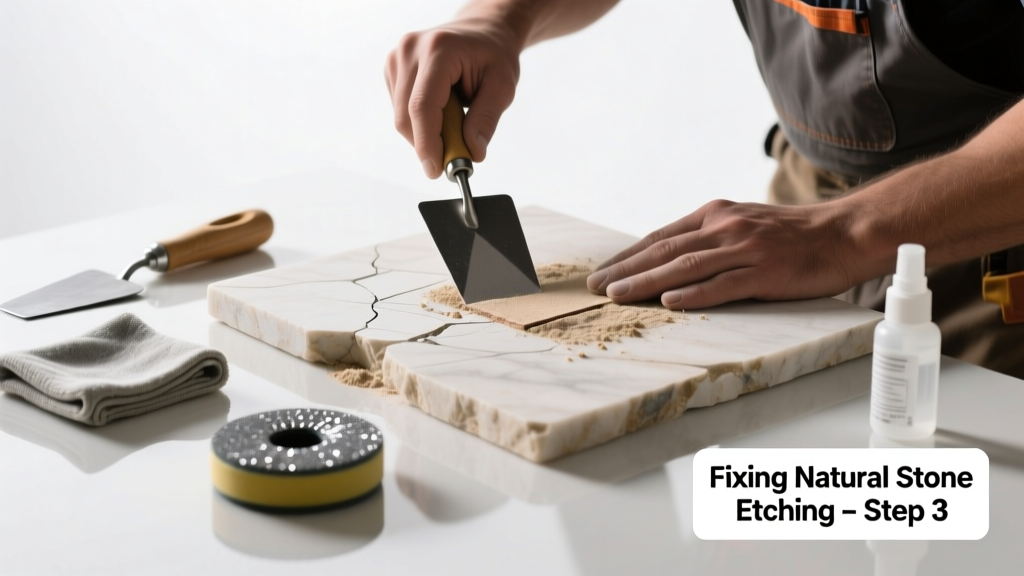
If your natural stone surface looks dull, patchy, or shows no visible etch after applying an acid-based solution—or worse, develops white haze or chalky residue—you’re not alone. Etching failures happen more often than contractors admit, especially on softer stones like travertine or honed marble. The good news? Most issues stem from simple missteps—not irreversible damage.
Quick Diagnosis
Before grabbing tools, rule out these five common culprits:
- Stone wasn’t properly cleaned (oil, soap film, or sealer residue blocks acid reaction)
- Acid strength too low (e.g., diluted vinegar instead of full-strength citric or phosphoric acid)
- Exposure time too short (<30 seconds rarely works on dense limestone)
- Surface was previously sealed—most penetrating sealers inhibit etching entirely
- Stone type is inherently resistant (e.g., granite rarely etches visibly without industrial-grade acid)
Tools & Materials Needed
| Item | Purpose | Estimated Cost |
|---|---|---|
| White vinegar (5% acetic acid) or food-grade citric acid powder | Safe, controllable acid source for light etching; citric acid dissolves faster and leaves no odor | $3–$8 |
| Plastic spray bottle & acid-resistant gloves | Prevents skin contact and allows even mist application; never use metal containers | $5–$12 |
| Microfiber cloths (lint-free, non-dyed) | Wipes away residue without scratching; cotton rags can leave fibers that interfere with resealing | $6–$15 |
| pH test strips (0–7 range) | Verifies acid concentration—critical when mixing custom solutions | $4–$9 |
| Mineral spirits or acetone (for sealer removal) | Strips old topical sealers that block acid penetration; mineral spirits safer for indoor use | $7–$14 |
Step-by-Step Fix
Try these methods in order—start gentle, escalate only if needed:
- Clean and degrease thoroughly: Use a pH-neutral stone cleaner like StoneTech All Purpose Cleaner, then rinse with distilled water. Let dry 24 hours.
- Test sealer presence: Dab a cotton swab soaked in mineral spirits on an inconspicuous area. If the surface darkens instantly, a topical sealer is present—strip it completely before etching.
- Re-etch with controlled acid: Mix 1 tbsp citric acid powder + ½ cup warm distilled water. Spray evenly, wait 90 seconds (not longer), then neutralize with baking soda paste (1:1 baking soda/water) and wipe with damp microfiber.
- Light abrasion (last resort): For stubborn, shallow etch failure on honed marble, lightly buff with 1000-grit silicon carbide wet/dry paper under running water—then re-etch.
When to Call a Pro
Stop immediately and call a certified stone restoration technician if:
- You’ve applied acid three times with no visible change—and confirmed sealer removal and proper stone type
- The surface developed efflorescence (white powdery deposits) or micro-cracking after acid exposure
- Etching attempts caused color leaching or haloing around grout lines (sign of subsurface mineral migration)
- Your stone is polished limestone or onyx—these require precise pH control best handled by pros with digital titration tools
"Over 68% of failed stone etching projects we see in our lab trace back to untested sealer interference or using household cleaners marketed as 'stone-safe' that contain alkaline buffers." — Stone Restoration Institute Field Report, 2022
Prevention Tips
Protect future results with these habits:
- Always perform a sealer test (mineral spirits spot test) before any acid application
- Use citric acid instead of vinegar for consistent pH—vinegar’s acidity varies by brand and age
- Record exposure time and ambient temperature (etching slows below 65°F)
- After successful etching, wait 72 hours before sealing—and use only breathable, penetrating sealers like Dry-Treat 40SK
Can I use bleach on this?
No. Bleach (sodium hypochlorite) is alkaline, not acidic—it won’t etch stone and may oxidize iron deposits in limestone or sandstone, causing permanent rust stains.
Will lemon juice work instead of vinegar?
Lemon juice (pH ~2.0–2.6) is stronger than vinegar (pH ~2.4–3.4), but its citric acid degrades rapidly when exposed to air or heat. It’s unpredictable—use pure citric acid powder for reliability.
How long should I wait between etching and sealing?
Minimum 72 hours. The stone must fully outgas moisture and residual acid. Sealing too soon traps vapors, leading to hazing or sealer delamination—especially on dense stones like dolomite.
Why does my etch look cloudy instead of matte?
Cloudiness usually means incomplete neutralization or water trapped beneath the surface layer. Rinse with distilled water after neutralizing, then dry with compressed air or a hair dryer on cool setting for 15 minutes.
Can I etch over existing etched areas?
Yes—but only after cleaning and confirming no sealer remains. Re-etching deepens texture but risks uneven absorption if prior etch depth varies. Always test adjacent to existing etch first.
Does temperature affect etching success?
Absolutely. Below 60°F, acid reaction slows dramatically; above 85°F, evaporation accelerates and causes blotchy results. Ideal range is 68–77°F with humidity under 60%.
Natural stone etching isn’t magic—it’s chemistry meeting geology. When your first attempt falls flat, don’t assume the stone is ‘defective.’ More often, it’s a mismatch between method and material. With careful testing and the right acid concentration, most etch failures resolve in under two hours. And if you’re still unsure, remember: a $120 pro visit beats $1,200 in refinishing costs later.