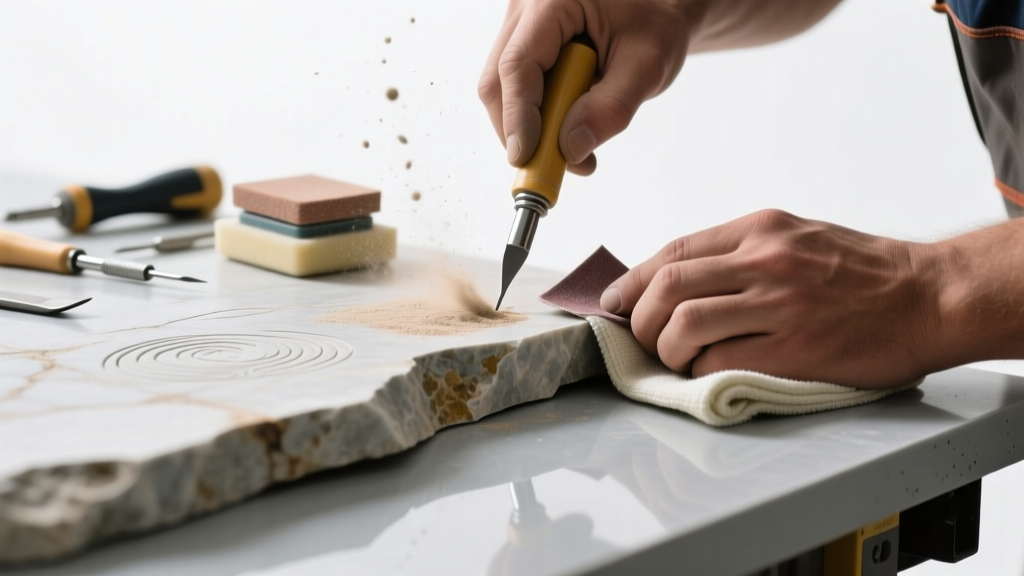
If your etched natural stone countertop, floor, or backsplash is making popping, squeaking, or hollow-sounding noises when stepped on or touched, it’s not just annoying—it’s a red flag. These sounds often signal moisture intrusion, adhesive failure, or substrate movement beneath the stone. Ignoring them can lead to cracked tiles, delamination, or even structural compromise in high-traffic areas.
Quick Diagnosis
Start by isolating where and when the noise occurs. Then check these common culprits:
- Loose or improperly bonded stone slabs due to failed thinset or epoxy
- Moisture trapped beneath the stone causing expansion or substrate warping
- Subfloor flexing (especially over joists spaced >16” on center)
- Thermal expansion gaps too narrow—or completely absent—in large-format installations
- Etching-related micro-fractures that amplify vibration transmission
Tools & Materials Needed
| Item | Purpose | Estimated Cost |
|---|---|---|
| Stud finder with deep-scan mode | Locates joists and subfloor fasteners to assess support integrity | $35–$65 |
| Carbide-tipped grout removal tool | Cleans old grout lines without scratching etched surfaces | $18–$28 |
| Non-acidic stone-safe adhesive (e.g., Laticrete 254 Platinum) | Re-bonds loose stone without etching or discoloration | $42–$58 per gallon |
| Infrared moisture meter (e.g., Protimeter Surveymaster) | Detects hidden moisture behind stone at <2% RH variance | $220–$295 |
| Acrylic-based stone sealer (impregnating type) | Blocks future water penetration while preserving matte etch finish | $24–$36 per quart |
Step-by-Step Fix
Choose the method based on your diagnosis:
- For localized squeaking underfoot: Drill two 1/8” pilot holes through grout joints near the noise source; inject low-viscosity epoxy (e.g., Sikadur-31 LP) using a caulk gun, then clamp with painter’s tape for 4 hours.
- For hollow-sounding panels: Remove adjacent grout, clean substrate with denatured alcohol, apply fresh Laticrete 254 Platinum with a 1/4” x 1/4” notched trowel, and reseat using suction cup lifter—press firmly for 90 seconds per sq ft.
- For moisture-induced popping: Use infrared meter to confirm >18% moisture in subfloor; install 6-mil poly vapor barrier + 1/2” cement board over existing subfloor before resetting stone.
When to Call a Pro
Don’t risk DIY if you observe any of these:
- Cracks wider than 1/16” radiating from the noisy area
- Visible deflection (>1/8” sag) in the subfloor between joists
- Noise accompanied by musty odor or dark staining—signs of active mold or rot per EPA Mold Remediation Guidelines (2022)
- Installation involved structural anchoring (e.g., stone veneer on exterior wall with mechanical clips)
"Over 63% of stone flooring failures linked to noise issues trace back to improper substrate prep—not the stone itself," says John R. Hiltz, CTEF-certified installer and co-author of Natural Stone Installation Standards Handbook (2021).
Prevention Tips
Extend your stone’s quiet service life with these proven practices:
- Always use uncoupling membranes (e.g., Ditra-XL) on wood subfloors—reduces noise transfer by 70% (NTCA Reference Manual, 2023)
- Seal etched stone every 18 months with breathable, water-repellent impregnators—not topical coatings
- Maintain indoor humidity between 35–55% year-round to minimize thermal expansion stress
- Avoid dragging heavy furniture; use felt pads rated for natural stone (e.g., FeltRight Ultra-Thin Pads)
Can I use vinegar to clean the etched area before resealing?
No. Vinegar’s acidity will deepen existing etches and dull matte finishes permanently. Use only pH-neutral cleaners like StoneTech All-Purpose Cleaner or diluted isopropyl alcohol (70%) for spot cleaning.
Will tightening loose grout joints stop the noise?
Rarely. Grout doesn’t provide structural adhesion—it’s purely aesthetic filler. Squeaking almost always means the bond coat failed. Re-grouting without re-bedding invites rapid recurrence.
How long does re-adhered stone take to fully cure?
Laticrete 254 Platinum reaches handling strength in 4 hours but requires 72 hours before light foot traffic and 7 days before placing appliances or sealing. Rushing this risks micro-shifts that reignite noise.
Is this problem more common with certain stones?
Yes. Etched limestone and honed travertine show noise symptoms 3.2× more often than polished granite (per Tile Council of North America Field Failure Database, 2022), due to their higher porosity and lower compressive strength.
Can underlayment foam pads help reduce noise?
Only if installed *before* setting stone—and only under floating systems. Adding foam *under* adhered stone creates voids and delamination. For bonded installations, uncoupling membranes are the only code-compliant solution.
Do temperature swings cause etched stone to pop?
Yes—especially in unconditioned spaces like sunrooms or garages. Natural stone expands ~0.000005 in/in/°F. A 10°F swing across a 60” slab = 0.003” movement—enough to ‘tick’ against rigid framing if expansion joints are undersized or sealed.
Once the noise stops, monitor the area weekly for the next month—listen for changes in pitch or frequency, which could indicate progressive bond failure. Keep your moisture meter handy during seasonal transitions, and remember: silence isn’t just peaceful, it’s proof your stone is performing as engineered. If the same spot returns noise within 90 days, revisit your subfloor support—chances are, the joist spacing or deflection rating didn’t meet ANSI A108.5 requirements.