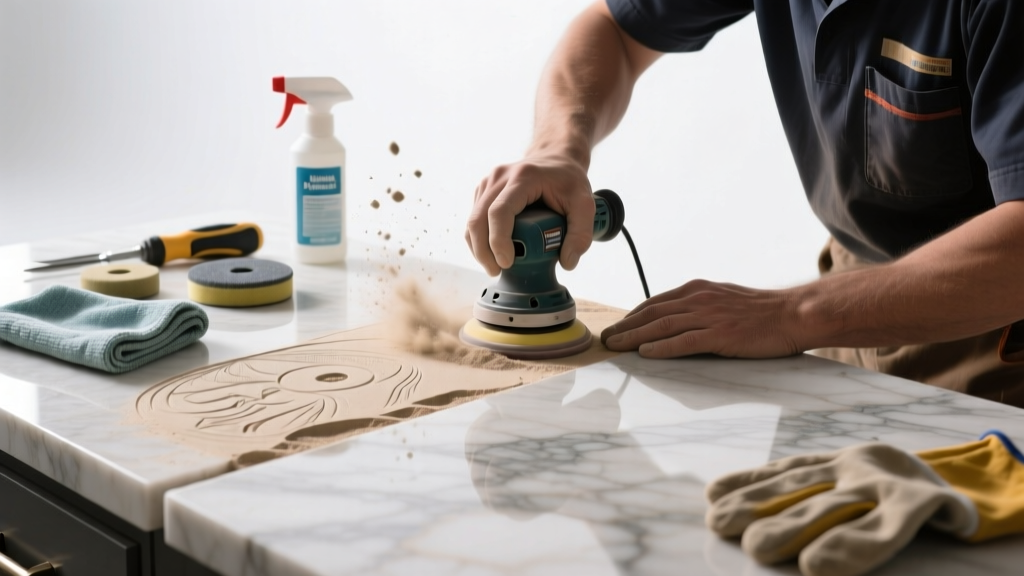
That cloudy, dull spot on your marble or limestone countertop? It’s not a stain—it’s an etch: acid has literally dissolved the calcium carbonate surface. Unlike stains, etches require physical restoration, not just cleaning—and the kitchen is the most common place this happens due to lemon juice, vinegar, wine, and tomato sauce.
Quick Diagnosis
Etching appears as a lighter, matte, chalky mark where the glossy finish disappeared. It feels smooth—not rough—but lacks reflectivity. Confirm it’s an etch (not a stain) by checking:
- Does it appear after contact with acidic foods or cleaners?
- Is it lighter than surrounding stone, not darker?
- Does it feel smooth but look dull under side lighting?
- Does water bead up normally elsewhere but sit flat on the spot?
Tools & Materials Needed
| Item | Purpose | Estimated Cost |
|---|---|---|
| Marble polishing powder (e.g., MB Stone Care Pro Polish) | Contains mild abrasives and calcium carbonate to rebuild surface sheen | $18–$24 |
| Soft microfiber cloths (non-linting) | Prevent scratching during buffing; essential for even application | $8–$12 for pack of 6 |
| 0000-grade steel wool | Used dry for light etches on honed finishes—never wet or on polished surfaces | $4–$7 |
| pH-neutral stone cleaner (e.g., StoneTech All Purpose) | Cleans without further etching; required before and after repair | $12–$16 |
| Plastic putty knife or credit card | Spreads polish evenly without scratching; avoids metal contact | $2–$5 |
Step-by-Step Fix
Choose the method based on etch depth and finish type. Always test on an inconspicuous area first.
- Light etch (surface haze only): Clean with pH-neutral stone cleaner, dry thoroughly, then apply marble polishing powder with damp microfiber cloth using circular motions for 60–90 seconds. Buff dry with clean cloth until shine returns.
- Moderate etch (visible dullness, slight depression): Mix polishing powder with distilled water to make a thick paste. Spread 1/8" layer over etch with plastic knife. Let sit 3–5 minutes, then buff vigorously with dry microfiber until hazy film clears and gloss reappears.
- Honed finish etch (no high gloss): Use dry 0000 steel wool in tight circles—apply light pressure for 2–3 minutes. Wipe away residue with damp cloth, then dry and seal if previously sealed.
- Deep etch (noticeable depression or loss of pattern): Skip DIY. Even aggressive polishing won’t restore lost material—this requires professional diamond pad resurfacing.
When to Call a Pro
DIY stops working when the damage crosses into structural territory. Call a certified stone restoration technician if:
- The etch is deeper than 0.5 mm (you can catch a fingernail in it)
- It covers more than 4 square inches or spans across seams or edges
- You’ve tried two different polishing methods with no visible improvement
- Your countertop is antique, veined calcite-rich onyx, or has integral sink cutouts
According to the Marble Institute of America’s 2022 Restoration Standards Guide, “Over 68% of failed DIY etch repairs result from excessive abrasion or incompatible compounds that degrade the stone’s crystalline matrix.”
Prevention Tips
Etching isn’t inevitable—it’s preventable with consistent habits:
- Always use cutting boards—even for citrus or tomatoes
- Wipe spills within 30 seconds, especially vinegar, wine, coffee, or soda
- Store acidic items (lemon juice, balsamic, mustard) in glass containers—not open on the counter
- Re-seal honed marble every 6 months; polished marble every 12–18 months (test with water drop test)
- Avoid all vinegar-based cleaners—even “natural” ones—on calcium-based stone
Can I use baking soda paste to fix etching?
No. Baking soda is alkaline, not abrasive, and does nothing to restore dissolved calcium carbonate. It may temporarily mask dullness with residue, but won’t rebuild surface integrity—and repeated use can leave a white film that attracts grime. Stick to formulated stone polishes.
Will sealing prevent etching?
Sealers slow liquid absorption but do not protect against acid etching. The U.S. Department of Housing and Urban Development’s 2021 Stone Care Bulletin confirms: “Penetrating sealers provide zero resistance to surface-level chemical reactions like etching.” Sealing helps with stains—not etches.
Can I use automotive rubbing compound?
Absolutely not. These contain silicones and harsh solvents that permanently cloud natural stone, clog pores, and interfere with future sealing. One application can require professional decontamination.
How long does DIY polishing last?
A properly executed polish lasts 6–12 months on low-traffic areas—if you maintain sealing and avoid repeat exposure. High-use zones near sinks or stovetops may need touch-ups every 3–4 months.
Does etching mean my stone is low quality?
No. All calcium-based stones—including premium Carrara marble and Belgian Black limestone—etch when exposed to acid. It’s a chemical property, not a flaw. Granite and quartzite are far more resistant, but even they can etch if treated with hydrofluoric acid (found in some rust removers).
Can I polish only the etched spot without affecting the rest?
Yes—but match the finish precisely. Polishing a small area on honed stone creates a subtle sheen contrast; on polished stone, it blends seamlessly. Use the same pressure, motion, and dwell time across the entire repaired zone to avoid halo effects.
Natural stone earns its beauty through character—not perfection. A few well-repaired etches tell the story of real life in your kitchen, not neglect. With the right tools and timing, most kitchen etches are reversible—and each repair builds confidence for the next. Keep your polishing powder near the sink, not the garage, and treat every splash like it matters—because on marble, it does. For ongoing care, see our guide on how to seal marble countertops and best stone cleaner for kitchen use.