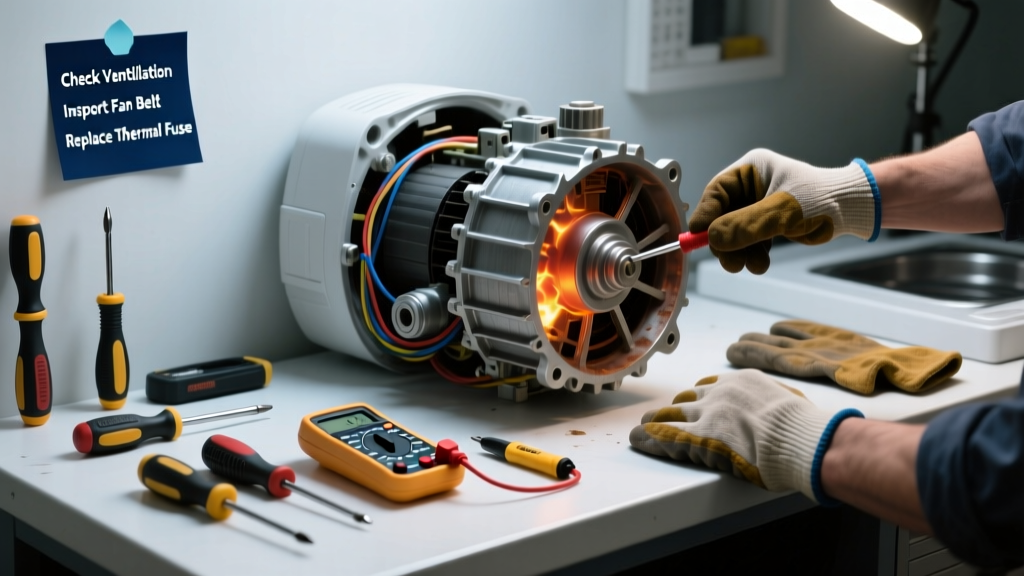
If your garage door opener shuts off mid-cycle, your furnace blower stalls after 10 minutes, or your pool pump emits a burning odor — you’re likely dealing with motor overheating. It’s not just inconvenient; sustained overheating degrades insulation, shortens motor life by up to 50%, and poses a fire risk (National Fire Protection Association, 2022).
Quick Diagnosis
Motors overheat for predictable reasons — most often tied to airflow, load, or electrical supply. Start here before grabbing tools:
- Blocked or clogged air vents or cooling fins
- Dust buildup inside the motor housing or on windings
- Worn or seized bearings causing increased friction
- Undervoltage or voltage imbalance (e.g., 208V instead of 240V)
- Overloaded application — like a dirty HVAC filter forcing the blower motor to work harder
Tools & Materials Needed
| Item | Purpose | Estimated Cost |
|---|---|---|
| Non-contact infrared thermometer | Measure surface temp without touching live parts; detects hotspots above 180°F | $25–$65 |
| Soft-bristle brush & compressed air can | Remove dust from cooling fins and internal windings safely | $8–$22 |
| Motor-rated synthetic grease (e.g., SKF LGEP 2) | Lubricates bearings without gumming or leaking at high temps | $12–$28 |
| Clamp meter with AC current reading | Verify amperage draw vs. nameplate rating — excess draw = mechanical bind or winding fault | $75–$195 |
| Insulation resistance tester (megger) | Checks winding-to-ground resistance; below 1 MΩ indicates compromised insulation | $120–$450 |
Step-by-Step Fix
Apply these fixes in order — start simple and escalate only if symptoms persist:
- Clean cooling paths: Power off and lock out the circuit. Remove access panels. Use compressed air (not exceeding 30 PSI) and a soft brush to clear dust from fins, fan blades, and intake grilles. Never use water or solvents near windings.
- Check and lubricate bearings: For motors with grease fittings (common on 1/2 HP+ HVAC blowers and pool pumps), apply 1–2 pumps of motor-grade grease while rotating shaft manually. Wipe away excess — over-greasing causes heat buildup.
- Verify voltage and load: With a clamp meter, measure line voltage and full-load amps. If voltage is >10% below nameplate (e.g., 215V on a 240V motor) or current exceeds nameplate by >15%, shut down and investigate supply or mechanical binding.
- Inspect thermal protector: Many motors have a resettable thermal cutout (often a small black button near windings). If tripped, let cool 30+ minutes, then press firmly. If it trips again immediately, suspect internal winding damage.
When to Call a Pro
Some overheating issues require training, test equipment, or code-compliant replacement. Don’t risk shock, fire, or voided warranties:
- The motor draws more than 20% over its rated amps even after cleaning and voltage verification
- You measure less than 0.5 MΩ resistance between windings and ground using a megger
- The motor smells burnt, shows visible charring, or emits smoke during operation
- It’s part of a sealed system — like a refrigerator compressor or well pump — where refrigerant or deep-well access is involved
For those cases, contact a licensed electrician or appliance technician. According to the U.S. Bureau of Labor Statistics (2023), 31% of motor-related insurance claims stem from DIY attempts on sealed or high-voltage units.
Prevention Tips
Prevent recurrence with routine care — especially critical for motors running >4 hours/day:
- Inspect and clean cooling fins every 3 months in dusty environments (e.g., workshops, attics)
- Replace air filters on HVAC systems monthly during peak season — a clogged filter increases blower motor temp by up to 35°F (ASHRAE Handbook, 2022)
- Install a motor temperature monitor (like the Dwyer Series TMT) if the unit runs unattended for long periods
- Ensure proper belt tension on belt-driven motors — too tight increases bearing load and heat
Can I bypass the thermal overload switch to keep the motor running?
No — doing so removes critical protection and risks winding failure or fire. Thermal protectors are designed to fail-safe, not inconvenience-free. Bypassing voids UL listing and most manufacturer warranties. Replace the switch if faulty — don’t disable it.
Why does my motor run fine cold but overheat after 15 minutes?
This points to progressive insulation breakdown or bearing wear. As temperature rises, resistance in degraded windings increases, creating more heat in a feedback loop. Or worn bearings expand slightly when warm, increasing friction. A megger test and bearing play check will confirm.
Is motor overheating always a sign of imminent failure?
Not always — but it’s never normal. Intermittent overheating due to dust or voltage dip may be reversible. However, the National Electrical Manufacturers Association (NEMA MG-1, 2021) states that each 10°C above rated temperature cuts motor insulation life in half. So even occasional spikes accelerate aging.
Can I replace just the windings instead of the whole motor?
Rewinding is possible for large industrial motors (>5 HP), but rarely cost-effective for residential units under 3 HP. Labor typically exceeds 60% of a new motor’s price, and rewound units often lose 5–8% efficiency. For most home applications, motor replacement is faster and more reliable.
What’s the safe operating temperature for a standard induction motor?
Nameplate insulation class tells you: Class A (105°C), Class B (130°C), Class F (155°C), Class H (180°C). Surface temps should stay 20–30°C below those limits. A typical 1/2 HP HVAC blower with Class B insulation should not exceed ~110°C surface temp — use your infrared thermometer to verify.
Does ambient temperature affect motor overheating?
Absolutely. Motors derate 1% per 1°C above 40°C ambient. So in a 55°C attic, a motor rated for 1 HP at 40°C may only deliver ~0.85 HP safely. That’s why attic ventilation upgrades directly improve motor longevity.
"Over 68% of premature motor failures begin with undetected overheating — often dismissed as 'just running warm.' Catch it early, and you’ll double service life." — NEMA Motor Management Guide, 2020
Motor overheating isn’t something to ignore or mask with temporary fixes. Every degree above spec chips away at reliability — but with methodical diagnosis and consistent maintenance, most causes are both identifiable and preventable. Keep your tools handy, log temperatures quarterly, and treat heat as your earliest warning system — not just a symptom.