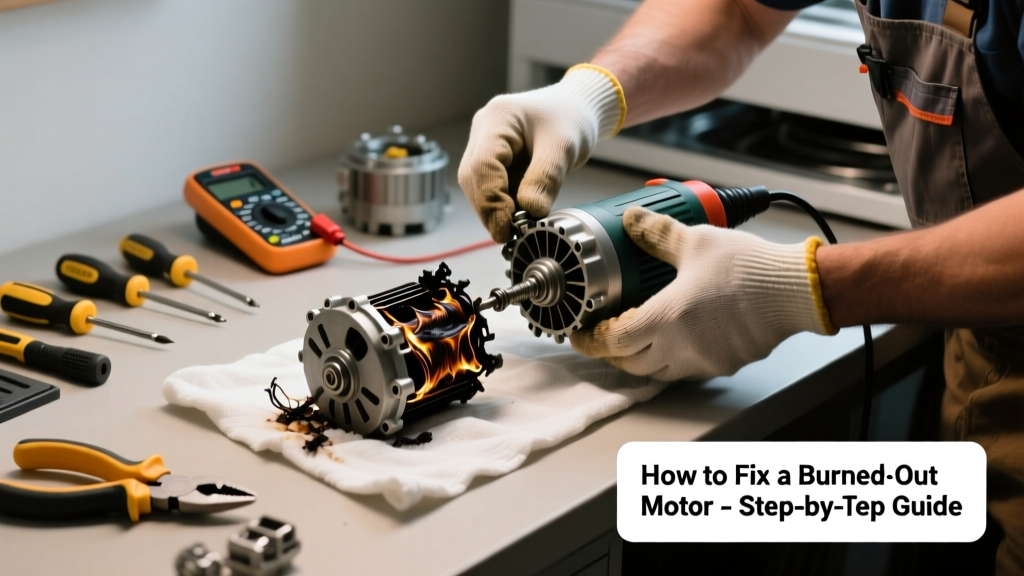
Your vacuum suddenly went silent. Your garage door opener whined then died. The furnace blower stopped mid-cycle. When a motor burns out, it’s rarely subtle—and rarely cheap to replace. But before you toss the appliance or call a technician, confirm it’s truly the motor—and not a switch, capacitor, or wiring issue.
Quick Diagnosis
A burned-out motor usually shows one or more of these signs:
- Burning smell (often like hot insulation or ozone)
- Visible charring, melted windings, or swollen casing
- Motor hums but won’t spin (often indicates seized bearings or shorted windings)
- Multimeter reads open circuit (infinite resistance) across main windings
- Tripped breaker or blown fuse that resets only to trip again under load
Tools & Materials Needed
| Item | Purpose | Estimated Cost |
|---|---|---|
| Digital multimeter | Tests continuity, resistance, and voltage to isolate motor failure | $15–$40 |
| Insulated screwdrivers & pliers | Safely disassemble housings and handle live components (if testing energized) | $12–$28 |
| Replacement motor (OEM or cross-referenced) | Exact match ensures proper mounting, shaft size, RPM, and thermal rating | $45–$220 |
| Wire strippers & crimping tool | Securely reconnect leads without cold solder joints or loose terminals | $8–$22 |
| Thermal paste (for high-temp motors) | Improves heat transfer from motor housing to mounting surface—critical for compressors and pumps | $6–$14 |
Step-by-Step Fix
Replacing a burned-out motor is rarely about rewinding—it’s about safe, precise substitution. Follow these methods in order:
- Power down and lockout/tagout: Unplug the device, disconnect from mains, and verify zero energy with your multimeter’s voltage setting.
- Remove access panels and document wiring: Take photos before disconnecting wires. Label terminals (e.g., “L1,” “COM,” “CAP”) with tape and a marker.
- Test motor windings: Set multimeter to ohms. Measure resistance between each pair of leads. An open reading (OL) on all pairs confirms burnout. A reading near zero ohms between two leads and OL elsewhere may indicate a shorted winding—not always repairable.
- Match replacement specs exactly: Check nameplate data: voltage, phase, RPM, frame size (e.g., 56Z), service factor, and enclosure type (TEFC, ODP). According to the National Electrical Manufacturers Association (NEMA) MG-1 standard, mismatched frame sizes cause misalignment and premature bearing failure.
- Install and torque correctly: Use a torque wrench if specified (e.g., 12–18 in-lbs for small HVAC blower motors). Over-tightening cracks housings; under-tightening causes vibration and overheating.
When to Call a Pro
Some motor failures aren’t just mechanical—they’re embedded in system-level safety or regulation:
- Any motor wired directly into 240V residential circuits (e.g., well pumps, central AC compressors) without a dedicated disconnect switch
- Motors in gas-fired appliances (furnaces, water heaters) where improper grounding risks carbon monoxide leaks or ignition hazards
- Hermetically sealed units (refrigeration compressors, some sump pumps) requiring refrigerant recovery and EPA-certified handling
- Industrial-grade motors over 1 HP used in commercial kitchens or workshops—subject to NEC Article 430 and local inspection requirements
"Over 68% of premature motor failures stem from improper installation—not manufacturing defects," states the U.S. Department of Energy’s Motor Systems Tip Sheet (2022).
Prevention Tips
Extending motor life isn’t magic—it’s maintenance discipline:
- Clean air intakes and cooling fins every 3 months on fans, blowers, and power tools
- Verify voltage supply stays within ±10% of nameplate rating using a clamp meter during peak operation
- Replace start/run capacitors every 5 years—even if they test OK—since internal degradation often precedes failure
- Install thermal overload relays on motors over ½ HP running continuously (e.g., pool pumps, attic fans)
Can I rewind a burned-out motor myself?
No. Rewinding requires specialized winding machines, varnish ovens, megohmmeter testing, and NEMA Class insulation knowledge. Even experienced electricians send motors to certified rewind shops—where labor alone runs $150–$400. For most household motors under 1 HP, replacement is faster and more reliable than rewinding.
Is a humming motor always burned out?
No. Humming usually means the motor is receiving power but can’t rotate—common causes include seized bearings, broken start capacitors, or jammed impellers. Test capacitor capacitance first (how to test a capacitor) before assuming motor failure.
Why does my new replacement motor run hotter than the old one?
Check alignment and load. A 10°F+ temperature rise over ambient suggests misalignment, undersized pulley, or excessive friction. Also verify supply voltage: a sustained 230V reading on a 208V motor increases winding temperature by ~35% (per IEEE Std 112-2017).
Do I need to replace the motor mount or bracket too?
Yes—if the original mount shows cracking, warping, or corrosion. Aluminum mounts fatigue after repeated thermal cycling. Replace with OEM-spec rubber-isolated mounts to dampen vibration and prevent coupling wear. See our guide on vibration dampening for motors.
Can I use a higher-horsepower motor as a drop-in replacement?
No. Oversizing increases current draw, overheats control wiring, and may exceed the device’s mechanical design limits (e.g., belt tension, gear train torque). It also voids UL/ETL certification. Always match nameplate HP, voltage, and speed.
What’s the average lifespan of a typical 120V AC motor?
Under normal load and cooling conditions, most fractional-horsepower motors last 8–12 years. But the U.S. EPA estimates that 30% fail prematurely due to voltage imbalance, dust accumulation, or lack of lubrication—issues easily mitigated with routine checks.
A burned-out motor feels like a dead end—but it’s really a diagnostic checkpoint. You now know how to tell whether it’s truly toast, how to swap it safely, and what habits actually extend motor life. Whether it’s a $29 shop vac or a $1,200 HVAC blower, treating the symptom without addressing root causes—like dirty filters or undersized circuits—just sets up the next failure. Keep your multimeter charged, your labels tidy, and your thermal paste fresh.