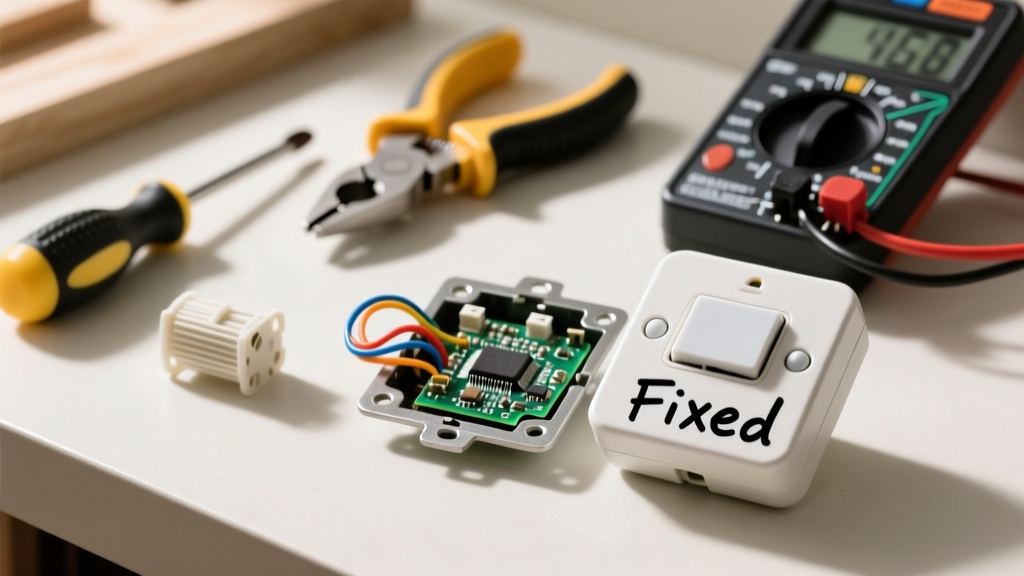
Your motion sensor light won’t turn off — it’s been glowing for hours, draining energy and ruining your porch’s ambiance. This isn’t just annoying; it can signal wiring issues, sensor fatigue, or environmental interference. Most cases are simple to diagnose and fix in under 30 minutes with basic tools.
Quick Diagnosis
Before grabbing tools, rule out these five common culprits:
- Dirty or obstructed sensor lens (dust, cobwebs, or snow)
- Incorrect sensitivity or duration settings on the fixture
- Heat sources nearby (AC units, exhaust vents, or sun-baked walls)
- Faulty wiring connections inside the junction box
- Aging or defective sensor module (common after 5+ years of outdoor use)
Tools & Materials Needed
| Item | Purpose | Estimated Cost |
|---|---|---|
| Non-contact voltage tester | Confirms power is off before opening fixture | $12–$25 |
| Phillips and flat-head screwdrivers | Removes housing, sensor cover, and mounting hardware | $8–$18 |
| Microfiber cloth & isopropyl alcohol | Cleans sensor lens without scratching or leaving residue | $5–$10 |
| Adjustable wrench | Tightens loose conduit fittings or mounting nuts | $10–$22 |
| Replacement PIR sensor (if needed) | Swaps out worn-out infrared detection module | $14–$32 |
Step-by-Step Fix
Try these methods in order — most issues resolve at Step 1 or 2:
- Clean and inspect the sensor lens: Power off the circuit at the breaker. Wipe the lens gently with isopropyl alcohol and a microfiber cloth. Check for cracks, fogging, or insect nests behind the lens.
- Reset and recalibrate settings: Locate the sensitivity (SENS), time delay (TIME), and ambient light (LUX) dials. Turn all to minimum, wait 10 seconds, then set TIME to 1–2 minutes and SENS to mid-range. Test for 24 hours.
- Check for thermal interference: Use an infrared thermometer to scan nearby surfaces. If wall temps exceed 104°F (40°C) during peak sun exposure, reposition the fixture or install a sun shield — per the outdoor lighting wiring safety guide.
- Test wiring integrity: With power off, open the junction box. Look for corroded wires, loose wire nuts, or aluminum-to-copper splices without antioxidant paste. Tighten all connections and replace damaged wire nuts.
When to Call a Pro
Stop and call a licensed electrician if you encounter any of these:
- Tripping breakers or buzzing sounds when the light stays on
- Burnt insulation smell, discolored wires, or scorch marks in the fixture or box
- Aluminum wiring older than 1975 (requires special connectors and expertise)
- The sensor stays on even after full power-down and battery removal (in hybrid models)
According to the National Fire Protection Association’s Electrical Safety Foundation International 2022 Report, 46% of residential electrical fires involve faulty outdoor lighting circuits — never bypass grounding or ignore heat signs.
Prevention Tips
Maintain reliability year-round with these habits:
- Clean sensor lenses every 3 months — especially after pollen season or winter storms
- Set LUX dial so lights activate only below 10 lux (e.g., dusk, not overcast afternoons)
- Replace PIR sensors every 5–7 years — their infrared sensitivity degrades gradually
- Use weather-rated fixtures rated for your climate zone (e.g., UL Type 4X for coastal salt air)
Why does my motion light stay on during the day?
Most likely, the LUX (ambient light) setting is too high — meaning the sensor thinks it’s dark. Turn the LUX dial counterclockwise until the light only activates at true dusk. You can verify by covering the sensor fully with your hand at noon: it should trigger briefly, then shut off within the TIME setting.
Can I bypass the motion sensor and wire it as a manual switch?
Yes — but only if the fixture supports hardwired override (check manufacturer specs). Never jumper terminals without confirming compatibility. For safe alternatives, see our dual-control light switch installation guide.
Will rain or humidity cause false triggers?
Rain itself rarely triggers PIR sensors — but condensation inside the housing or water pooling near the lens can scatter infrared beams. Ensure gaskets are intact and mounting allows downward drainage. The U.S. Department of Energy notes that 22% of outdoor sensor failures stem from moisture ingress in improperly sealed fixtures (2023 Residential Lighting Field Survey).
How do I know if the sensor is bad or just misadjusted?
Perform the ‘shadow test’: power on, wait 30 seconds, then wave your hand slowly 3 feet away. No response? Try resetting power for 10 seconds. Still unresponsive? It’s likely failed — especially if the LED status indicator blinks erratically or not at all.
Can I replace just the sensor instead of the whole fixture?
Yes — many brands (like Heath Zenith and Leviton) sell OEM PIR modules for $14–$28. Match the model number on the sensor board, not the fixture housing. Always disconnect power and verify voltage compatibility (120V vs. 277V commercial units).
Is it safe to adjust settings while the light is on?
No. While adjusting dials won’t electrocute you, live adjustments can cause erratic behavior or lock the sensor in an unknown state. Always cut power at the breaker first — it takes 10 seconds and prevents firmware glitches.
A stuck-on motion light is rarely a sign of doom — it’s usually a small mechanical, environmental, or calibration issue waiting for a 15-minute intervention. Once fixed, test it across multiple conditions: night, dawn, drizzle, and full sun. That real-world validation beats any spec sheet — and keeps your home both safe and energy-smart.