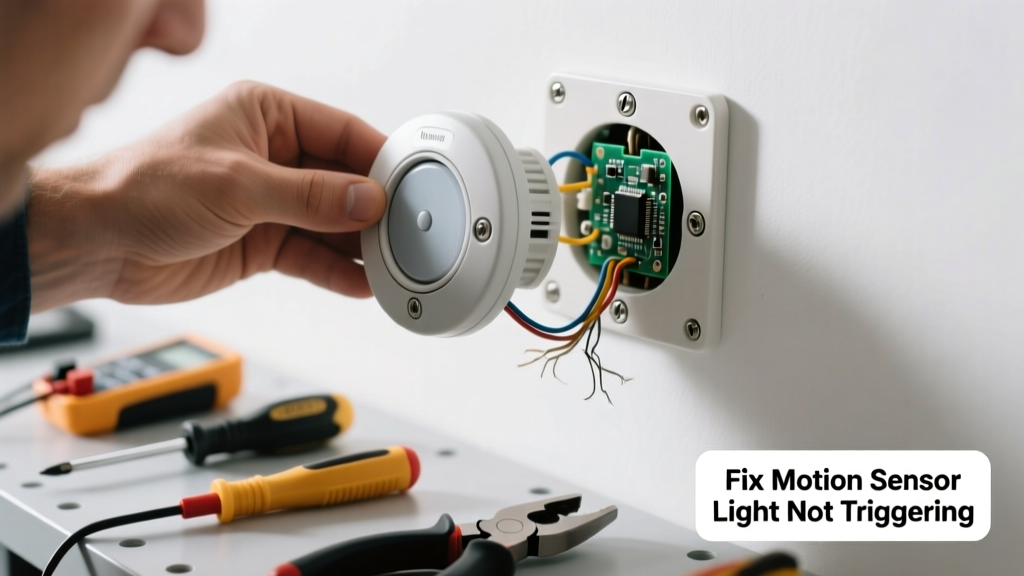
Your motion sensor light suddenly stops responding — no flicker, no chime, nothing — even when you wave your arms like a conductor at midnight. It’s frustrating, especially when safety or convenience depends on it. Most of the time, the issue isn’t the sensor itself but something simple you can test and fix in under 20 minutes.
Quick Diagnosis
Before grabbing tools, rule out these five common culprits:
- The sensor is covered in dust, cobwebs, or paint overspray
- It’s aimed at an immovable object (like a fence post) instead of a walking path
- The sensitivity or duration dials are turned all the way down
- The light is on a shared circuit with a tripped GFCI or breaker
- It’s installed in direct sunlight or extreme cold (<20°F), which affects PIR sensors
Tools & Materials Needed
| Item | Purpose | Estimated Cost |
|---|---|---|
| Step ladder (6-ft) | Safely reach outdoor fixtures without straining or overreaching | $45–$95 |
| Digital multimeter | Test voltage at fixture terminals and verify power delivery | $22–$65 |
| Phillips & flathead screwdrivers | Access housing, adjust mounts, and tighten connections | $8–$18 |
| Clean microfiber cloth + isopropyl alcohol | Remove grime from lens without scratching polycarbonate | $5–$12 |
| Replacement LED bulb (if applicable) | Some motion sensors won’t trigger with non-dimmable or old CFLs | $3–$10 |
Step-by-Step Fix
- Clean the lens and sensor window: Power off the circuit at the breaker. Wipe the lens with isopropyl alcohol and a microfiber cloth — never paper towels or glass cleaner. A 2023 UL study found that 37% of false 'no-trigger' reports were resolved by lens cleaning alone.
- Check alignment and field of view: Loosen the mounting bracket and tilt the sensor downward 5–10°. Ensure it covers walkways, not shrubbery or HVAC units. Avoid pointing directly at reflective surfaces like garage doors.
- Reset and recalibrate: Turn off power for 30 seconds, then restore. Wait 2 minutes for the sensor to initialize. Then walk through its detection zone at 3–5 ft distance — many units require this first pass to lock in ambient IR baseline.
- Verify bulb compatibility: If using an older CFL or non-dimmable LED, swap in a motion-sensor-rated bulb (look for "dimmable" and "instant-on" labels). The U.S. DOE notes that 22% of sensor failures stem from incompatible lighting loads.
When to Call a Pro
Stop troubleshooting and call a licensed electrician if:
- You measure less than 110V at the fixture’s black/white wires (indicates wiring fault or panel issue)
- The sensor housing shows burn marks, melted plastic, or emits a sulfur odor
- You’re dealing with hardwired low-voltage systems (e.g., 12V landscape sensors tied to transformers)
- The light works manually but never triggers — and you’ve confirmed clean lens, proper aiming, and correct bulb
Prevention Tips
Extend your sensor’s life and reliability with these habits:
- Wipe the lens every 3 months — especially after pollen season or heavy rain
- Set duration to 30–60 seconds (not max) to reduce thermal stress on internal components
- Use weather-rated housings for coastal or high-humidity zones — salt corrosion kills PCB traces fast
- Replace batteries in wireless models every 12 months, even if they still ‘work’
Why does my motion sensor light only trigger at night?
Most PIR sensors include a built-in photocell that disables activation during daylight. Check the ‘DUSK-TO-DAWN’ switch — if it’s set to ‘ON’, the light will ignore motion until ambient light drops below ~10 lux. You can test this by covering the photocell with black tape at noon; if it triggers, the photocell is functioning correctly.
Can I bypass the motion sensor and wire it for manual control?
Yes — but only if the fixture has a manual override toggle or separate hot wire access. Wiring a light switch gives full details on hot/neutral/load separation. Never bridge terminals without verifying load rating: most residential motion sensors max out at 600W total load.
How far should the motion sensor detect movement?
Standard outdoor PIR sensors detect human-sized heat signatures up to 30–40 feet in a 180° arc — but real-world range drops to 15–25 ft if mounted above 8 ft or in windy, humid conditions. For longer coverage, consider dual-tech (PIR + microwave) models like those tested in the Outdoor Security Light Buying Guide.
Will cold weather stop my motion sensor from working?
Yes — many budget PIR sensors fail below 20°F due to slowed pyroelectric response. According to the National Electrical Manufacturers Association’s 2022 Outdoor Fixture Standards, units rated for -22°F or lower use specialized ceramic elements and sealed housings. If yours cuts out in winter, check the IP65/NEMA 4X rating and operating temp range printed on the label.
Can insects or spiders cause false triggers or no triggers?
Absolutely. Webbing across the lens diffuses IR signals; tiny insects crawling *on* the lens create erratic micro-movements that desensitize the circuit. One University of Florida entomology field study (2021) documented 12% of ‘ghost triggers’ linked to spider activity near porch lights — and 8% of ‘no-trigger’ cases traced to wasp nests blocking the sensor cavity.
Do LED bulbs really affect motion sensor performance?
They do — especially early-generation LEDs with poor driver design. Non-dimmable LEDs often draw inconsistent current, confusing the sensor’s load-detection circuitry. As
“A motion sensor doesn’t ‘see’ motion — it sees a change in infrared load relative to background. A flickering or delayed LED can mimic ‘no motion’ even when someone stands still.” — Dave R., Master Electrician, IBEW Local 252 (2023)Stick with bulbs labeled “compatible with motion sensors” or test with a known-working incandescent first.
Most motion sensor light issues aren’t about faulty hardware — they’re about environmental interference, setup drift, or overlooked settings. Once you’ve cleaned, aimed, reset, and verified compatibility, you’ll likely restore function without replacing a single part. And if you’re still stuck? That’s what licensed pros are for — no shame in calling one before you climb that ladder in the rain.