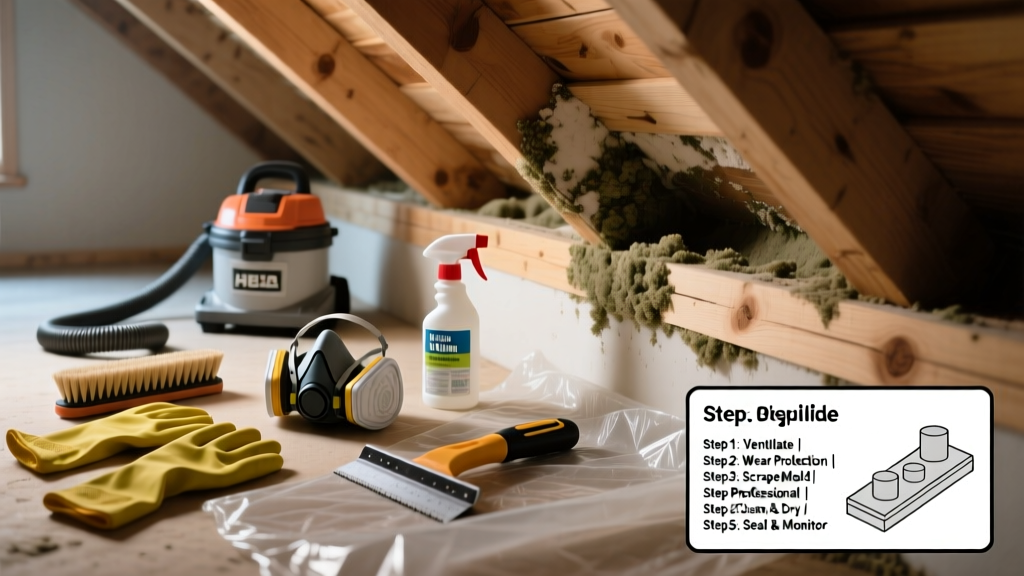
Mold in your attic isn’t just unsightly—it’s a red flag for moisture intrusion that can rot framing, degrade insulation, and send spores into living spaces through ceiling vents or ductwork. Left unchecked, even small colonies can double in size every 24–48 hours under humid conditions. Most attic mold starts quietly, often hidden under insulation or behind baffles, so early detection saves time, money, and health risk.
Quick Diagnosis
Attic mold rarely appears without cause. Spotting the root issue stops recurrence:
- Roof leaks from damaged shingles, flashing, or ice dams
- Inadequate or blocked soffit/ridge ventilation (less than 1:150 net free area ratio)
- Bathroom or dryer exhaust ducts venting *into* the attic instead of outside
- Missing or compressed insulation creating cold spots where condensation forms
- Blocked or disconnected attic fans or whole-house ventilation systems
Tools & Materials Needed
| Item | Purpose | Estimated Cost |
|---|---|---|
| N95 respirator (P100 preferred) | Filtration for mold spores; cloth masks offer zero protection | $12–$25 |
| HEPA vacuum with sealed filtration | Captures spores instead of recirculating them | $180–$320 |
| Dehumidifier (70+ pint/day capacity) | Lowers relative humidity below 50% to halt growth | $220–$450 |
| Concrobium Mold Control or EC3 Mold Solution | EPA-registered, non-toxic mold inhibitors (no bleach needed) | $28–$42 |
| Stiff-bristle brush & microfiber cloths | Physical removal without aerosolizing spores | $8–$16 |
Step-by-Step Fix
Do not spray first—dry, contain, then treat. Here’s how:
- Isolate the area: Seal off attic access with plastic sheeting and tape; turn off HVAC to prevent cross-contamination.
- Dry everything: Run a dehumidifier for 48–72 hours before touching mold—moisture must drop below 15% wood moisture content.
- Remove affected materials: Cut out and bag water-damaged plywood sheathing, rotted rafters, or soaked insulation (OSHA requires disposal of porous materials with >10 sq ft mold).
- Scrub non-porous surfaces: Use Concrobium on metal ducts, framing, and sheathing with stiff brush—never pressure wash or dry sweep.
- Apply antimicrobial sealant: Once fully dry, coat cleaned wood with a mold-inhibiting primer like Kilz Mold Defense (ASTM D3273-rated).
When to Call a Pro
DIY works only if mold covers <10 square feet *and* you’ve confirmed no structural decay or HVAC involvement. Call a certified IICRC technician immediately if:
- Mold covers more than 10 sq ft (EPA guidelines require professional remediation)
- You find black, slimy, or fuzzy growth on rafters or decking—likely Stachybotrys or Chaetomium
- There’s evidence of chronic roof leaks (staining, soft wood, missing fasteners)
- Insulation is wet or compacted over >25% of the attic floor
- Your home has a history of flooding or indoor air quality complaints (headaches, respiratory flare-ups)
Prevention Tips
Fixing mold once isn’t enough. Prevent regrowth with these field-tested upgrades:
- Install continuous soffit and ridge vents to hit the 1:150 ventilation ratio (e.g., 1,200 sq ft attic needs 8 sq ft net free area)
- Seal all attic bypasses—recessed lights, plumbing stacks, top plates—with fire-rated caulk or expanding foam
- Redirect bathroom and dryer ducts outside using rigid metal ducting (no flexible plastic or foil)
- Upgrade to open-cell spray foam on roof deck (R-38+) to eliminate thermal bridging and condensation points
- Install a smart hygrometer (like Tempest or Airthings) with alerts at >55% RH
Can I use bleach on attic mold?
No. Bleach only kills surface spores on non-porous materials and fails on wood or drywall. According to the U.S. EPA’s Mold Remediation in Schools and Commercial Buildings (2022), “Bleach does not penetrate porous surfaces, leaving roots intact—and its high pH encourages regrowth.” Stick to EPA-registered fungistats like Concrobium or EC3.
Will attic mold make me sick?
Yes—especially with prolonged exposure. The American College of Occupational and Environmental Medicine notes that attic mold spores (like Aspergillus and Penicillium) commonly trigger allergic rhinitis, asthma exacerbations, and hypersensitivity pneumonitis in sensitive individuals. If you’re experiencing unexplained fatigue, sinus pressure, or coughing after attic access, get an indoor air quality test.
How long does attic mold removal take?
A full DIY remediation—including drying, removal, cleaning, and sealing—takes 5–7 days for a typical 1,000–1,500 sq ft attic. Professionals complete it in 2–3 days but charge $1,800–$5,200 depending on scope. Time matters: the Insurance Institute for Business & Home Safety’s 2023 report found that delaying remediation beyond 72 hours increases secondary damage costs by 37%.
Does homeowner’s insurance cover attic mold?
Rarely—if the mold resulted from a sudden, accidental event (e.g., burst pipe), coverage may apply. But mold from chronic issues like poor ventilation or neglected roof maintenance is almost always excluded. Review your policy’s ‘fungus exclusion’ clause—and document everything with dated photos before starting work.
Can I just paint over attic mold?
Never. Painting traps moisture and creates a false sense of security. Mold will grow underneath, compromising adhesion and potentially pushing spores through the paint film. As one IICRC-certified remediator told us:
“If you can see it, you haven’t fixed the problem—you’ve just hidden the symptom. Mold is always a moisture problem first, a biological problem second.” — Chad Ramey, RIA Certified Mold Remediator, 2024
What’s the best way to check for hidden attic mold?
Use a moisture meter (like the General Tools MMD4E) on roof sheathing and rafters—readings above 18% indicate saturation. Also inspect insulation for dark staining, musty odors near vents, and brittle, discolored paper backing. Pull back insulation near exterior walls and eaves; 80% of attic mold hides within the first 24 inches of the perimeter.
Fixing attic mold isn’t about erasing stains—it’s about restoring the attic’s role as a dry, ventilated buffer zone between roof and house. Get the moisture source right, and the mold won’t come back. For deeper issues like ice damming or whole-house ventilation design, consider pairing your fix with a comprehensive attic ventilation upgrade or a roof leak diagnostic checklist. And if you spot mold near HVAC duct boots or along ceiling joists, don’t wait—review our guide to mold in ductwork before turning on the furnace again.