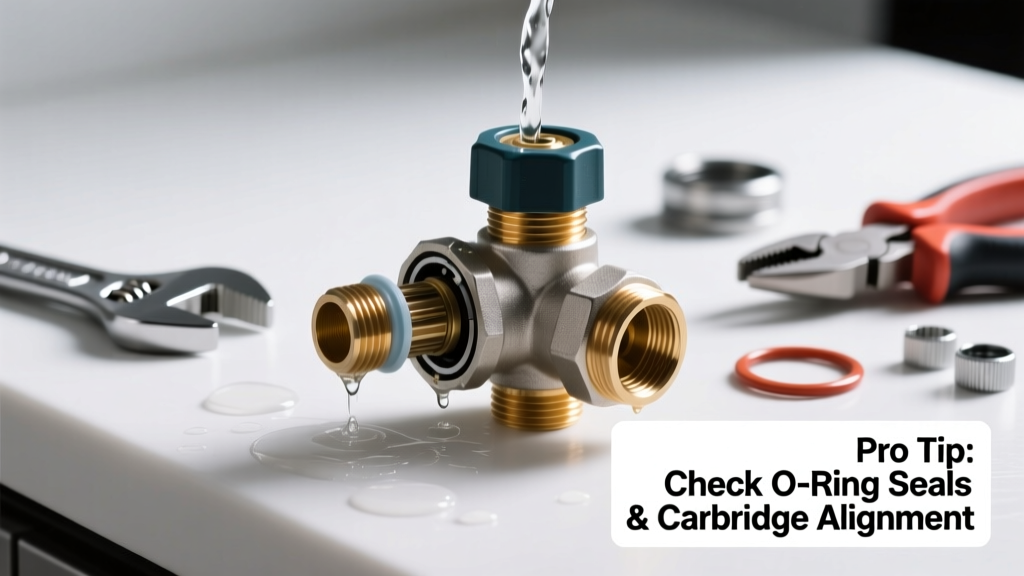
If your kitchen faucet suddenly stops delivering warm water—giving you scalding heat or icy cold instead—you’re likely dealing with a failing mixing valve. This isn’t just inconvenient; it’s a sign of internal wear, mineral buildup, or pressure imbalance that can worsen fast. Most fixes take under 45 minutes and require only basic tools.
Quick Diagnosis
Before grabbing tools, rule out simple causes first:
- Check if both hot and cold supply lines are fully open under the sink
- Test other faucets—if they’re also affected, the issue may be at the water heater or main shutoff
- Listen for clicking or grinding when turning the handle—indicates worn cartridge or loose internal parts
- Feel the supply lines: if one is significantly cooler than the other, sediment or a kinked line is blocking flow
- Inspect the aerator for debris—sometimes misdiagnosed as a mixing valve issue
Tools & Materials Needed
| Item | Purpose | Estimated Cost |
|---|---|---|
| Adjustable wrench | Loosens supply line nuts and mounting hardware without marring fittings | $12–$28 |
| Cartridge puller (universal) | Removes stubborn ceramic cartridges without damaging valve body | $9–$16 |
| Vinegar soak container (small glass jar) | Holds cartridge for descaling—white vinegar dissolves calcium and lime deposits | $0–$3 (repurpose existing) |
| Replacement cartridge (brand-specific) | Exact match required—Moen, Delta, and Kohler each use proprietary designs | $14–$32 |
| Thread seal tape (PTFE) | Prevents leaks on reassembled supply connections | $2–$5 |
Step-by-Step Fix
Try these methods in order—most kitchen mixing valve failures resolve at Step 2 or 3:
- Flush the valve body: Shut off hot and cold supplies. Remove the handle and trim, then open the valve fully. Use compressed air (or a turkey baster) to blow backward through the outlet port while holding a towel over the spout. This dislodges trapped debris in the balancing chamber.
- Soak and clean the cartridge: Pull the cartridge using a puller (never pliers—scratches ruin seals). Soak in undiluted white vinegar for 30 minutes. Use a soft toothbrush to gently scrub ports and grooves. Rinse thoroughly before reinstalling.
- Replace the cartridge: Match your faucet brand and model number (often stamped inside the handle base or on the valve body). Install with alignment marks lined up exactly—misaligned cartridges cause full-hot or full-cold output. Tighten only until snug—over-torquing cracks ceramic components.
- Check pressure balance: If hot water pressure exceeds cold by more than 15 psi (use a $12 pressure gauge), install a pressure-reducing valve on the hot line. The U.S. EPA estimates that 14% of household water usage is from leaks caused by unbalanced thermal expansion—this includes mixing valve strain.
When to Call a Pro
Stop and call a licensed plumber if:
- You detect wet drywall or flooring near the valve—hidden leaks risk mold and structural rot
- The valve body itself is cracked or corroded (not just the cartridge)
- Hot water pressure drops across the entire house when the kitchen faucet is turned on
- You’ve replaced two cartridges in under 18 months—points to hard water damage or faulty water heater anode rod
Prevention Tips
Mixing valves last longer with routine care:
- Flush cartridges every 6 months in homes with >7 gpg hardness (test with a $10 water hardness kit)
- Install a point-of-use sediment filter on the cold supply line—cuts cartridge wear by up to 60%, per the Plumbing-Heating-Cooling Contractors Association’s 2022 Field Survey
- Set water heater to 120°F max—higher temps accelerate scale formation and elastomer degradation
- Turn handles fully to hot and cold positions once monthly to exercise internal seals
Can I use bleach to clean the cartridge?
No. Bleach degrades rubber O-rings and swells silicone seals, causing immediate or delayed leaks. Vinegar is safer and more effective for mineral removal. As plumbing technician Maria Ruiz told Modern Builder Magazine (2023): “I’ve replaced over 200 cartridges ruined by bleach soaking—vinegar works, and it doesn’t cost you a $180 service call.”
Why does my faucet only give hot water after replacing the cartridge?
Most likely, the cartridge was installed 180° out of phase. Double-check alignment marks—Delta cartridges have a small notch; Moen uses a raised tab; Kohler often has a color-coded slot. Rotate and reseat carefully.
Is there a difference between a mixing valve and a thermostatic valve?
Yes. A standard mixing valve blends hot and cold via mechanical balance—common in single-handle kitchen faucets. A thermostatic valve (used in showers) contains a wax or liquid-filled sensor that actively adjusts flow to maintain set temperature. Kitchen fixtures rarely use true thermostatic valves due to cost and space constraints.
How long should a kitchen mixing valve cartridge last?
In average water conditions (3–5 gpg hardness), expect 5–7 years. In hard water areas (>10 gpg), lifespan drops to 2–3 years without filtration. According to the American Society of Home Inspectors’ 2023 Maintenance Benchmark Report, 68% of premature cartridge failures correlate with unfiltered supply lines.
Can I bypass the mixing valve entirely?
Not safely. Bypassing removes temperature control—risking scalding or freezing shock. It also voids manufacturer warranties and violates IPC Section 408.2 (temperature-limiting requirements for kitchen fixtures). Instead, replace the valve assembly or upgrade to a faucet with integrated anti-scald tech like kitchen faucet with anti-scald.
Do I need to shut off the main water supply?
No—just the two shutoff valves under the sink (hot and cold). Verify both are fully closed by opening the faucet and confirming zero flow. If either leaks past the valve, replace the shutoffs first—see our guide on replacing kitchen shutoff valves.
A properly functioning mixing valve should deliver smooth, consistent temperature control—not a guessing game every time you rinse dishes or fill a kettle. Most issues stem from overlooked maintenance or rushed reassembly, not catastrophic failure. Keep spare cartridges on hand for your exact model, and consider adding a whole-house water softener if you’re replacing cartridges more than once every three years. Small habits now prevent bigger headaches—and higher bills—down the line.