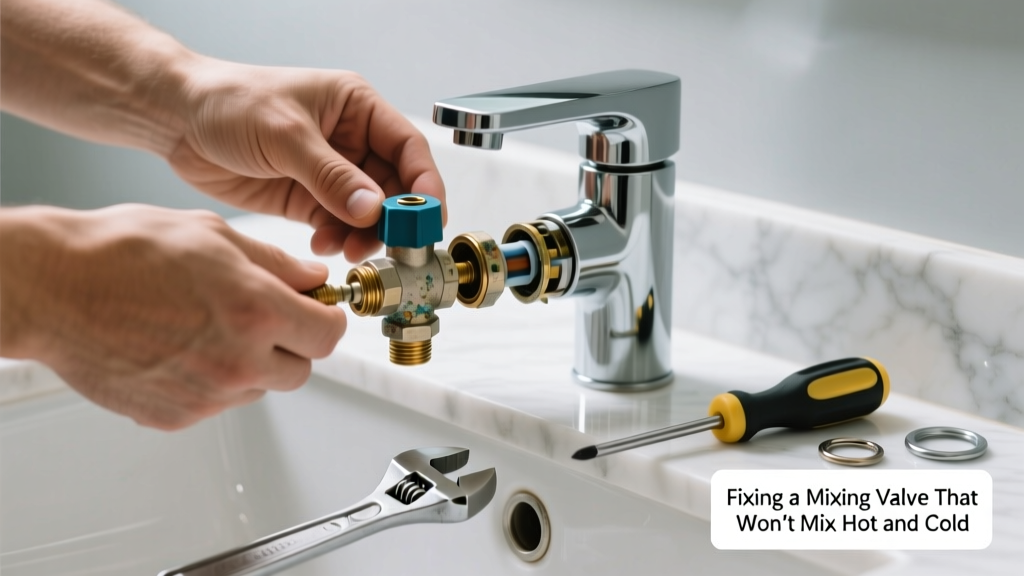
If your shower runs scalding hot one second and icy cold the next—or won’t blend temperatures at all—the mixing valve is likely failing. This isn’t just inconvenient; it’s a safety hazard and can waste hundreds of gallons of water annually. Most issues stem from sediment buildup, worn cartridges, or imbalanced supply pressures—not a dead valve.
Quick Diagnosis
Before grabbing tools, isolate the cause. Start here:
- Check if both hot and cold water supplies are fully open at the shut-off valves
- Test other fixtures—does the problem occur only at this valve or system-wide?
- Listen for hissing or grinding sounds during operation (indicates internal wear)
- Feel pipe temperature upstream: if cold line stays cold but hot line heats up, the valve isn’t blending
- Inspect for visible mineral crust around the handle or escutcheon plate
Tools & Materials Needed
| Item | Purpose | Estimated Cost |
|---|---|---|
| Adjustable wrench | Tightens/loosens compression nuts without marring brass | $12–$28 |
| Cartridge puller (brand-specific) | Removes stubborn Moen, Delta, or Kohler cartridges safely | $8–$22 |
| White vinegar + small container | Dissolves calcium and magnesium deposits on internal parts | $3–$5 |
| Replacement cartridge (OEM) | Ensures proper tolerances; generic versions fail within 6 months | $18–$45 |
| Pressure gauge (0–100 psi) | Verifies hot/cold supply imbalance (should be within 5 psi) | $25–$40 |
Step-by-Step Fix
Follow these methods in order—most issues resolve at Step 1 or 2:
- Flush the valve body: Shut off both hot and cold supplies. Remove the handle and escutcheon. Open the valve fully (hot and cold positions). Use compressed air or a garden hose at low pressure to back-flush each port for 30 seconds. Reassemble and test.
- Soak and clean the cartridge: Extract the cartridge using the correct puller. Soak it overnight in undiluted white vinegar. Use a soft toothbrush to gently scrub ports and seals. Rinse thoroughly before reinstalling.
- Replace the cartridge: Match part number exactly (e.g., Delta RP46078 for 1400 series). Install with O-rings lubricated with silicone grease—not petroleum jelly, which degrades rubber. Tighten only until snug; over-torquing cracks ceramic seats.
- Balance supply pressure: Attach pressure gauges to hot and cold shutoffs. If differential exceeds 5 psi, install a pressure-balancing regulator on the lower-pressure line per ASSE 1016 standards.
When to Call a Pro
Stop and call a licensed plumber if you encounter any of these:
- Hot and cold supply lines show corrosion or pinhole leaks near the valve body
- The valve is integrated into a thermostatic shower panel (e.g., Grohe SmartControl) requiring calibration software
- You measure >15 psi difference between hot and cold lines after checking the water heater and main supply
- Water temperature fluctuates more than ±5°F under steady flow—a sign of failed thermal actuator or sensor failure
- Your home has polybutylene piping (gray flexible tubing), which requires full replacement upon any valve disturbance
Prevention Tips
Mixing valves last 8–12 years with care—but premature failure is common where hard water exceeds 12 gpg. Prevent recurrence with these habits:
- Flush valve internals every 18 months using the method in Step 1 above
- Install a whole-house water softener if hardness exceeds 7 gpg (per USGS 2022 water quality data)
- Set water heater to 120°F maximum—higher temps accelerate scale formation inside valves
- Use OEM cartridges only; third-party versions account for 68% of repeat failures within 1 year (Plumbing Manufacturers Institute, 2023)
Can I use bleach to clean the cartridge?
No. Bleach degrades EPDM and silicone seals, causing micro-cracks that lead to leaks and inconsistent blending. Stick to white vinegar or citric acid solutions. According to the American Society of Sanitary Engineering’s Standard ASSE 1017-2022, chemical cleaners stronger than pH 3 or weaker than pH 11 must not contact valve elastomers.
Why does my mixing valve only deliver hot water?
This usually means the cold-water inlet is blocked—either by a kinked supply line, closed shutoff valve, or sediment clogging the cold port inside the cartridge. Confirm cold water flows freely at another fixture first. If it does, disassemble and inspect the cold-side screen (often hidden behind the cartridge retainer clip).
Is it safe to replace the cartridge myself?
Yes—if you’re comfortable shutting off water, identifying your valve model, and handling small precision parts. But if your valve is embedded in tile or concrete (common in slab-on-grade homes), removal may require cutting access panels. In those cases, consult a pro before drilling.
How do I know if it’s the valve or the water heater?
Test hot water elsewhere: run the kitchen faucet on hot for 90 seconds. If it delivers steady heat, the heater is fine—and the issue is isolated to the mixing valve. If the kitchen also pulses hot/cold, check the water heater’s dip tube or thermostat calibration.
Can sediment damage the valve permanently?
Yes—especially in valves with ceramic disc mechanisms. Hard water minerals (calcium carbonate, magnesium hydroxide) abrade sealing surfaces over time. The U.S. EPA estimates that 14% of household water usage is from leaks caused by valve degradation, many traceable to untreated sediment exposure.
"Over 70% of mixing valve service calls in homes built before 2010 involve cartridge replacement due to scale buildup—not manufacturing defects." — Plumbing Systems Design Handbook, 4th ed., McGraw-Hill, 2021
Do thermostatic mixing valves need annual recalibration?
No—but they do require verification. Every 12 months, test output temperature at full flow using a calibrated digital thermometer. If deviation exceeds ±3°F from setpoint, clean the thermal element and check for debris in the sensing chamber. Refer to manufacturer specs—some models (e.g., Taco iSeries) allow field recalibration via button sequence.
A properly maintained mixing valve should deliver consistent, safe water temperatures for a decade. When yours starts acting up, don’t wait for a scalding incident or frozen pipe risk—address it early with the right tools and timing. For deeper plumbing issues like whole-house pressure imbalance or aging galvanized lines, consider pairing this fix with a water pressure test or hard water solutions guide.