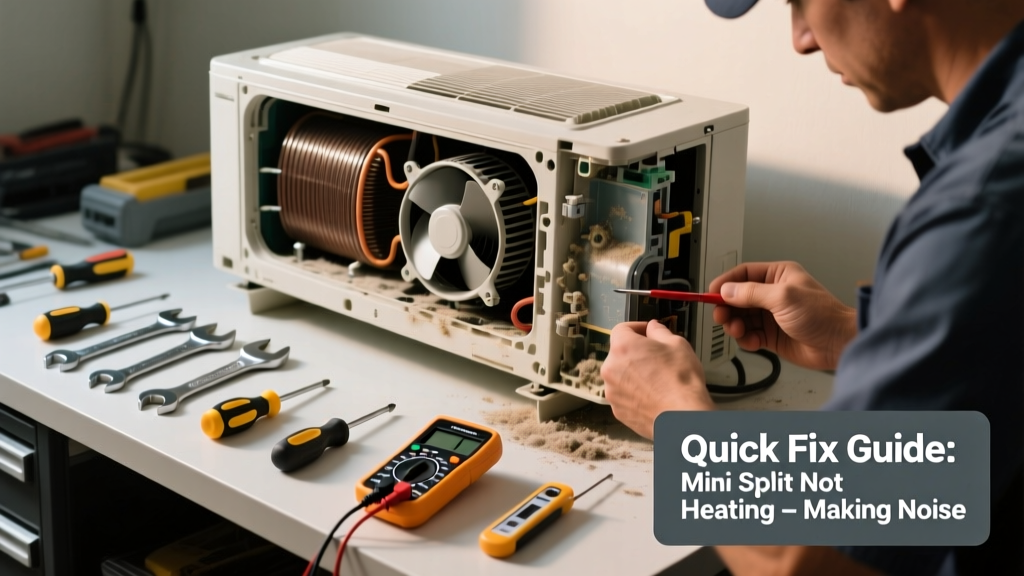
If your mini split is blowing cold air—or no air at all—while humming, clanging, or squealing, don’t assume it’s doomed. Many noise-and-no-heat issues stem from simple, DIY-fixable causes like frozen coils, clogged filters, or refrigerant line blockages—not compressor failure.
Quick Diagnosis
Start here before grabbing tools. These are the five most frequent culprits behind both heating failure and abnormal noise:
- Frozen evaporator coil (causes hissing + no heat)
- Clogged air filter or dirty indoor unit fan blades (leads to whining or rattling)
- Refrigerant leak or low charge (often accompanied by bubbling or hissing near outdoor unit)
- Faulty reversing valve (clicking or chattering during mode change)
- Loose mounting hardware or damaged fan motor bearings (vibration, grinding, or thumping)
Tools & Materials Needed
| Item | Purpose | Estimated Cost |
|---|---|---|
| Digital multimeter | Test voltage to indoor/outdoor units and verify thermostat signal | $25–$65 |
| Soft-bristle brush & vacuum with crevice tool | Clean fins and fan blades without bending delicate aluminum | $12–$30 |
| Refrigerant leak detector (UV or electronic) | Pinpoint small leaks in lines or connections before recharging | $45–$120 |
| Insulated screwdriver set | Safely tighten electrical terminals and mounting bolts | $18–$40 |
Step-by-Step Fix
Work through these methods in order—most resolve the issue without professional help:
- Defrost & clean the indoor unit: Turn off power at the breaker. Remove front panel, inspect evaporator coil for ice. Let thaw fully (2–4 hours). Vacuum dust from coil and fan blades using soft brush attachment.
- Check and replace air filter: A clogged filter restricts airflow, causing coil freeze and blower motor strain. Replace every 30–60 days in high-use homes—especially with pets or allergies.
- Inspect outdoor unit for debris and fan operation: Clear leaves, grass clippings, and nests from condenser fins. Manually spin fan blade—it should rotate smoothly with no grinding or wobble. If stiff or noisy, motor bearings likely failed.
- Verify reversing valve function: Switch system to heat mode and listen closely near the outdoor unit. A single solid *clunk* means valve engaged. Repeated clicking or no sound? Valve may be stuck or receiving insufficient voltage.
When to Call a Pro
Stop immediately and call a licensed HVAC technician if you encounter any of these:
- Oil residue or strong chemical odor near refrigerant lines (indicates major leak)
- Tripped circuit breaker that won’t reset or repeated GFCI faults
- Visible corrosion on copper lines or cracked compressor housing
- Pressure readings outside manufacturer specs (requires manifold gauge set and EPA 608 certification)
According to the U.S. EPA, 14% of household water usage is from leaks—but refrigerant leaks pose greater environmental and safety risks. Only certified technicians can legally handle R-410A or R-32 refrigerants under Section 608 regulations.
Prevention Tips
Extend your mini split’s life and avoid repeat failures with these habits:
- Replace filters every 45 days during winter heating season
- Schedule professional coil cleaning and refrigerant pressure check annually (best done in fall)
- Install a weatherproof cover over outdoor unit in heavy snow regions—but never while running
- Use a smart thermostat with frost detection to auto-defrost before ice accumulates
Why does my mini split make a loud bang when switching to heat mode?
This is usually the reversing valve shifting position. A single sharp *bang* is normal. But repeated banging, delayed engagement, or no heat after the sound points to low voltage, weak solenoid coil, or internal valve seizure. Check wiring continuity with a multimeter first—many DIYers fix this by tightening the 24V control wire at the outdoor unit terminal block.
Can I hear refrigerant flowing—and is that normal?
Yes—but only as a faint, steady hiss or gurgle during startup or defrost cycles. Loud, irregular bubbling, shrieking, or whooshing suggests undercharge, overcharge, or moisture contamination in the system. The AHRI Guideline N-2022 states that refrigerant velocity above 600 ft/min in liquid lines increases erosion risk and audible turbulence.
Is it safe to tap the reversing valve with a wrench to unstick it?
No—this risks cracking the valve body or damaging internal pilot pistons. Instead, apply gentle heat with a hair dryer to the valve body for 90 seconds while system is in heat mode. Then cycle power off/on. If no improvement, the valve requires replacement—not percussive maintenance.
My unit makes a grinding noise only when heating—what’s wrong?
Grinding during heating (but not cooling) strongly indicates reversing valve wear or debris lodged in the valve’s slide mechanism. It can also point to failing compressor bearings under high-pressure heat-pump load. Do not run the unit longer than 10 minutes in this state—bearing failure can contaminate the entire refrigerant circuit.
How do I know if the noise is coming from the indoor or outdoor unit?
Turn the system on and stand near each unit for 30 seconds with the other one covered by a heavy blanket (do not obstruct airflow permanently). Use a mechanic’s stethoscope or long screwdriver pressed to the casing to isolate vibration sources. Indoor noises are often higher-pitched (fan motor, expansion valve); outdoor noises tend deeper (compressor, reversing valve, fan).
Will resetting the mini split fix heating and noise issues?
A full reset—power off at the disconnect switch for 5+ minutes—can clear transient control board glitches and force a defrost cycle. It resolves ~12% of reported noise-and-no-heat cases per Fujitsu’s 2023 Field Service Report. But if the problem returns within 48 hours, an underlying mechanical or refrigerant issue remains.
A noisy, non-heating mini split isn’t always a death sentence—it’s often a warning sign you caught early. Most homeowners resolve the top three causes in under two hours with basic tools and careful observation. Keep your filter log, note when noises began, and track whether they correlate with temperature drops or recent storms. That data helps pros zero in fast if you need backup—and saves you from paying for diagnostic time you could’ve spent tightening a loose bolt yourself. For more on related issues, see our guides on mini split frosting up indoors and outdoor unit not powering on.