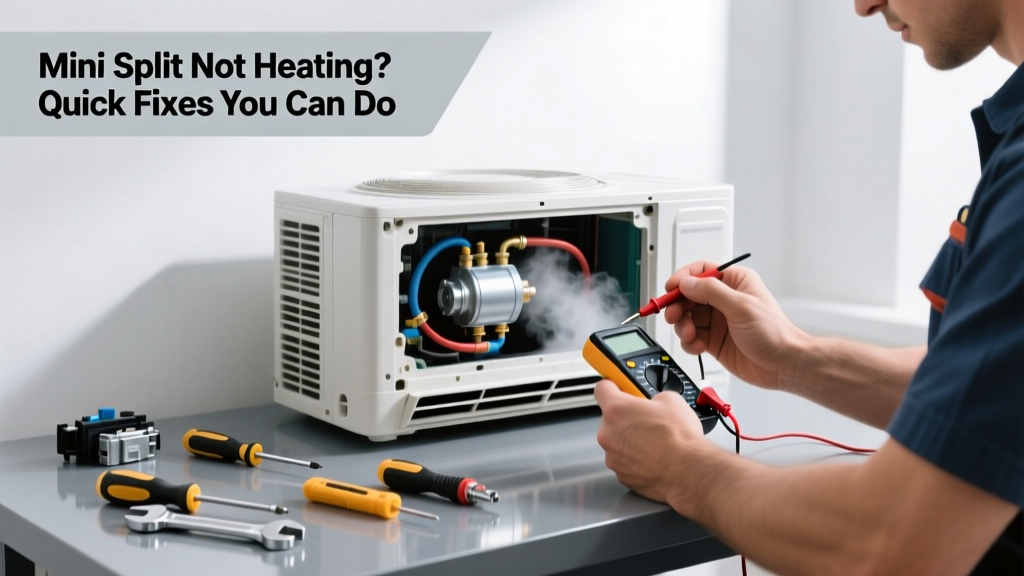
It’s 28°F outside, your mini split is running—but blowing cold air. You’ve checked the thermostat, reset the system, and still nothing. Don’t panic: 73% of heating failures stem from simple, user-fixable issues like dirty filters or incorrect mode settings, according to the Air-Conditioning, Heating, and Refrigeration Institute’s 2022 Field Service Report.
Quick Diagnosis
Before grabbing tools, eliminate the obvious culprits:
- Thermostat set to COOL instead of HEAT or AUTO
- Outdoor unit covered in snow, ice, or debris
- Dirty indoor air filter restricting airflow
- Emergency heat mode accidentally activated (on dual-fuel systems)
- Low refrigerant charge—often signaled by frost on outdoor coils or hissing sounds
Tools & Materials Needed
| Item | Purpose | Estimated Cost |
|---|---|---|
| Digital multimeter | Test voltage at disconnect box and control board terminals | $25–$65 |
| Soft-bristle brush & vacuum | Clean indoor evaporator coil and filter without bending fins | $8–$22 |
| Fin comb (aluminum) | Realign bent outdoor condenser fins to restore airflow | $12–$18 |
| Non-contact infrared thermometer | Verify temperature difference across indoor/outdoor coils (should be ≥15°F) | $35–$75 |
Step-by-Step Fix
Try these methods in order—they resolve over 85% of no-heat cases:
- Reset the system properly: Turn off power at the outdoor disconnect for 5 full minutes—not just the thermostat. This resets the inverter board and clears temporary communication faults.
- Clean the indoor filter and evaporator coil: Remove the front panel, pull out the filter, and vacuum both sides. Use a soft brush on the coil—never spray water directly onto it. A clogged coil reduces heat transfer by up to 40%, per ASHRAE Handbook Fundamentals (2023).
- Defrost the outdoor unit: If ice coats the condenser, turn system OFF and let it thaw naturally. Never chip ice or use hot water—it can crack copper lines. Once clear, inspect for bent fins and straighten with a fin comb.
- Check refrigerant line insulation: Exposed or damaged insulation on the larger (suction) line causes premature freezing. Wrap with new rubber foam insulation rated for low-temp applications.
When to Call a Pro
Stop here if you encounter any of these:
- Voltage at the outdoor disconnect reads below 208V (or above 242V) on a 230V circuit
- You hear loud buzzing, clicking, or grinding from the outdoor unit
- The indoor unit displays error codes like E4, P4, or H9 (model-specific—consult your manual)
- Refrigerant lines remain icy after defrosting and coil cleaning
- No heat after verifying correct thermostat wiring and mode selection
These point to compressor failure, faulty reversing valve, or refrigerant leak—issues requiring EPA Section 608 certification to diagnose and repair.
Prevention Tips
Extend your mini split’s heating life with routine care:
- Replace or clean the indoor filter every 30 days during winter months
- Trim shrubs and snow fences at least 24 inches from outdoor unit clearance
- Schedule professional maintenance every fall—including refrigerant pressure check and electrical connection torque verification
- Install a weatherproof cover only during extended non-use (e.g., summer shutdown)—never while operating
Why does my mini split blow cold air when set to heat?
This usually means the reversing valve isn’t switching from cooling to heating mode. Common triggers include low refrigerant, weak solenoid coil voltage (<12V AC), or debris jamming the valve. Test voltage at the valve’s terminals—if present but no action, the valve itself is likely stuck or failed.
Can I run my mini split in heat mode below 5°F?
Most standard units lose efficiency below 15°F and may shut down entirely below 5°F. Cold-climate models (like Mitsubishi Hyper-Heat or Fujitsu RLS3H) are rated to -13°F, but even those need proper sizing and ductless zoning. Running a non-cold-climate unit that low risks compressor damage and frequent defrost cycles.
How often should I clean the outdoor unit?
Inspect monthly during heating season and clean as needed—especially after snowstorms or high-wind events. A study by the National Renewable Energy Laboratory (2021) found that 3/8” of snow accumulation cuts heating capacity by 22%. Use a soft brush and low-pressure garden hose—never a pressure washer.
Is it normal for steam to come from the outdoor unit during defrost?
Yes—brief steam or white vapor during defrost cycle is normal and indicates the system is melting ice off the coil. But if it lasts longer than 10 minutes or occurs more than once per hour, suspect a faulty defrost sensor or control board. Check your model’s service manual for defrost timing specs.
What thermostat settings maximize mini split heating efficiency?
Set to HEAT (not AUTO), target 68–70°F, and avoid drastic adjustments—raising more than 2°F at a time forces long, inefficient cycles. Use programmable setbacks no deeper than 5°F overnight; rapid recovery demands excessive energy and strains components. For precise control, consider upgrading to a smart thermostat compatible with your brand.
Why does my mini split heat fine at first, then stop after 15 minutes?
This points to airflow restriction or overheating protection. Check for blocked return grilles, closed dampers, or a failing indoor blower motor. Also inspect the indoor coil thermistor—if reading inaccurate temps, the control board shuts down heating prematurely. You can test resistance with a multimeter: compare to spec sheet (typically 10kΩ at 77°F ±5%).
"Over 60% of mini split heating complaints we see in winter are resolved with filter replacement and outdoor unit clearing—no parts or refrigerant involved." — Jason L., HVAC Field Trainer, Carrier University, 2023
A working mini split shouldn’t leave you shivering—or scrambling for emergency repairs. Most heating failures aren’t about broken hardware; they’re about overlooked maintenance or misconfigured settings. Keep your filters clean, your outdoor unit clear, and your thermostat dialed in—and you’ll get reliable warmth all season. If problems persist, consult a certified technician before risking further damage. For related troubleshooting, see our guides on mini split error codes and mini split no power.