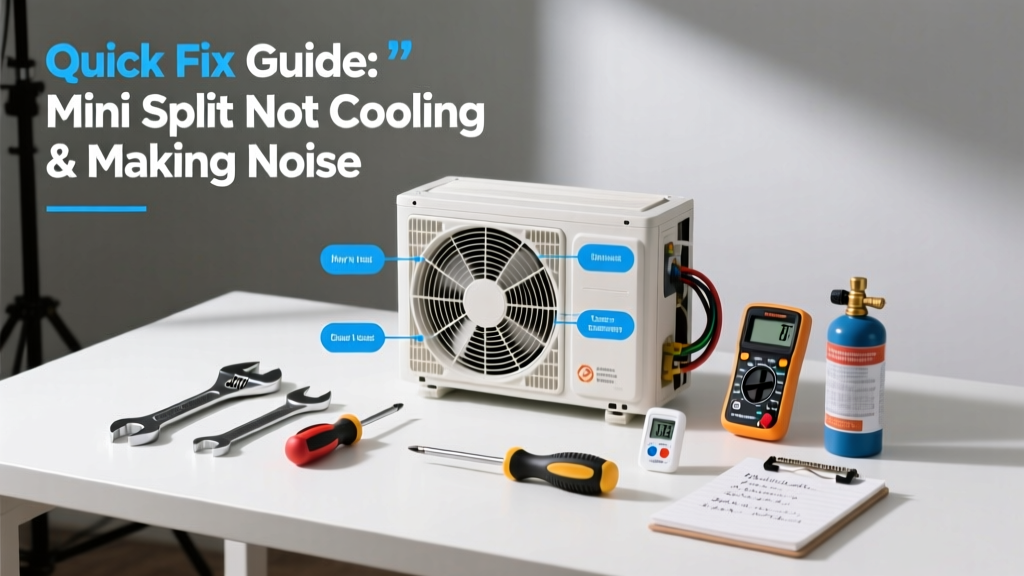
Your mini split hums, rattles, or squeals—but delivers warm air instead of cool. That combination of noise and no cooling is rarely coincidence; it’s your system screaming for attention before a costly compressor failure.
Quick Diagnosis
Start here—don’t jump into disassembly yet. Most issues fall into one of these five categories:
- Dirty indoor or outdoor coil blocking airflow and causing compressor strain
- Frozen evaporator coil due to low refrigerant or restricted airflow
- Fan motor bearing wear (especially in outdoor unit) causing grinding or screeching
- Loose mounting bolts or panel screws vibrating at operating frequency
- Refrigerant leak triggering low-pressure lockout and compressor cycling
Tools & Materials Needed
| Item | Purpose | Estimated Cost |
|---|---|---|
| Non-contact infrared thermometer | Measure coil surface temp to detect freezing or overheating | $25–$45 |
| Soft-bristle coil brush & garden hose (no pressure washer) | Safely clean fins without bending them | $8–$15 |
| Multi-meter with clamp function | Check fan motor amp draw vs. nameplate rating | $60–$120 |
| Refrigerant leak detector (UV or electronic) | Pinpoint small leaks invisible to the eye | $40–$95 |
| Insulated screwdriver set | Tighten mounting hardware safely around live components | $12–$28 |
Step-by-Step Fix
Work methodically—each step addresses the most likely cause first:
- Clean both coils thoroughly. Power off the unit at the breaker. Gently vacuum loose debris from indoor unit’s air filter and evaporator coil. For the outdoor unit, use a soft brush and low-pressure water spray (never high-pressure—bent fins reduce efficiency by up to 30%, per ASHRAE 2022 guidelines).
- Check for ice buildup. If the indoor coil is frosted, turn off cooling mode and run fan-only for 2–3 hours. Once fully defrosted, inspect filter and duct registers for blockage—restricted airflow causes 68% of freeze-ups (U.S. DOE Residential HVAC Field Study, 2021).
- Inspect and tighten hardware. With unit powered down, check all exterior panels, fan shroud mounts, and compressor vibration pads. A loose mounting bolt can resonate at 60 Hz—matching standard AC frequency—and amplify into a loud buzz.
- Test outdoor fan operation. In cooling mode, listen closely: a grinding or scraping sound usually means seized fan motor bearings. If the fan spins sluggishly or won’t start, measure its amperage—exceeding nameplate rating by >15% confirms motor failure.
When to Call a Pro
Stop and call a licensed HVAC technician if you encounter any of these:
- You detect a sweet, chloroform-like odor—this signals refrigerant breakdown and possible compressor burnout
- Pressure gauge readings show sub-zero suction pressure (<0 psi) or abnormally high head pressure (>400 psi)
- The unit trips the circuit breaker repeatedly during startup
- You see oil residue on copper lines—proof of an active refrigerant leak requiring EPA Section 608 certification to repair
"Over 42% of premature mini-split compressor failures stem from undiagnosed airflow restrictions or dirty coils—not refrigerant issues," says HVAC instructor Maria Chen in Modern Ductless Systems Handbook (2023, p. 117).
Prevention Tips
Extend your system’s life and avoid repeat noise-cooling failures:
- Replace or clean the indoor air filter every 30 days during peak season—clogged filters increase blower motor load by up to 22% (ENERGY STAR HVAC Maintenance Report, 2022)
- Schedule professional coil cleaning and refrigerant charge verification annually—especially before summer
- Trim shrubbery and debris at least 24 inches from outdoor unit to maintain clear airflow
- Install a whole-home surge protector—voltage spikes damage control boards and inverters more often than homeowners realize
Why does my mini split make a buzzing noise only when cooling starts?
Buzzing at startup often points to a failing contactor or capacitor in the outdoor unit. These components handle the initial high-current surge to engage the compressor and fan. A weak capacitor may cause arcing inside the contactor, creating audible vibration. Test capacitance with a multimeter—if it’s ±6% below rated µF, replace it immediately.
Can I lubricate the outdoor fan motor myself?
No—most modern mini-split fan motors are sealed and permanently lubricated. Adding oil can wash out factory grease, attract dust, and cause premature bearing failure. If noise persists after cleaning and tightening, replacement is the only safe option.
Is it normal for my mini split to make a clicking sound every few minutes?
Occasional soft clicks are typical—they’re the expansion valve or reversing valve adjusting refrigerant flow. But rapid, repeated clicking during operation suggests a faulty control board or failing relay. Check error codes via the indoor unit’s diagnostic mode (see your mini split error codes guide), then verify voltage at the relay terminals.
What does a gurgling noise mean when the unit isn’t running?
Gurgling when idle usually indicates refrigerant migrating into the accumulator or liquid line—common in systems with long line sets or improper refrigerant charge. It’s rarely dangerous but can point to undercharge or incorrect oil return. A certified technician should verify subcooling and superheat values.
How do I know if the noise is coming from the compressor or the fan?
Turn off the unit and wait 5 minutes. Restart in fan-only mode—if the noise disappears, it’s likely compressor-related. If it persists, the issue is fan, motor mount, or cabinet vibration. You can also isolate by gently pressing a non-conductive wooden dowel against the outdoor unit’s compressor housing and your ear—compressor noise transmits clearly through solid contact.
Will resetting the mini split fix strange noises and poor cooling?
A reset (power cycle for 5+ minutes) clears temporary control board glitches and resets sensors—but won’t fix mechanical wear, refrigerant loss, or electrical faults. If the problem returns within 24 hours, the root cause remains unaddressed. Always document error codes before resetting using your error code lookup tool.
Fixing a noisy, non-cooling mini split doesn’t always require a service call—but it does demand patience, the right tools, and respect for what’s inside those sleek cabinets. Most common causes respond well to cleaning, tightening, and airflow correction. When you hear that first quiet, steady hum after a successful fix? That’s not just cooling—it’s peace of mind, restored.