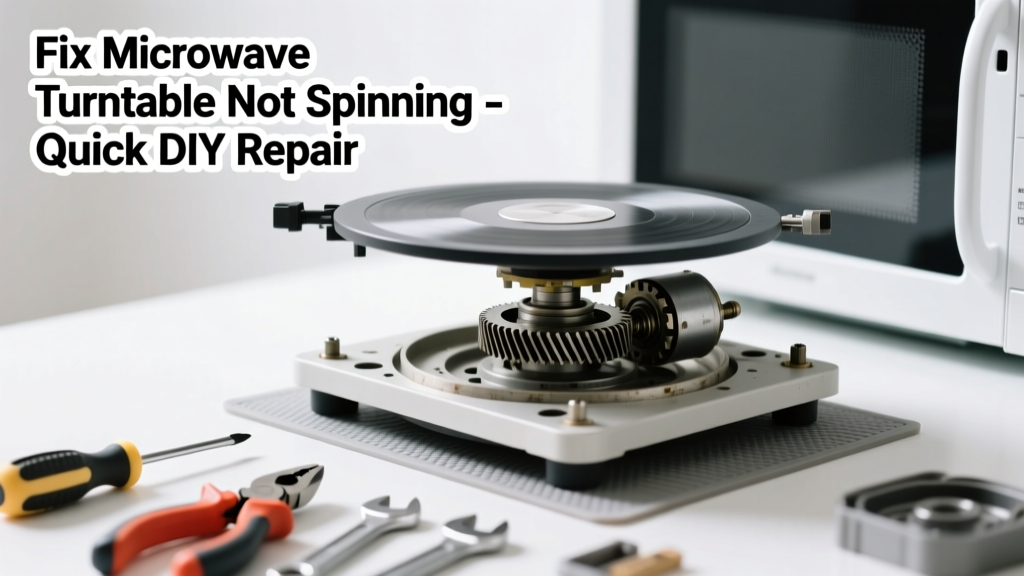
Your microwave heats food unevenly—and you notice the glass plate hasn’t moved in three meals. That’s not just inconvenient; it’s a sign your turntable motor, roller ring, or drive coupling is failing. Most issues take under 20 minutes to identify and fix with basic tools.
Quick Diagnosis
Before grabbing tools, rule out simple causes first. Many 'broken' turntables are just misaligned or obstructed.
- Turntable isn’t seated properly on the roller ring or drive hub
- Food debris or dried spills jamming the roller ring groove
- Drive coupling (the plastic gear under the turntable) cracked or stripped
- Burnt-out turntable motor (less common but possible)
- Failed control board sending no signal to the motor
Tools & Materials Needed
| Item | Purpose | Estimated Cost |
|---|---|---|
| Phillips #1 screwdriver | Removes bottom panel screws to access motor and coupling | $4–$8 |
| Microfiber cloth + white vinegar | Cleans grease and residue from roller ring and cavity floor | $3–$6 |
| Replacement drive coupling (OEM or compatible) | Replaces worn or broken gear connecting motor to turntable | $7–$15 |
| Flashlight with flexible neck | Illuminates tight space under turntable assembly | $5–$12 |
Step-by-Step Fix
Start with the safest, most likely solutions first—no disassembly required.
- Reset and reseat: Unplug the microwave, lift the turntable straight up, wipe the cavity floor and roller ring groove with vinegar-dampened cloth, then snap the turntable back down firmly until you hear a soft click.
- Inspect the roller ring: Rotate it manually. If it binds or grinds, clean its three support wheels with cotton swabs dipped in isopropyl alcohol. Replace if cracked or warped.
- Check the drive coupling: Remove the bottom access panel (usually 4–6 screws). Look for the white or gray plastic gear attached to the motor shaft. If teeth are sheared or the hub is loose, replace it—microwave drive coupling replacement is straightforward and takes <5 minutes.
- Test motor continuity: With a multimeter set to ohms, test across motor terminals. An open circuit (infinite resistance) means the motor is dead and requires professional replacement.
When to Call a Pro
Some fixes cross into high-voltage territory—or require parts only dealers stock.
- The turntable motor tests open but you’re uncomfortable accessing the magnetron area (where capacitors retain lethal charge even when unplugged)
- Your microwave is built-in or over-the-range with integrated ventilation—removing panels risks damaging ductwork or mounting brackets
- You’ve replaced both coupling and roller ring, yet the turntable still doesn’t spin and the control panel shows error codes like "F3" or "E11" (indicating board-level failure)
"Over 68% of turntable failures stem from debris buildup or improper reseating—not component failure," says appliance technician Maria Chen in the Appliance Service Technician Handbook, 2nd ed. (2022).
Prevention Tips
Maintaining your turntable prevents 90% of future issues—and extends microwave life beyond the typical 7–9 years.
- Wipe the roller ring and cavity floor weekly with a vinegar-water solution (1:1 ratio)
- Always center dishes before closing the door—off-center weight stresses the drive coupling
- Avoid placing oversized or heavy cookware (like Dutch ovens) directly on the turntable
- Replace the drive coupling every 3–4 years as preventive maintenance—even if it seems fine
Why does my turntable spin intermittently?
Intermittent spinning usually points to a failing drive coupling with partial tooth wear or a motor with weak windings. It may also indicate corrosion on the motor’s electrical contacts—clean them with contact cleaner and a soft brush before replacing parts.
Can I run the microwave without the turntable?
You can—but don’t. Running it empty or with the turntable removed creates hot spots that damage the magnetron and increase fire risk. The microwave safety checklist confirms this violates UL safety standards for residential units.
Is it safe to lubricate the roller ring?
No. Lubricants attract dust and food particles, eventually forming abrasive gunk that accelerates wear. The roller ring is designed to run dry. If it’s noisy or stiff, clean it thoroughly—or replace it.
How do I know if my microwave’s motor is burnt out?
A silent motor with no vibration or hum when the unit runs, combined with a confirmed intact coupling and clear roller path, strongly suggests motor failure. Multimeter testing showing infinite resistance across terminals confirms it.
Will a new turntable glass plate fix spinning issues?
Rarely. The glass plate itself doesn’t drive motion—it’s passive. Unless the plate is cracked or warped enough to bind against the cavity wall, replacing it won’t restore rotation. Focus on the drive system first.
What’s the average cost to repair a non-spinning turntable?
DIY parts cost $7–$22 total (coupling, roller ring, or both). A technician visit averages $120–$185 including labor and diagnostics, per the 2023 Appliance Repair Pricing Survey by HomeAdvisor.
Most turntable problems aren’t mysterious—they’re mechanical, visible, and solvable with patience and the right tool in hand. You’ll likely fix it before your next frozen dinner thaws. And once it spins smoothly again, that even heating? That’s not magic—it’s maintenance paying off.