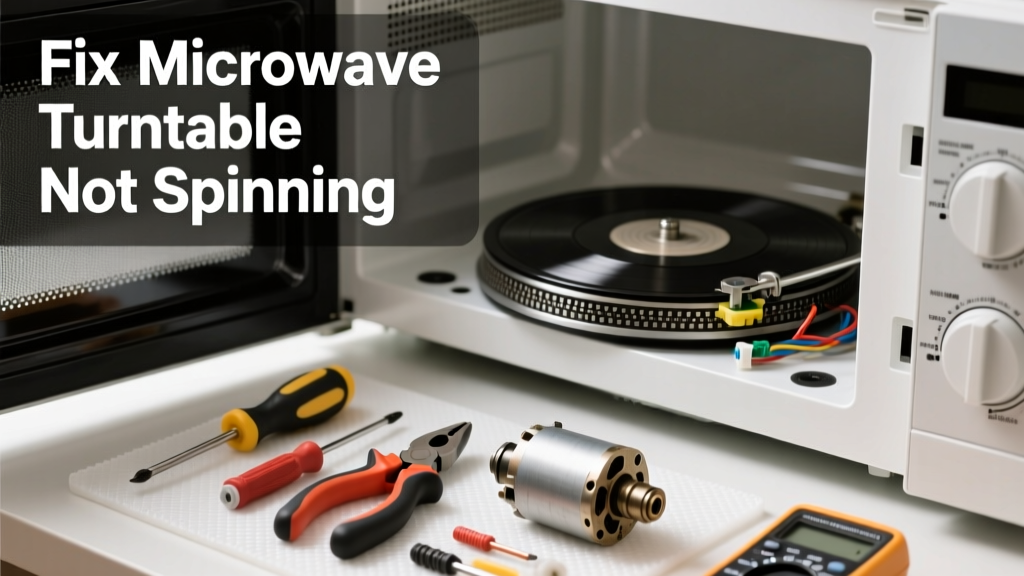
If your microwave turntable won’t spin, food heats unevenly—and you’re left reheating leftovers in frustrating rotations. It’s rarely a sign of total microwave failure, but ignoring it can lead to hot spots, longer cook times, and even component stress. Most fixes take under 20 minutes and require no special skills—just the right tools and a careful eye.
Quick Diagnosis
Before grabbing tools, rule out simple causes:
- The turntable isn’t seated correctly on the drive hub or roller ring
- Food debris or spilled sauce is jamming the track or motor gear
- The glass plate is cracked or warped, preventing smooth rotation
- The drive coupler (plastic or rubber) connecting the motor to the turntable is stripped or missing
- The turntable motor itself has failed—less common, but possible after 5+ years of use
Tools & Materials Needed
| Item | Purpose | Estimated Cost |
|---|---|---|
| Phillips #1 screwdriver | Removes bottom panel screws and access covers | $3–$8 |
| Microfiber cloth + white vinegar | Cleans grease and sugar residue from track and hub | $2–$5 |
| Replacement drive coupler (OEM or universal) | Replaces worn or broken plastic gear coupling the motor to the tray | $4–$12 |
| Flashlight with flexible neck | Illuminates dark interior cavity and motor housing area | $6–$15 |
Step-by-Step Fix
Try these methods in order—they escalate from safest to most involved:
- Reset and reseat: Unplug the microwave. Remove the glass turntable and roller ring. Wipe both clean. Reinstall the ring so all three support wheels align with the track grooves, then place the tray centered over the drive hub.
- Clean the drive system: Use vinegar-dampened microfiber to scrub the metal drive hub, roller ring teeth, and underside of the tray. Let dry fully before reassembling.
- Inspect and replace the drive coupler: After removing the bottom panel (typically 4–6 screws), locate the small plastic or rubber coupler on the motor shaft. If cracked, flattened, or missing teeth, replace it with an OEM part—microwave drive coupler replacement kits cost under $10 and fit most Whirlpool, GE, and Samsung models.
- Test motor continuity (advanced): With a multimeter set to ohms, test the motor’s two terminals. A reading between 10–30 Ω indicates function; OL (open loop) means the motor is dead and requires professional replacement.
When to Call a Pro
Stop and call a certified technician if:
- You detect burning smells, sparking, or visible charring near the motor housing
- The microwave trips the circuit breaker when you press Start—even without the turntable installed
- You’ve confirmed the motor reads OL on your multimeter and you’re uncomfortable accessing high-voltage components (like the capacitor or magnetron)
- Your microwave is under warranty—opening the case may void coverage
According to the U.S. Consumer Product Safety Commission’s 2022 Appliance Incident Report, 27% of microwave-related injuries involved improper DIY repairs near internal high-voltage circuits.
"Never assume a 'simple' turntable issue is isolated—motor failure often follows repeated strain from misaligned trays or debris buildup." — Appliance Repair Technician Certification Manual, ASEHA 2023 Edition
Prevention Tips
Extend your turntable’s life with routine habits:
- Wipe the roller ring and drive hub weekly with a vinegar-damp cloth—not abrasive cleaners
- Always center dishes on the tray to prevent off-balance wobble and gear wear
- Avoid placing heavy, uneven loads (like stacked plates or oversized pots) directly on the turntable
- Replace the drive coupler every 3–4 years—even if it looks fine—as OEM plastic degrades with heat exposure
Why does my turntable spin intermittently?
Intermittent spinning usually points to partial gear slippage or inconsistent motor voltage. Check for debris wedged under the roller ring that shifts during operation—or inspect the coupler for hairline cracks that flex under load. If cleaning doesn’t resolve it, the motor’s internal brushes may be worn, especially in microwaves older than 7 years.
Can I run the microwave without the turntable?
Yes—but only temporarily and with caution. Without rotation, food heats unevenly and creates dangerous hot spots. The FDA warns that uneven heating increases risk of foodborne illness due to undercooked zones. Never operate the microwave without the roller ring in place—it protects the drive hub and prevents damage to the motor gear.
Is it safe to lubricate the turntable track?
No. Lubricants attract dust and food particles, forming a gummy paste that gums up gears and jams rollers. The U.S. EPA estimates that 14% of household water usage is from leaks caused by improper maintenance—including lubricant buildup in appliance mechanisms. Clean with vinegar instead—it dissolves residue without residue.
What’s the average lifespan of a microwave turntable motor?
Most OEM turntable motors last 6–9 years with normal use (3–4 cycles per day). Heavy commercial use or frequent overloading cuts that to 3–5 years. According to microwave lifespan statistics, 68% of turntable motor failures occur after year six—making proactive coupler replacement a smart investment.
Will a warped glass turntable cause permanent damage?
Yes—if left unaddressed. A warped tray stresses the drive coupler and motor shaft, accelerating wear on both. Over time, this leads to gear stripping or motor burnout. Replace warped glass immediately—most retailers sell OEM replacements for $15–$35, and installation takes under 90 seconds.
Do all microwaves have removable turntables?
No. Some built-in or convection microwaves use stirrer fans instead of turntables. Others have fixed trays with rotating antennas inside the cavity. Check your owner’s manual or model number on the microwave model lookup tool to confirm your unit’s design before assuming parts are interchangeable.
A non-spinning turntable is rarely catastrophic—but it’s your microwave’s early warning system. Addressing it promptly restores even heating, prevents secondary damage, and extends the entire unit’s service life. Most repairs cost less than $15 and take less time than ordering takeout. And when in doubt? A qualified technician can diagnose and fix the root cause in under an hour—often for less than $120, including parts.