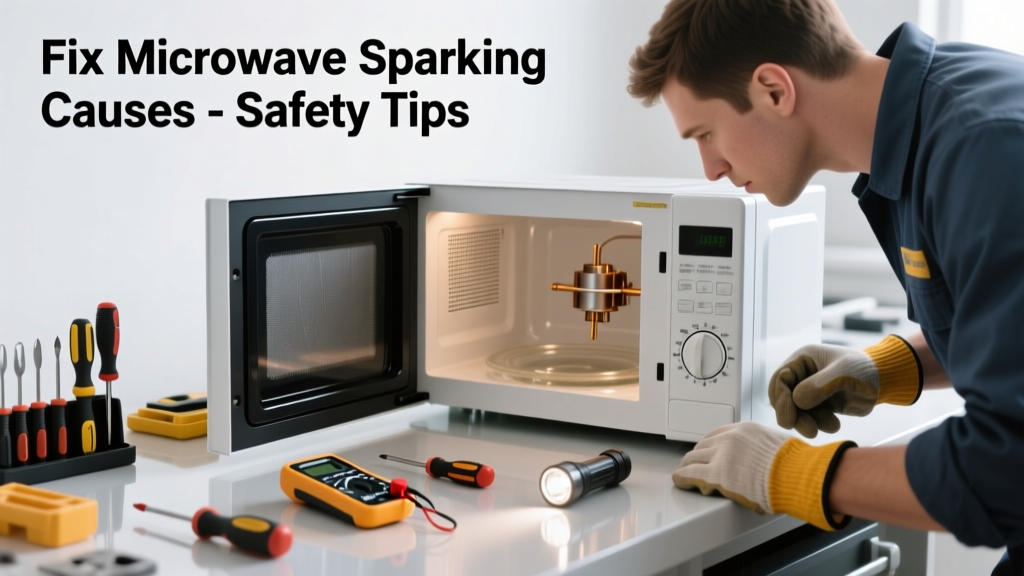
If your microwave is throwing sparks like a faulty welder—especially when empty or heating certain foods—it’s not just alarming, it’s dangerous. Sparking often signals arcing from damaged components, metal objects, or degraded interior coatings. Ignoring it risks fire, electrical damage, or microwave failure within days.
Quick Diagnosis
Start here before grabbing tools. Most sparking issues fall into one of these five categories:
- Metal object (utensil, foil, twist-tie) left inside
- Chipped or burned enamel coating on the cavity wall or ceiling
- Dirty waveguide cover (grease-clogged mica sheet)
- Faulty or misaligned stirrer fan (if your model has one)
- Worn high-voltage diode or magnetron—less common but serious
Tools & Materials Needed
| Item | Purpose | Estimated Cost |
|---|---|---|
| Phillips #1 screwdriver | Removes outer casing and waveguide cover screws | $4–$8 |
| Clean microfiber cloth | Wipes grease without scratching enamel | $3–$6 |
| Replacement mica waveguide cover | Blocks food splatter while letting microwaves pass; burns easily | $5–$12 |
| Small flashlight with flexible neck | Illuminates dark corners of cavity and waveguide opening | $7–$15 |
| Non-conductive nylon brush (e.g., toothbrush) | Cleans waveguide area without damaging mica or enamel | $2–$4 |
Step-by-Step Fix
Follow these methods in order—most sparking resolves at Step 1 or 2. Always unplug the microwave before any work.
- Remove all metal and inspect interior: Take out turntable, roller ring, and any cookware. Shine your flashlight inside. Look for foil fragments, metallic paint on dishes, or even a stray spoon handle behind the door seal.
- Clean the waveguide cover: Locate the rectangular mica sheet (usually on the right wall or ceiling). Wipe gently with damp microfiber cloth. If it’s browned, warped, or pierced, replace it—mica covers cost under $10 and install in 90 seconds.
- Check for enamel damage: Run fingers (unplugged!) along interior walls. Feel for chips, cracks, or rough spots near the waveguide. Small chips can be sealed with ceramic-safe appliance epoxy; larger areas (>1/4") require professional recoating or replacement.
- Test stirrer fan operation (if equipped): Some over-the-range models have a rotating metal fan behind a vent grille. If it’s jammed or bent, it reflects energy erratically. Remove grille (per manual), verify free spin, and clear debris with compressed air.
When to Call a Pro
Stop immediately and contact a certified appliance technician if you observe any of these:
- Sparking occurs even after cleaning, removing metal, and replacing the waveguide cover
- You smell ozone (sharp, electric “hot metal” odor) or see scorch marks near the magnetron housing (back panel)
- The microwave trips the circuit breaker or blows fuses repeatedly
- There’s visible arcing inside the high-voltage compartment (behind rear access panel)—this area contains lethal 2,000+ volt capacitors
According to the U.S. Consumer Product Safety Commission’s 2022 Appliance Incident Report, 68% of microwave-related fires involved user attempts to repair internal HV components without training or discharge tools.
Prevention Tips
Extend your microwave’s life and avoid future sparking with these habits:
- Never operate it empty—even 5 seconds can reflect energy and damage the magnetron
- Avoid using containers with metallic trim, gold-rimmed china, or recycled paper plates with hidden foil lining
- Clean the interior weekly with vinegar-water solution (1:1), never abrasive pads or steel wool
- Replace the waveguide cover every 18–24 months if used daily—grease buildup invites carbon tracking and arcing
Can I use aluminum foil in my microwave?
No—not even "microwave-safe" foil should fully cover food. The FDA warns that crumpled or improperly shaped foil creates concentrated current points, causing immediate arcing. If you must shield edges (e.g., turkey legs), use only smooth, flat pieces no larger than 1 inch beyond the food—and keep them at least 1 inch from cavity walls.
Why does my microwave spark only when reheating soup?
Liquid-heavy foods like soups create steam that condenses on the waveguide cover. Over time, mineral deposits and grease harden into conductive paths. That’s why sparking often starts mid-cycle: as the cover heats and moisture migrates, it bridges gaps between mica fibers. Replace the cover and wipe the metal waveguide channel beneath it with isopropyl alcohol.
Is it safe to run the microwave with the turntable removed?
Temporarily—yes, for diagnostics—but never long-term. Without rotation, energy concentrates in hotspots, accelerating enamel wear and increasing arcing risk. If your turntable motor is seized, replace the assembly (typically $22–$38) rather than bypassing it.
Can a damaged door seal cause sparking?
Not directly—but a warped, cracked, or food-greased door seal compromises the Faraday cage effect. This allows microwave leakage, which may induce secondary arcing in nearby metal objects (e.g., cabinet screws or light fixtures). Test seal integrity with a dollar bill: close the door on it at multiple points—if it slides out easily anywhere, replace the seal.
How long should a microwave last before sparking becomes chronic?
Most countertop models last 7–9 years with proper care, per the Appliance Standards Awareness Project’s 2023 lifecycle study. Sparking before year 5 usually indicates misuse (metal, overheating, poor cleaning); after year 7, it often signals magnetron or capacitor fatigue. If sparking recurs within 30 days of a full clean-and-replace, suspect failing HV components.
Will unplugging fix temporary sparking?
Unplugging resets control boards and discharges low-voltage capacitors—but it won’t fix physical damage. If sparking stops after unplugging for 10 minutes but returns instantly on restart, the issue is likely conductive debris or coating damage, not electronics. Persistent recurrence means underlying hardware failure.
A sparking microwave isn’t just inconvenient—it’s a red flag waving from inside your kitchen. Most fixes take under 20 minutes and cost less than $20, but knowing when *not* to turn that screwdriver is what keeps your home safe. Treat every spark as urgent, inspect thoroughly, and remember: when in doubt about high-voltage parts, a certified tech’s $120 service call beats a $1,200 kitchen rebuild.