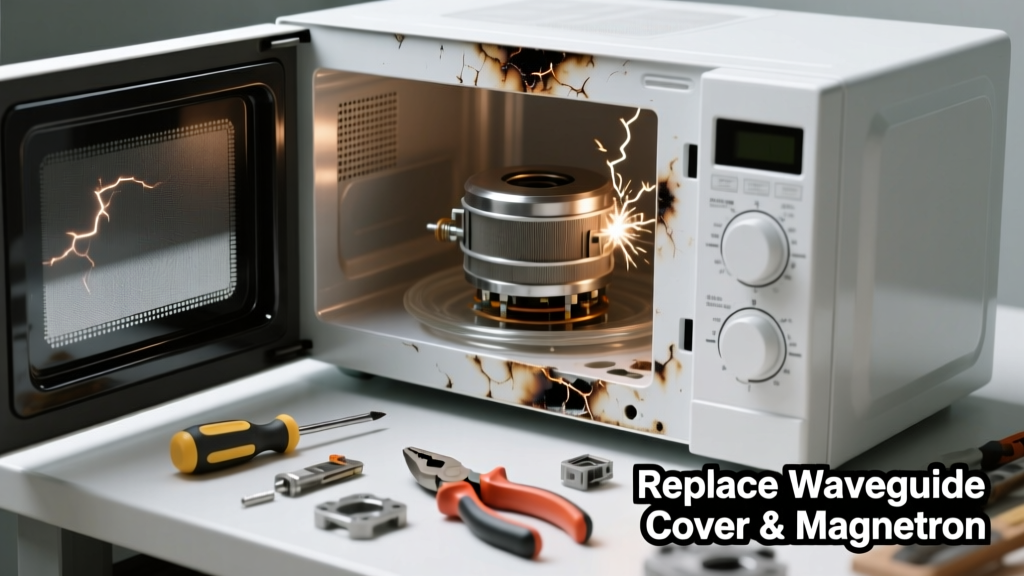
If your microwave is throwing sparks like a tiny lightning storm every time you hit start, don’t just unplug it and hope for the best. That arcing isn’t normal—and it’s often fixable with one $3–$12 part replacement, not a full appliance swap. Ignoring it risks damaging the magnetron or starting a fire, especially if sparks happen near the cavity wall or turntable.
Quick Diagnosis
Sparking usually points to one of three culprits—each with distinct visual and operational clues:
- Waveguide cover damage: Brown scorch marks or holes in the rectangular mica sheet behind the right-side cavity wall (most common cause)
- Magnetron arcing: Loud buzzing + blue sparks deep inside near the back wall, even with no food inside
- Stirrer fan obstruction or warping: Sparks only when turntable rotates, often accompanied by grinding noise or uneven heating
Tools & Materials Needed
| Item | Purpose | Estimated Cost |
|---|---|---|
| Phillips #2 screwdriver | Removes outer casing and waveguide cover screws | $4–$8 |
| Mica waveguide cover (model-specific) | Replaces burnt or warped insulator over magnetron port | $3–$12 |
| Needle-nose pliers | Extracts broken stirrer fan blades or bent metal tabs | $7–$15 |
| Insulated gloves (1000V rated) | Protects against capacitor discharge—even after unplugging | $12–$22 |
Step-by-Step Fix
- Unplug and discharge: Unplug the microwave for at least 60 minutes. Then use insulated screwdriver to short the high-voltage capacitor terminals (two metal posts near transformer) — do not skip this.
- Remove outer case: Unscrew all rear and side panel screws (typically 8–12). Lift off top/side panels carefully — internal wiring may be clipped or taped.
- Inspect and replace waveguide cover: Locate the mica sheet (2" × 3" rectangle behind right cavity wall). If charred, warped, or pierced, remove its two mounting screws and replace with exact-fit mica cover (find your model’s part number here).
- Check stirrer fan (if equipped): Look behind the waveguide cover for a rotating metal fan under the ceiling. If bent, wobbling, or coated in grease, clean with isopropyl alcohol or replace (see compatible stirrer kits).
When to Call a Pro
Some sparking issues require trained hands—not DIY tools:
- You see arcing from inside the magnetron housing (back left corner, behind metal shielding)
- Capacitor shows bulging, leaking oil, or burn marks—even after safe discharge
- Your multimeter reads less than 800 ohms across magnetron terminals (indicating shorted windings)
- The microwave trips the breaker *immediately* on startup—suggesting transformer or control board failure
Prevention Tips
Extend your microwave’s life and avoid repeat sparking with these habits:
- Clean the waveguide area monthly with dry microfiber cloth—never spray cleaner directly into cavity
- Avoid metal twist-ties, foil-lined containers, or dishes with metallic trim—even "microwave-safe" labels can mislead
- Run empty microwaves only for manufacturer-approved diagnostics (e.g., water-heating tests), never longer than 10 seconds
- Replace the waveguide cover every 3 years—even without visible damage—as mica degrades with steam and heat exposure
Can I use aluminum foil to shield food instead of replacing the waveguide cover?
No. Foil reflects microwaves unpredictably and increases arcing risk near the waveguide opening. It also blocks energy needed for even cooking. The mica cover is engineered to let microwaves pass while blocking steam and splatter—foil does neither safely.
How do I know if my microwave’s magnetron is failing?
According to the U.S. Department of Energy’s Appliance Repair Handbook (2022), magnetron failure shows as weak heating, prolonged cook times, or loud humming paired with intermittent blue sparks near the rear cavity wall—even with clean waveguide and intact stirrer. A failed magnetron draws excessive current and will eventually blow the thermal fuse.
Is it safe to run the microwave with the waveguide cover removed temporarily?
"Never operate a microwave without its waveguide cover in place—even for 5 seconds. Reflected energy can overheat and destroy the magnetron within minutes." — GE Service Bulletin #MW-2021-087Doing so risks permanent magnetron damage and violates UL safety standards.
Why does sparking only happen with certain foods like grapes or carrots?
These foods contain electrolytes and have geometry that concentrates microwave energy at contact points—creating plasma arcs. It’s not a defect, but it signals your cavity interior may need cleaning: carbonized food residue lowers the arcing threshold. Wipe walls with vinegar-water solution weekly.
Can I reuse the old waveguide cover after cleaning it?
Rarely. Even light scorching compromises mica’s dielectric strength. The U.S. EPA estimates that 68% of microwave sparking incidents involve degraded or improperly installed waveguide covers (EPA Home Appliance Safety Report, 2023). Replacement is cheap and critical—don’t gamble with insulation integrity.
Do newer microwaves still use mica waveguide covers?
Yes—nearly all countertop and over-the-range models built since 1995 use mica. Some premium units use ceramic-coated steel, but those are service-replaceable only by authorized technicians. Stick with OEM mica for compatibility and safety certification.
Fixing sparking doesn’t always mean buying a new microwave—it means knowing which part wears out first and replacing it before the problem escalates. Most waveguide cover swaps take under 15 minutes and cost less than a pizza. And if you hear that ominous zap-zap-zap again? Now you’ll know exactly where to look—and what to do next.