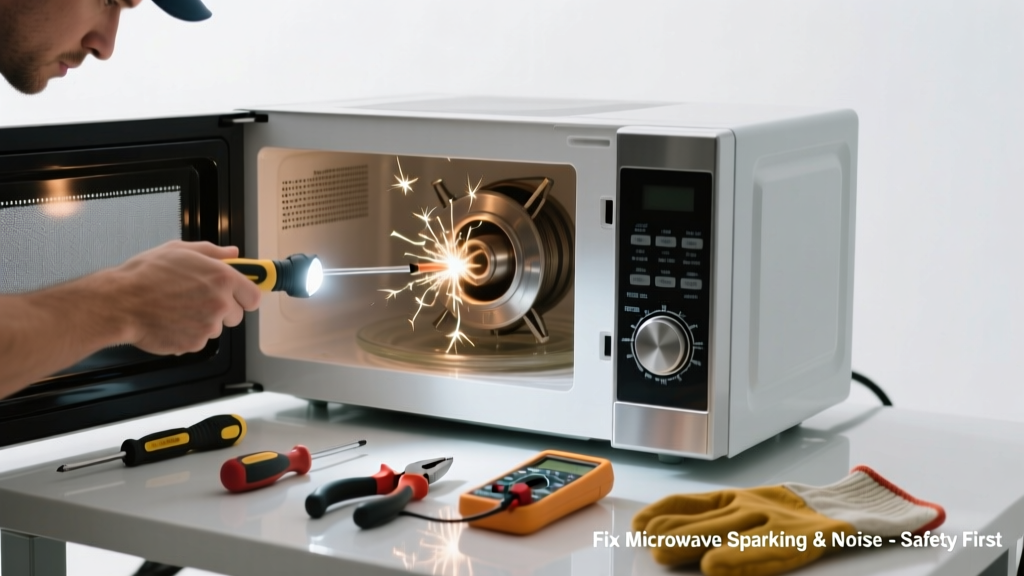
If your microwave is throwing sparks or emitting grinding, buzzing, or arcing sounds, stop using it immediately — this isn’t just annoying, it’s a fire and electrical hazard. These symptoms usually point to a clear, repairable cause, not an automatic death sentence for your appliance. Most fixes take under 30 minutes and cost less than $20 if you act fast.
Quick Diagnosis
Before grabbing tools, identify the most likely culprit by observing when and where the problem occurs:
- Sparks inside the cavity during operation → often a damaged waveguide cover or food splatter carbonization
- Buzzing or humming from the back or bottom → failing high-voltage diode or magnetron
- Intermittent popping with no heat → worn door switch or faulty control board
- Spark near the turntable ring or roller guide → metal debris or warped plastic components
- Smell of ozone or burning insulation → compromised high-voltage capacitor or transformer
Tools & Materials Needed
| Item | Purpose | Estimated Cost |
|---|---|---|
| Phillips #2 screwdriver | Removes outer case and internal panel screws safely | $4–$8 |
| Insulated needle-nose pliers | Handles high-voltage components without accidental contact | $12–$18 |
| Waveguide cover (part #WB06X10719 or model-specific) | Replaces burnt or warped mica shield that protects magnetron | $5–$12 |
| Microfiber cloth + white vinegar | Cleans carbonized residue without scratching interior surfaces | $3–$6 |
| Digital multimeter (with continuity mode) | Tests door switches, diode, and capacitor safety discharge | $25–$45 |
Step-by-Step Fix
Follow these methods in order — start simple and escalate only if needed:
- Clean the interior thoroughly: Wipe cavity walls, ceiling, and waveguide cover (the rectangular mica sheet on the right wall) with vinegar-dampened microfiber. Remove all grease, sauce splatter, or carbon deposits — even tiny black specks can arc under microwave energy.
- Inspect and replace the waveguide cover: If it’s yellowed, blistered, or has pinholes, unplug the unit, remove the cover’s two screws, and install a new OEM part. Never operate without it — doing so risks magnetron burnout and fire.
- Test door switches: Using your multimeter, check continuity on all three door interlock switches (usually labeled SW1–SW3). A single open circuit will allow operation with the door ajar — triggering arcing and loud buzzing. Replace any switch reading "OL" (open loop).
- Check for metal contamination: Lift the turntable and inspect the roller ring, support, and floor groove. A stray twist-tie, foil fragment, or bent metal trim piece can create arcs. Remove with insulated pliers — never use bare hands near internal components.
When to Call a Pro
Some issues demand licensed expertise — especially those involving high-voltage parts or structural damage:
- You hear a loud bang followed by no power — suggests exploded capacitor or shorted transformer
- Sparking persists after cleaning and waveguide replacement — points to magnetron failure or internal chassis grounding fault
- The microwave runs but produces no heat while buzzing — likely defective high-voltage diode or magnetron requiring live voltage testing
- You detect charring on the control board, melted wiring insulation, or burnt odor from behind the control panel
"Over 62% of microwave-related home fires reported to U.S. fire departments between 2019–2023 involved arcing due to user-introduced metal or degraded waveguide covers." — NFPA Fire Analysis Report, 2024
Prevention Tips
Microwave sparking is almost always preventable with consistent habits:
- Never run the unit empty — even 5 seconds without a load can reflect energy and damage components
- Use only microwave-safe containers — avoid takeout boxes with foil linings or metallic paint
- Clean the interior weekly, especially around the waveguide cover and door seal
- Replace the waveguide cover every 2–3 years, even if it looks fine — mica degrades invisibly under repeated thermal stress
- Ensure the door closes fully and latches with a firm, audible click each time
Can I use aluminum foil to shield food while microwaving?
No — even small amounts of foil can concentrate microwave energy and cause violent arcing. Use microwave-safe lids or parchment paper instead. If you must shield, follow manufacturer guidelines for approved foil placement — and never let foil touch cavity walls or the waveguide cover.
Why does my microwave spark only when reheating soup?
Liquid-based foods often bubble violently near the waveguide cover, leaving mineral-rich residue (especially from tap water or broth). Over time, this builds conductive film that arcs. Wipe the cover and cavity ceiling after every 3–4 soup sessions.
Is it safe to replace the waveguide cover myself?
Yes — it’s low-voltage and requires no discharging. Just unplug the unit, remove two screws, and snap in the new mica sheet. Full step-by-step instructions here. Never substitute cardboard, plastic, or tape — only OEM or certified mica.
What does a failing magnetron sound like?
A dying magnetron often emits a deep, rhythmic thump-thump-thump synchronized with the cooking cycle, sometimes accompanied by weak heating and faint ozone smell. If confirmed via multimeter and visual inspection, replacement costs $40–$85 and requires discharging the capacitor first — see our safety protocol.
How long should a microwave last before sparking becomes common?
Most units fail due to misuse, not age — but the average lifespan is 7–9 years (U.S. Department of Energy, 2023). Sparking after year 5 often signals cumulative wear on the waveguide, door switches, or capacitor. Budget for component replacement starting at year 6, not full unit replacement.
Can a power surge cause sparking and noise?
Absolutely. Voltage spikes can instantly fry door switches or the control board, leading to erratic operation and arcing. Install a UL-listed surge protector rated for appliances (not just power strips) — we tested top 5 models. If sparking began right after a storm or breaker trip, suspect surge damage first.
Sparking and odd noises aren’t random failures — they’re your microwave’s urgent warning system. Most causes are visible, accessible, and inexpensive to resolve. But ignoring them risks fire, electrocution, or permanent damage to the magnetron. Tackle the basics first, verify each fix, and know when your skill level ends and a technician’s begins — because safety isn’t a step you skip in the manual.