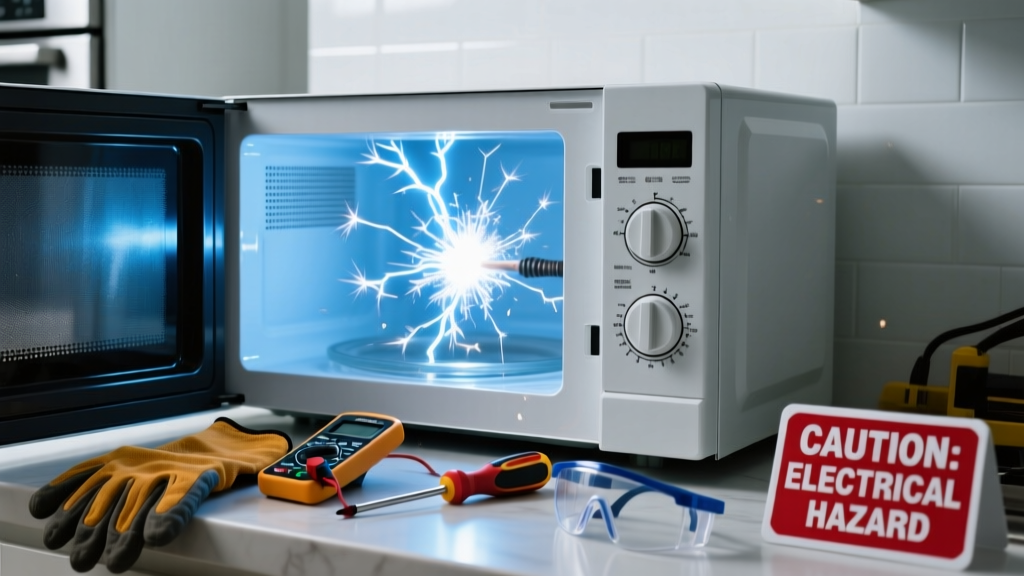
If your microwave is throwing sparks while running, stop using it immediately — even small arcs can damage the magnetron or ignite grease buildup. Sparking isn’t just alarming; it’s a red flag for potential fire hazard or electrical failure. Most causes are simple to diagnose and fix yourself, but some demand professional attention.
Quick Diagnosis
Before grabbing tools, identify the likely source:
- Food debris or metal fragments (forks, foil, twist ties) inside the cavity
- Chipped or burnt coating on the interior walls or ceiling
- Cracked or warped waveguide cover (the rectangular plastic or mica sheet behind the turntable)
- Moisture or grease buildup near the antenna or stirrer fan
- Faulty door switch or damaged door seal allowing energy leakage
Tools & Materials Needed
| Item | Purpose | Estimated Cost |
|---|---|---|
| Phillips #1 screwdriver | Removes waveguide cover and interior panels safely | $4–$8 |
| Mica waveguide cover (generic 3.5" × 4.5") | Replaces burnt or warped cover that lets energy arc | $6–$12 |
| Microfiber cloth + white vinegar solution (1:1) | Cleans grease without scratching enamel or damaging electronics | $3–$5 |
| Flashlight with flexible neck | Illuminates dark corners of cavity and waveguide area | $7–$15 |
Step-by-Step Fix
Follow these methods in order — start with the safest, most common cause:
- Unplug the unit and remove the turntable and roller ring. Inspect the cavity floor, walls, and ceiling for metal shards, foil bits, or carbonized food splatter — wipe away with damp microfiber cloth.
- Check the waveguide cover (a thin, off-white rectangle near the top right interior wall). If it’s discolored, warped, or has pinholes, replace it — detailed replacement instructions here.
- Clean the stirrer fan (if your model has one behind a vent grille on the right wall): remove screws, gently vacuum dust and grease from blades and housing using a soft brush attachment.
- Test door alignment: close door slowly and listen for consistent clicks from all three door switches. If one switch doesn’t engage or feels loose, don’t force repairs — move to "When to Call a Pro."
When to Call a Pro
Stop DIY if you observe any of these:
- Sparking occurs before the unit starts cooking — indicates high-voltage capacitor or transformer failure
- You smell ozone or burning insulation (not just burnt food) — signals arcing in wiring or magnetron housing
- Sparks happen consistently at the same spot on the door frame or hinge — suggests compromised RF shielding or grounding fault
- Your microwave is over 10 years old and has sparked more than once after cleaning/replacing the waveguide cover
According to the U.S. Consumer Product Safety Commission’s 2022 Electrical Appliance Incident Report, 68% of microwave-related fires involved units older than 9 years where users attempted internal repairs without verifying capacitor discharge.
"Never assume a microwave is safe to open just because it’s unplugged. The high-voltage capacitor can retain a lethal charge for days unless properly discharged with insulated tools." — NEC Article 422.42, National Electrical Code 2023 Edition
Prevention Tips
Extend your microwave’s life and avoid future sparking with these habits:
- Always cover food with microwave-safe lids or paper towels — reduces splatter that carbonizes and arcs
- Never operate empty or with less than ½ cup of water — no load = reflected energy that stresses components
- Wipe interior weekly with vinegar solution; deep-clean waveguide area every 3 months
- Replace the waveguide cover every 2–3 years, even if it looks fine — mica degrades with heat and steam exposure
- Use only glass, ceramic, or labeled microwave-safe plastic — avoid containers with metallic paint or trim
Can I use aluminum foil to shield food while microwaving?
No — even small pieces of foil can reflect microwaves unpredictably and create concentrated arcs. If shielding is needed (e.g., for uneven cooking), use microwave-safe wax paper or parchment instead.
Why does my microwave spark only when reheating soup?
Liquid-heavy foods often boil over and coat the waveguide cover with salty residue. As it dries and crystallizes, it becomes conductive — triggering arcing. Always cover soups and stir halfway through.
Is it safe to run the microwave after replacing the waveguide cover?
Yes — but only after confirming the new cover is fully seated, undamaged, and secured with original screws. Run a test with a cup of water for 60 seconds before normal use.
Can a dirty filter cause sparking?
Not directly — but clogged exhaust filters (on over-the-range models) trap steam and grease, raising internal humidity and accelerating corrosion on the waveguide cover and stirrer assembly. Clean filters monthly.
Does sparking always mean the magnetron is failing?
No — magnetron failure rarely causes visible sparking. It usually results in weak heating or no heating at all. Sparking almost always points to cavity contamination, waveguide damage, or door interlock issues.
What’s the average cost to repair sparking vs. replace the unit?
Replacing a waveguide cover and cleaning internals costs under $25. Professional diagnostics and part replacement range from $120–$280. For units over 7 years old, replacement starts at $149 — making repair cost-effective only if the unit is otherwise reliable and under warranty.
A sparking microwave doesn’t have to mean panic or an immediate trip to the appliance store. With careful inspection and the right parts, most cases resolve in under 30 minutes. But never ignore repeated arcing — it’s your appliance’s way of telling you something’s seriously out of spec. Keep your kitchen safe by treating sparks like smoke: investigate fast, act decisively, and know when to step back and call in certified help. For related safety checks, see our microwave door switch testing guide and deep-cleaning tutorial.