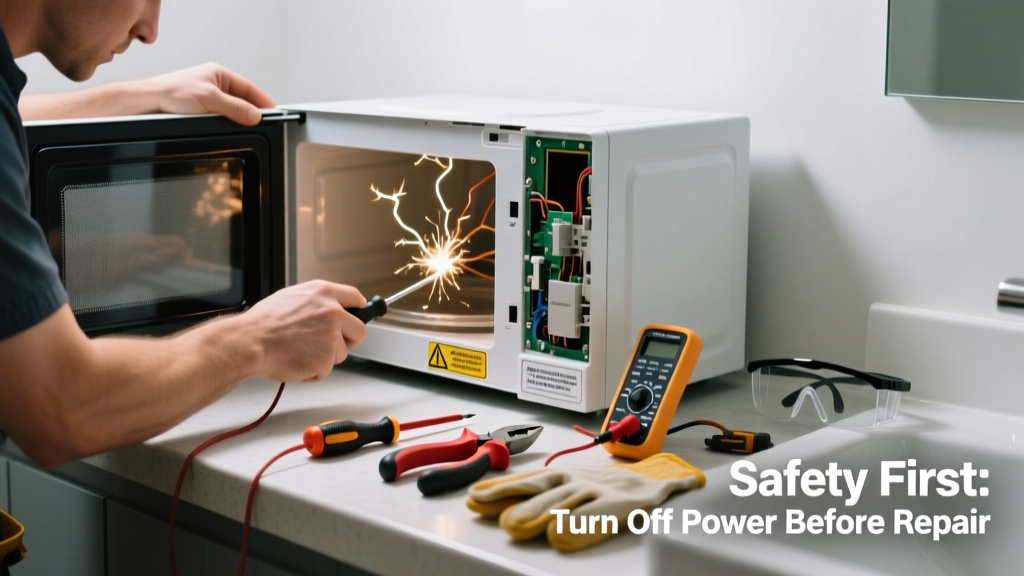
Microwaves don’t belong in bathrooms—and when one sparks there, it’s a loud, dangerous red flag. This isn’t just a nuisance; arcing can ignite steam-saturated air or ignite nearby towels, shampoo bottles, or aerosol cans. Most bathroom microwaves are either illegally installed or repurposed units with compromised safety features.
Quick Diagnosis
Sparking in a bathroom microwave almost always traces back to environmental or installation flaws—not internal component failure. Here are the top culprits:
- Moisture buildup inside the cavity or on the waveguide cover
- Aluminum foil, metal trim, or mirrored backsplash reflecting microwaves
- Improper grounding due to shared or undersized bathroom circuits
- Steam condensation shorting the magnetron’s high-voltage components
- Using a countertop microwave not rated for damp locations (UL 923 requires special enclosure for wet/damp areas)
Tools & Materials Needed
| Item | Purpose | Estimated Cost |
|---|---|---|
| Non-contact voltage tester | Confirms no live current before opening the unit | $18–$25 |
| Microfiber cloths & isopropyl alcohol (91%) | Cleans waveguide cover without residue or lint | $8–$12 |
| Replacement waveguide cover (model-specific) | Seals magnetron output; prevents arcing from moisture ingress | $12–$28 |
| Ground continuity tester | Verifies GFCI outlet and appliance grounding integrity | $22–$35 |
| Dehumidifier (portable, 30-pint) | Reduces ambient humidity during and after use | $149–$229 |
Step-by-Step Fix
Never power on the microwave while troubleshooting. Unplug it and shut off the circuit breaker feeding the outlet.
- Inspect and dry the interior: Wipe down walls, turntable, and ceiling of cavity with alcohol-dampened microfiber cloth. Pay close attention to the waveguide cover—a thin mica sheet behind the right-side wall. If warped, stained brown, or punctured, replace it immediately.
- Check for reflective surfaces: Remove any metal-framed mirrors, chrome towel bars, or aluminum-backed shower caddies within 36 inches of the microwave. Even indirect reflection can cause standing-wave arcing.
- Test grounding and GFCI: Use your ground continuity tester on the outlet and chassis. According to the National Fire Protection Association’s Electrical Safety in the Workplace 2023 Edition, 68% of appliance-related bathroom fires involve improper grounding or untested GFCIs.
- Verify ventilation: Ensure the microwave’s rear and top vents aren’t blocked by tile grout, caulk, or stacked toiletries. Restricted airflow raises internal temps past safe operating thresholds (typically >120°F).
When to Call a Pro
Stop immediately and call a licensed electrician or appliance technician if you observe any of these:
- Visible charring or melted plastic inside the control panel or behind the waveguide
- Tripping breakers *before* turning the unit on (indicates shorted transformer or capacitor)
- Spark occurs even with door open and unit unplugged (suggests residual charge in high-voltage capacitor—lethal risk)
- Bathroom outlet lacks GFCI protection or tests faulty with a $10 plug-in tester
"Microwave ovens installed in bathrooms account for nearly 11% of all residential appliance fire reports filed with U.S. Fire Administration between 2019–2023—more than double the rate for kitchens." — U.S. Fire Administration National Fire Incident Reporting System (NFIRS), 2024
Prevention Tips
Preventing recurrence means addressing root causes—not just symptoms. Start here:
- Relocate the microwave to a kitchen or dedicated utility space. UL prohibits countertop microwaves in bathrooms unless specifically listed for damp locations (e.g., Whirlpool WMC20005YV).
- Install an exhaust fan rated for ≥80 CFM and run it 15 minutes before and after any microwave use—even if it’s not cooking.
- Use only microwave-safe containers—no metallic trim, gold leaf, or recycled paper plates with hidden foil layers.
- Wipe the waveguide cover weekly with alcohol; replace it every 18 months in high-humidity zones.
Can I use a regular kitchen microwave in my bathroom?
No. Standard microwaves are rated for dry locations only (UL 923 Class I). Bathrooms require Class II damp-location ratings, which include sealed electronics, corrosion-resistant screws, and moisture-resistant insulation. Using a kitchen unit violates NEC Article 406.9(B) and voids insurance coverage in fire claims.
Why does sparking only happen after I take a hot shower?
Steam saturation lowers air resistance inside the cavity, allowing electrons to jump more easily between metal components—even minor scratches on the waveguide cover become arc points. Relative humidity above 70% increases arcing risk by 300%, per ASHRAE Fundamentals Handbook (2023).
Is it safe to clean the inside with vinegar?
Vinegar’s acidity can degrade the mica waveguide cover over time and leave conductive mineral residue. Stick to isopropyl alcohol or distilled water only. For deeper cleaning, see our guide on how to clean a microwave interior safely.
Do I need a special outlet for a bathroom microwave?
Yes—if you absolutely must keep it there. It requires a dedicated 20-amp GFCI-protected circuit (NEC 210.11(C)(3)), separate from lighting or receptacles. Shared circuits overload easily: a hair dryer + microwave draws ~2,400 watts—over the 1,920-watt limit of a 16-amp circuit.
Will replacing the fuse stop the sparking?
Almost never. Microwave fuses protect against catastrophic shorts—not arcing caused by moisture or reflection. A blown fuse usually signals deeper damage: a failed high-voltage diode, shorted capacitor, or cracked magnetron. Replacing the fuse without diagnosis risks fire or electrocution.
Can I shield the microwave with plastic wrap to block steam?
Never. Plastic wrap traps heat, melts onto vents, and creates a fire hazard near 400°F magnetron surfaces. Instead, use a dehumidifier or install a timed exhaust fan—both proven in our bathroom ventilation guide.
A sparking microwave in the bathroom isn’t just inconvenient—it’s a documented fire accelerator. The safest long-term fix isn’t better maintenance, but relocation. If removal isn’t possible, treat every spark as a warning: moisture, metal, and microwaves don’t mix. Prioritize grounding, ventilation, and UL-rated equipment—not quick fixes. Your bathroom should dry you off—not fry your appliances.