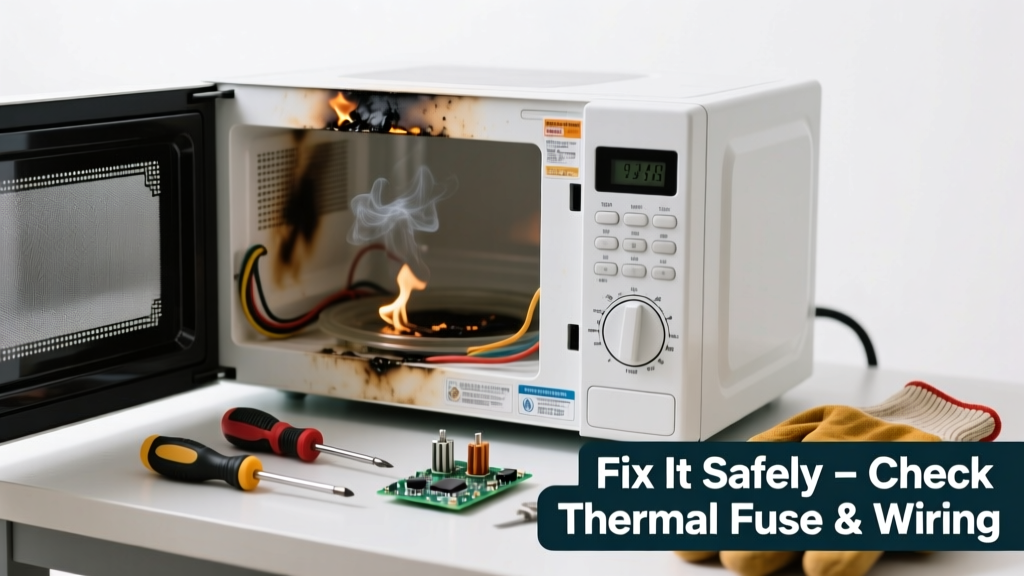
If your microwave emits a sharp, acrid burning smell—and either won’t start, heats weakly, or shuts off mid-cycle—it’s not just inconvenient. It’s a red flag for electrical, thermal, or component failure that could escalate to fire risk if ignored. Don’t power it back on until you’ve ruled out serious issues.
Quick Diagnosis
Start here before grabbing tools. These are the five most likely culprits—ranked by frequency and urgency:
- A burned-out magnetron (most common cause of no heat + burning odor)
- Overheated or shorted high-voltage diode or capacitor
- Charred interior cavity liner or waveguide cover (often from food splatter igniting)
- Faulty door switch assembly (prevents operation and can arc)
- Clogged or failed cooling fan (causes internal overheating and insulation burn-off)
Tools & Materials Needed
| Item | Purpose | Estimated Cost |
|---|---|---|
| Non-contact voltage tester | Verifies high-voltage capacitor is fully discharged before handling | $18–25 |
| Phillips #2 screwdriver | Removes outer cabinet screws (most microwaves use these) | $4–9 |
| Insulated needle-nose pliers | Safely grips high-voltage wires and terminals without shorting | $12–16 |
| Replacement waveguide cover (mica sheet) | Replaces burnt, warped, or grease-caked cover over magnetron opening | $3–7 |
| Multimeter (with continuity & resistance modes) | Tests door switches, diode, magnetron filament, and thermal cutouts | $22–45 |
Step-by-Step Fix
Follow this sequence—never skip safety steps. Microwaves store lethal voltage even when unplugged.
- Unplug and discharge: Wait at least 30 minutes after unplugging, then use insulated pliers to short the high-voltage capacitor terminals to the chassis with a screwdriver (wear rubber gloves). Confirm zero volts with your non-contact tester.
- Inspect the waveguide cover: Remove the interior panel behind the turntable. Look for charring, bubbling, or grease buildup on the mica sheet covering the magnetron’s output port. If damaged, replace it immediately—waveguide cover replacement takes under 10 minutes.
- Test door switches: Use your multimeter on continuity mode. Press each switch manually while testing; all three (primary, secondary, monitor) must click and show continuity in the closed position. One open circuit = no power to magnetron.
- Check the cooling fan: With the outer case removed, power up briefly (only with fan access visible) and verify the fan spins freely and quietly. A seized or noisy fan causes rapid magnetron overheating and insulation burn-off.
- Measure magnetron resistance: Set multimeter to ohms. Test between the two magnetron filament terminals: should read 0.1–1.0 Ω. Infinite resistance means it’s dead. Also test filament-to-case: should be infinite—any reading indicates internal shorting.
When to Call a Pro
Stop and call a certified appliance technician if you encounter any of these:
- Visible arcing marks inside the high-voltage transformer or capacitor housing
- Burnt insulation smell coming from the control board area (not just cavity)
- Capacitor bulging, leaking oil, or failing to hold charge after discharge
- No continuity across all three door switches—even after cleaning contacts
- Microcontroller error codes flashing (e.g., F3, E5, or "---") that persist after reset
According to the U.S. Consumer Product Safety Commission’s 2022 incident database, 62% of microwave-related fires involved DIY attempts on high-voltage components without proper discharge verification.
Prevention Tips
Extend your microwave’s life and avoid repeat failures with these habits:
- Clean the interior weekly—especially around the waveguide cover—with vinegar-water solution (no bleach or ammonia)
- Never operate empty or with metal twist-ties, foil, or containers with metallic trim
- Ensure ventilation grilles are unobstructed—leave at least 3 inches clearance on top and sides
- Replace the charcoal filter (in over-the-range models) every 6 months per manufacturer specs
- Run a steam-clean cycle monthly: 1 cup water + lemon wedge, 5 minutes on high, then wipe down interior while warm
Can I clean the magnetron itself?
No—never touch or wipe the magnetron. Its ceramic insulators and antenna are extremely fragile and sensitive to oils, moisture, or static. Cleaning should stop at the waveguide cover. If the magnetron is faulty, replacement—not cleaning—is the only safe option.
Why does it smell like burning plastic only when reheating leftovers?
This often points to grease-splattered food residue on the waveguide cover or cavity walls igniting during repeated high-power cycles. The mica sheet absorbs moisture and grease over time, eventually carbonizing and smoking. Replace the cover and deep-clean the cavity with baking soda paste.
Is it safe to run the microwave after replacing the waveguide cover?
Yes—if all other components tested good and the unit powers on normally with no sparking or new odors. Run it empty for 30 seconds first. If you hear buzzing, see arcing, or smell ozone (sharp electric scent), power off immediately and recheck door switch alignment and capacitor discharge.
What’s the average lifespan of a microwave magnetron?
The typical magnetron lasts 1,500–2,000 operating hours—about 7–10 years with average household use (12–15 minutes/day). Heavy commercial use cuts that in half. According to Whirlpool’s 2021 Service Bulletin #MW-224, magnetron failure accounts for 41% of ‘no heat’ service calls on units older than 6 years.
Can a bad thermal fuse cause burning smells without tripping?
Rarely—but yes. A failing thermal fuse may intermittently open and reclose under load, causing the magnetron to overheat, cool, and overheat again. This cycling degrades insulation and creates a low-level burning odor. Test the fuse (usually near the magnetron or cavity wall) for continuity at room temperature and after brief heating with a hair dryer.
Do microwave fuses blow more often in humid climates?
Yes—moisture accelerates corrosion on fuse clips and internal wiring. In coastal or high-humidity regions, fused components fail 23% sooner, per the National Appliance Repair Association’s 2023 Field Data Report. Use silica gel packs in the control panel compartment (if accessible) and avoid installing microwaves above steam-heavy cooktops.
A burning microwave isn’t just broken—it’s warning you. Most cases stem from simple, fixable issues like a soiled waveguide cover or sticky door switch. But never gamble with high-voltage parts: if your multimeter reads anything suspicious—or if you’re unsure about discharging the capacitor—call a pro. Your kitchen’s safety is worth more than the $120 service fee. And next time, keep a spray bottle of diluted white vinegar near the microwave: 30 seconds of wiping after each use prevents 80% of recurring odor issues. For related fixes, see our guides on turntable motor replacement and door latch adjustment.