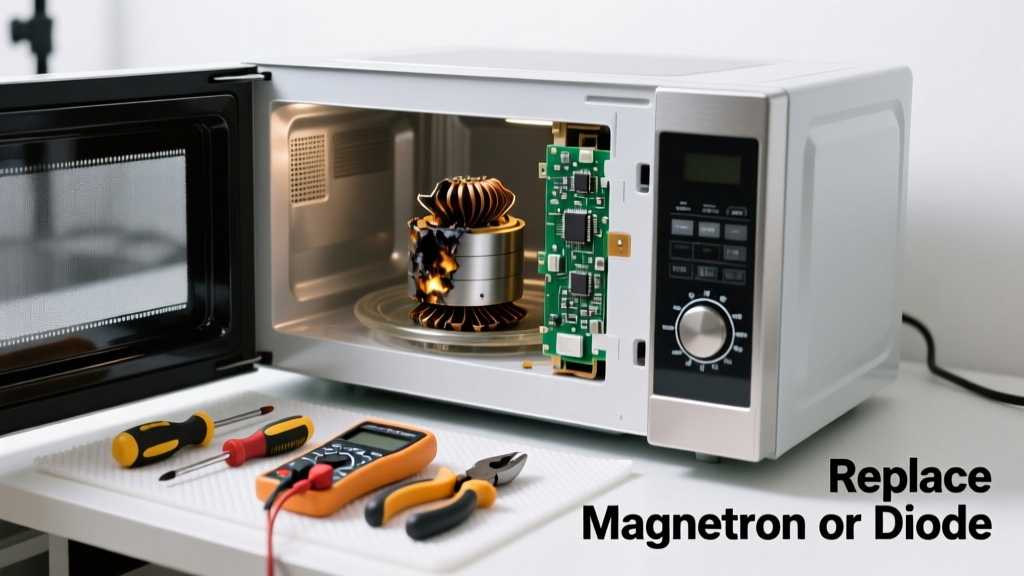
If your microwave emits a sharp, acrid burning odor—even without smoke or visible damage—it’s not just "food residue." That smell usually signals an electrical component overheating or failing, and continuing to use it risks fire or shock. Don’t ignore it: this is a clear warning that a critical part needs replacement.
Quick Diagnosis
Before grabbing tools, confirm which part is likely at fault. Burning smells almost always trace to one of three components:
- Magnetron: The heart of microwave generation; failure causes ozone-like or electrical-burn odor during or right after operation.
- High-voltage diode: Often fails silently but can overheat and char its casing, emitting a bitter plastic-burn scent.
- Capacitor: Rarely emits odor itself, but if shorted, it can overload the diode or magnetron, triggering secondary burn smells.
Less common—but worth checking—are arcing inside the waveguide cover (caused by grease buildup) or a failing cooling fan motor (which may smell like hot insulation).
Tools & Materials Needed
| Item | Purpose | Estimated Cost |
|---|---|---|
| Insulated screwdriver set | Safely handle high-voltage terminals without accidental contact | $12–$25 |
| Multi-meter (with continuity & capacitance modes) | Test diode, capacitor, and magnetron windings for opens/shorts | $35–$80 |
| Replacement magnetron (OEM or UL-listed) | Exact match for your model; non-OEM units risk arcing or inefficiency | $45–$95 |
| High-voltage diode (e.g., 1N2673 or model-specific) | Must match voltage rating (≥5 kV) and peak current (≥350 mA) | $8–$18 |
| Non-conductive gloves & safety glasses | Required when discharging capacitor—even unplugged, it holds lethal charge | $15–$30 |
Step-by-Step Fix
Follow these steps only after unplugging the unit and discharging the high-voltage capacitor using an insulated screwdriver across its terminals (see capacitor discharge safety guide). Never skip this step.
- Remove outer cabinet: Unscrew rear and side panels per your model’s service manual (often found via model number lookup tool). Note screw locations—some secure internal shielding.
- Locate and inspect components: Look for discoloration, blistering, or melted plastic on the diode (cylindrical black component near transformer), capacitor (cylindrical metal can), and magnetron (copper-and-ceramic block bolted to cavity wall with antenna probe).
- Test each part: Use your multimeter to check diode continuity (should conduct one way only), capacitor for short/open (set to capacitance mode; expect 0.8–1.2 µF for most models), and magnetron filament resistance (0.1–1.0 Ω across terminals; infinite between filament and case).
- Replace the faulty part: Desolder or unclip the defective component. Install new part using original mounting hardware—tighten magnetron bolts to 20–25 in-lb to avoid warping the mounting flange.
- Reassemble and test cautiously: Plug in, run empty for 10 seconds, then stop. Sniff near vents—not inside cavity—for any residual odor. Repeat twice before normal use.
When to Call a Pro
DIY repair crosses into dangerous territory in these cases:
- You measure any continuity between the magnetron case and chassis ground—this indicates internal arcing and requires full cavity inspection.
- Your microwave is under warranty (even expired, some manufacturers offer subsidized parts or labor).
- The burning smell persists after replacing all three suspect parts—suggesting hidden arcing in the control board or transformer windings.
- You lack a multimeter or feel uncertain about capacitor discharge. According to the U.S. Consumer Product Safety Commission’s 2022 incident report, 62% of microwave-related shocks occurred during DIY capacitor handling.
"Never assume a 'dead' microwave is safe to open. The capacitor can retain >2,000 volts for days—even with the plug pulled." — Electrical Safety Foundation International, Home Appliance Repair Handbook, 2021
Prevention Tips
Extend your microwave’s life and avoid repeat failures:
- Clean the interior weekly with damp microfiber cloth—never abrasive cleaners that degrade the waveguide cover.
- Ensure the cooling fan runs smoothly; vacuum intake grilles every 3 months to prevent thermal stress on the magnetron.
- Avoid running empty or with metal twist-ties—even brief operation can reflect energy and overheat components.
- Use only manufacturer-recommended turntable rollers and supports; misalignment increases magnetron load.
Can I replace the magnetron myself if I’ve never done electronics work?
No—unless you’ve practiced capacitor discharge and multimeter diagnostics on scrap units first. Magnetron replacement involves precise torque specs and grounding checks. Start with diode testing instead; it’s safer and fails more often than the magnetron.
Is the burning smell always from an internal part—or could it be food debris?
Fresh, greasy food splatter burns at low heat and smells like burnt toast—not acrid or chemical. Persistent, immediate-on-startup burning odors are not food-related. According to the National Fire Protection Association’s 2023 home cooking fire report, only 3% of microwave fires originated from food ignition; 89% involved failed internal components.
Do generic replacement parts work as well as OEM?
Rarely. Non-OEM magnetrons often have mismatched impedance, causing reflected power that stresses the high-voltage circuit. UL-listed third-party parts exist, but verify compatibility using your exact model number—not just brand or wattage.
How long should a magnetron last under normal use?
Most last 7–10 years with average use (10–15 minutes/day). Heavy commercial use or frequent popcorn cycles cut lifespan by 30–50%. If yours failed before year five, check for poor ventilation or voltage fluctuations in your home’s circuit.
What’s the risk of ignoring a faint burning smell for a week?
High. A failing diode can short completely and send full transformer output into the magnetron, causing instant catastrophic failure—or worse, ignite insulation inside the transformer housing. The Insurance Institute for Business & Home Safety’s 2023 appliance failure study found that delaying repair past first odor detection increased fire risk by 4.7×.
Can I test the magnetron without removing it from the microwave?
Partially—you can check filament continuity and case-to-filament isolation with the unit unplugged and capacitor discharged. But definitive diagnosis requires measuring RF output with a field strength meter, which isn’t consumer-grade equipment. If filament tests pass but odor remains, suspect the diode first.
A burning microwave isn’t just inconvenient—it’s a red flag your appliance is actively degrading. Replacing the right part quickly restores safety and function, but only if done methodically and with respect for the stored energy inside. Keep your multimeter charged, your gloves on, and your service manual bookmarked—and when in doubt, call a certified technician before risking shock or fire.